

Auteur/autrice : AEGIS
Best Practices for Electrical Bearing Protection in Manufacturing
Variable Frequency Drives (VFDs) are now standard equipment in manufacturing facilities, where precise motor speed control, process optimization, and energy efficiency are central to competitiveness. From process pumps to high-capacity conveyors, VFDs enable operators to match output to demand, reduce energy costs, and improve overall system performance.
Yet with these benefits come a well-documented reliability challenge: electrical bearing damage caused by shaft voltage. Without proper protection, this failure mode shortens motor life, increases maintenance costs, and leads to unplanned downtime—outcomes no manufacturer can afford.
The Reliability Risk in VFD-Driven Motors
 VFDs generate a high-frequency common-mode voltage that couples onto motor shafts. In the absence of a safe discharge path, this shaft voltage seeks the path of least resistance — often through the motor bearings. The resulting electrical discharge machining (EDM) creates pitting and fluting on the bearing raceways, which accelerates wear and ultimately causes premature failure.
The consequences are significant:
- Unexpected costs of motor repair or replacement
- Production delays caused by motor outages
- Lost revenue from downtime
Best Practices for Bearing Protection in Manufacturing Applications
To mitigate shaft voltage damage, the following practices are recommended:
- Adhere to manufacturer guidance: Always follow drive manufacturer’s recommendations for VFD setup and grounding practices.
- Install AEGIS® Shaft Grounding Rings: A properly mounted grounding ring provides a low-impedance path for harmful shaft voltage to safely discharge.
- Select appropriate mounting methods: Options include solid and split rings, secured by clamps or conductive epoxy, solid and split uKITs with universal mounting brackets, and bolt-through designs.
- Enhance shaft conductivity: Applying a conductive shaft coating improves the shaft-ring electrical interface and helps maintain long-term performance.
- For motors over 100 HP: Best practice is to isolate one bearing and install an AEGIS® Shaft Grounding Ring on the opposite end to ensure complete protection.
The effectiveness of any shaft grounding solution depends on proper installation. A well-installed ring provides years of bearing protection, whereas a poorly installed ring may offer little benefit.
Why AEGIS Rings Are the Industry Standard
AEGIS Shaft Grounding Rings have become the benchmark for VFD-driven motor bearing protection across manufacturing environments. Engineered with 360° circumferential microfibers, they deliver continuous shaft contact to safely bleed voltage away from bearings.
Key advantages include:
- Virtually frictionless operation with a lab-tested wear life of up to 200,000 hours
- Low-to-no maintenance once installed
- Proven reliability across diverse motor sizes and industrial environments
- Broad range of designs to accommodate new equipment and retrofit applications
For real-world applications, explore: AEGIS Applications
FAQs: Shaft Grounding for Manufacturing
Q: Do all VFD-driven motors in manufacturing require shaft grounding?
A: Yes. Any VFD-controlled motor is at risk of shaft voltage discharge. Grounding rings are a preventive measure to avoid bearing damage.
Q: What’s the best practice for motors over 100 HP?
A: Isolate one bearing and install an AEGIS Shaft Grounding Ring on the opposite end for maximum protection.
Q: Can shaft grounding rings be retrofitted to existing motors?
A: Yes. Split rings, clamp-on designs, and epoxy kits make it possible to retrofit AEGIS rings to motors already in service. However, AEGIS rings only protect against future damage – they cannot undo damage that’s already occurred.
Protecting Manufacturing Assets Before Failure Happens
For manufacturers, the question is not whether VFDs will be used — they are an industry standard — but how to mitigate the unintended reliability risks they introduce. Installing shaft grounding rings is one of the most effective and practical steps for preventing electrical bearing damage.
By combining VFD-enabled efficiency with proven shaft grounding, facilities can achieve the performance they expect without sacrificing uptime.
AEGIS Rings come with a 2-year extended warranty against bearing fluting damage. No other form of protection against VFD-caused bearing damage offers a warranty like this.
To learn more about AEGIS shaft grounding and best practices for electrical bearing protection, sign up for a training. We offer monthly live training webinars, and we can also visit your facility to review your exact application.
Protecting Pump Systems from Electrical Bearing Damage
Variable Frequency Drives (VFDs) enable pump users to control motor speed, improve process control, and optimize energy usage. But with these advantages comes an often-overlooked reliability risk: premature failure due to electrical bearing damage.
For facilities that depend on operation, unplanned downtime is not an option. That’s where AEGIS® Shaft Grounding Rings come in—offering a proven, low-maintenance solution to premature bearing failure to help keep your operations running smoothly.
The Hidden Problem: VFD-caused Shaft Voltage
Drives induce high-frequency voltage onto the shafts of the motors they control. This shaft voltage tends to discharge through the motor or pump bearings, causing
- Premature bearing wear and failure
- Increased maintenance costs
- Unplanned downtime and lost production
So while VFDs can save money by reducing energy consumption, they also increase the risk of unplanned downtime and the huge cost of lost production.
AEGIS Shaft Grounding Rings: How They Protect Your Systems
The AEGIS Shaft Grounding Ring is designed to bleed voltage off the shaft, preventing it from building up enough to discharge through the bearings.
Key features include:
- 360° microfiber contact for continuous grounding
- Virtually frictionless operation with up to 200,000 hours of wear life
- Little to no maintenance after installation
- Multiple mounting options to fit diverse system configurations
Installing a shaft grounding ring on a VFD-driven system is a simple, effective step toward improving reliability and avoiding costly downtime.
FAQs: Shaft Grounding for Pump Systems
Q: Do all VFD-driven systems need shaft grounding rings?
A: Yes. Any VFD-controlled system is at risk of premature failure from electrical bearing damage. Installing an AEGIS ring is a preventive measure to protect system reliability.
Q: Will a shaft grounding ring improve my system’s efficiency?
A: No. Shaft grounding rings protect reliability by mitigating electrical bearing damage, but they do not directly affect energy efficiency.
Q: How long do AEGIS Shaft Grounding Rings last?
A: Based on lab testing, AEGIS rings’ conductive microfibers can last up to 200,000 hours. In the field, their lifetime will be significantly shorter, but they can still be expected to function much longer than the L10 life of the bearings.
Q: Can AEGIS rings be installed on existing pump systems?
A: Absolutely. While AEGIS rings will not repair any electrical bearing damage already done, they will greatly reduce the risk of further damage.
Next Steps: Protect Your Assets Before Failure Happens
AEGIS Shaft Grounding Rings have become the trusted solution for pump operators who can’t afford unscheduled outages. With a low-maintenance design and a proven record of success across many industries, they’re the smart choice for any facility using VFD-driven pumping systems.
AEGIS Rings also come with a 2-year extended warranty against bearing fluting damage. No other form of protection against VFD-caused bearing damage offers a warranty like this.
To learn more about AEGIS shaft grounding and best practices for electrical bearing protection, sign up for a training. We offer monthly live training webinars, and we can also visit your facility to review your exact application.
Detecting Bearing Current: Other Methods
In our last post, we looked at how shaft voltage testing can be used to detect stray current arcing through motor bearings. In this post, we look at other methods of detecting bearing currents (or not).
Electrical Discharge Detection
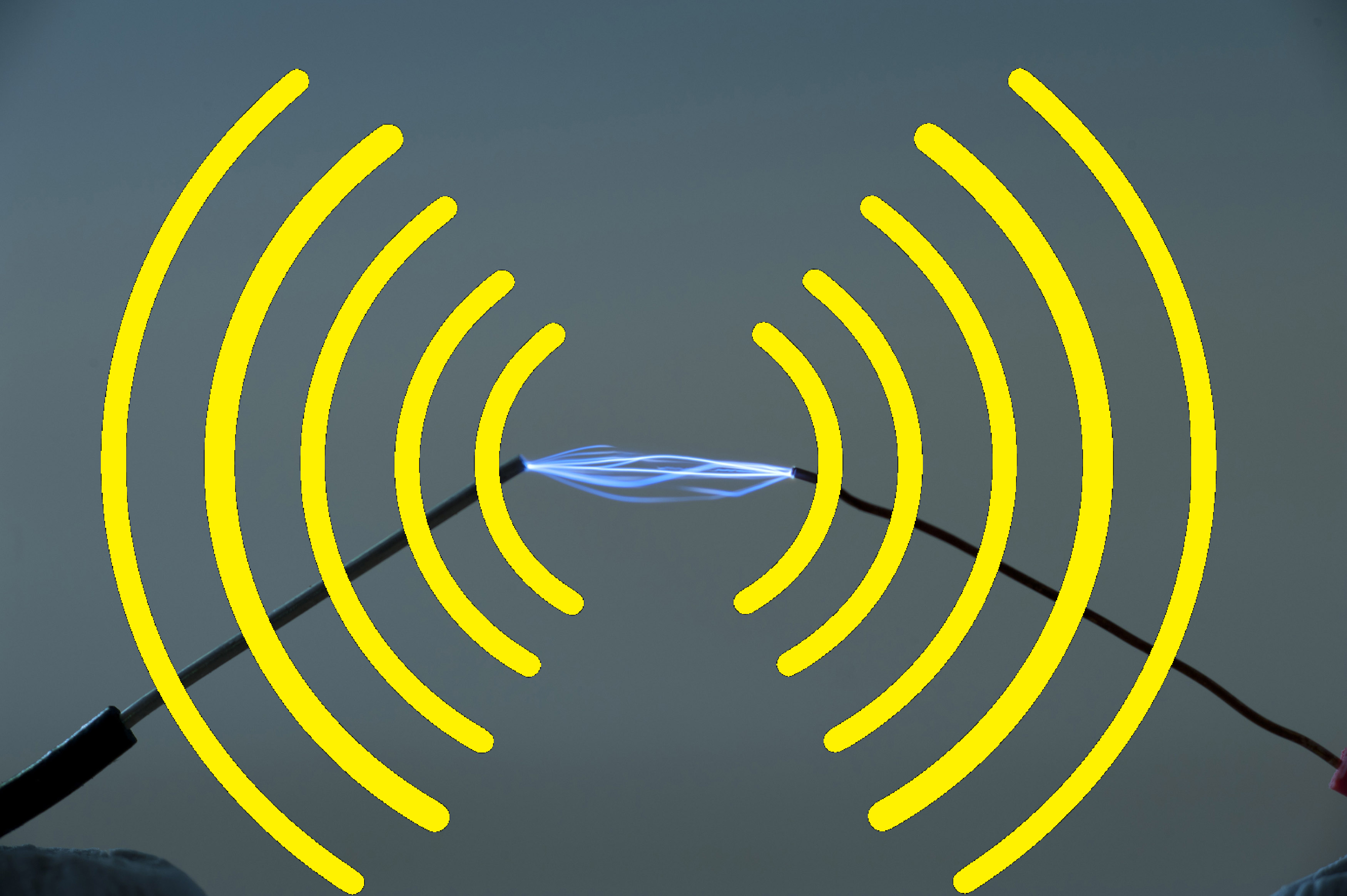
When current arcs through a dielectric – whether grease in a bearing, or air, or any other insulator – it produces a pulse of radio waves. This is how the first radio transmitters, spark gap transmitters, worked. So in theory, you should be able to detect arcing through bearings by detecting RF pulses.
And indeed you can. There is at least one electrical discharge detector on the market that uses this method. Testing is easy and nonintrusive. The device counts and reports the number of pulses detected, with the assumption that the more frequently discharge occurs, the sooner the bearing may fail. This assumption is not wrong, but it is limited – it ignores the fact that not all discharges are equally destructive. Counting pulses doesn’t tell you anything about the amount of energy each discharge releases in the bearing (which shaft voltage testing does).
But there is a bigger problem with these discharge detector pens: They assume that every detected burst came from a bearing discharge in the equipment being tested. In 2014, a large motor manufacturer did a field study that, among other things, compared discharge detector readings with shaft voltage measurements, which are known to be accurate. They found that the detector agreed with shaft voltage 63% of the time: In 22% of the comparisons, the detector correctly predicted discharge, and in 41%, it agreed that no discharge occurred. But 30% of the time, it predicted discharge when the scope showed none. So these detectors evidently have a problem with false positive results – so much so that a positive reading is more likely to be wrong than right!
Common Mode Current Measurement
As we mentioned in our last post, it is impractical to directly measure bearing current in the field. So we recommend measuring shaft voltage, because it can unambiguously capture bearing discharge. Some consultants and manufacturers of VFDs and output filters recommend instead measuring common mode current (CMC) as an alternative. Like common mode voltage, CMC changes too quickly to be measured with a multimeter. It can only be measured with an oscilloscope and a current sensor called a Rogowski coil.
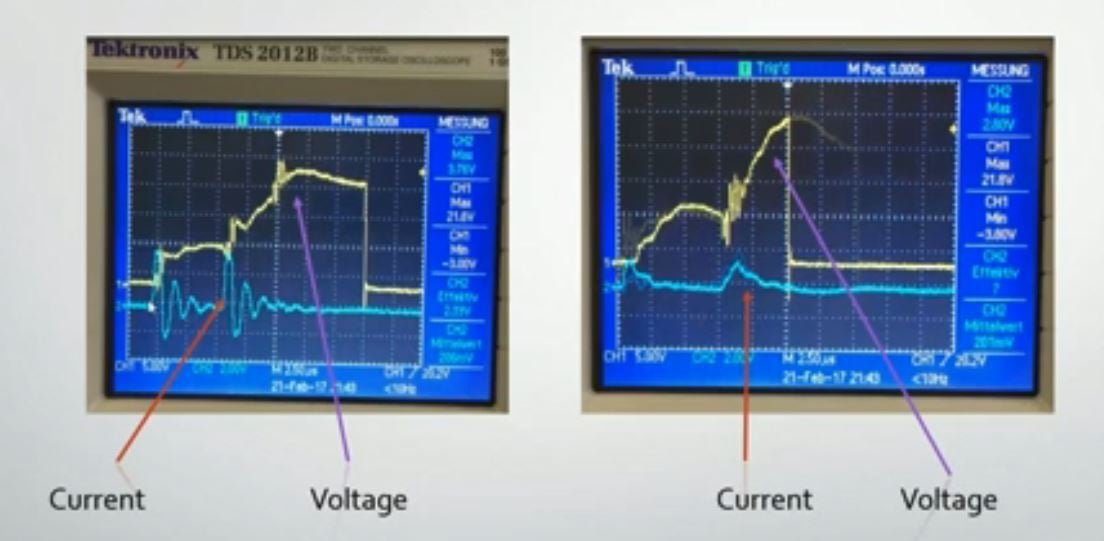
When you measure shaft voltage, it’s easy to identify a discharge. But CMC includes all stray high frequency current through the motor. In small, properly grounded/bonded motors, only a small fraction of this current goes through the bearings – Most passes into the stator frame and then to ground or back to the drive. Measuring CMC may be useful in assessing the potential for bearing currents, but it cannot detect whether they are occurring.
This is shown the figure below, showing real data on CMC and shaft voltage levels. Notice the discharges shown in the shaft voltage – There is no hint in the CMC waveform that anything has happened. Simply put: Measuring common mode current cannot tell you whether a motor has bearing currents. Measuring CMC does have its uses, but detecting bearing current is not one of them, and as illustrated in the figure, low CMC does not mean low risk of shaft voltage discharge.
Conclusion
Shaft voltage testing is the gold standard of testing for bearing current. Discharge detection and common mode current measurements have their uses – both can be very helpful in measuring electrical noise (EMI/RFI). But neither of them can show what shaft voltage measurement can: the unambiguous presence of electrical discharge in bearings, and a measure of how much damage those discharges can do.
AEGIS Rings also come with a 2-year extended warranty against bearing fluting damage. No other form of protection against VFD-caused bearing damage offers a warranty like this.
To learn more about AEGIS shaft grounding and best practices for electrical bearing protection, sign up for a training. We offer monthly live training webinars, and we can also visit your facility to review your exact application.
Detecting Bearing Current with Shaft Voltage Testing
Electric motors controlled by drives are at risk of destructive bearing currents causing premature bearing failure. No one argues this, but opinions vary on how to assess that risk – What can you do, what can you measure, to find out whether a motor is at risk of premature failure? In this two part series, we’ll look at the options.
Bearing Current and Bearing Voltage
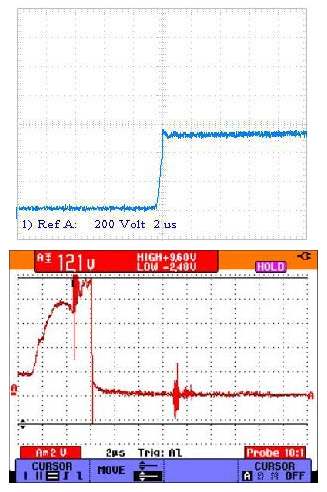
Unfortunately, you can’t directly measure bearing current in the field. Measuring it requires special equipment and serious alterations to the motor, and is unfeasible outside a research lab. You could measure bearing voltage instead: Whenever current arcs through a bearing, the voltage (electric potential difference) across the bearing suddenly drops. By “suddenly,” we mean over the course of under 20 nanoseconds. For comparison, modern drives have switching speeds between tens and hundreds of nanoseconds (see figure).
 Unfortunately, it’s also impractical to directly measure bearing voltage. So what can you measure?
Measuring Shaft Voltage
The shaft voltage – between the motor shaft and frame – is an excellent measure of the bearing voltage, because the shaft is in metal-metal contact with the inner bearing race, and the frame contacts the outer race. And luckily, it can be easily measured with an oscilloscope. The shaft voltage changes too rapidly to be accurately measured by a multimeter – we recommend a scope with at least 100 MHz bandwidth.
When a shaft voltage reading shows a relatively slow buildup and then a sudden collapse, that is the smoking gun for capacitive discharge bearing current, or EDM current, which occurs when the rotor first gets capacitively charged by the common mode voltage in the motor windings, and then discharges through a bearing.
The Damage Done
You can even compare the damage done by discharges with shaft voltage readings. The energy stored in a capacitor is
E = ½ CV2,
where C is the bearing’s capacitance and V is the shaft voltage when the discharge occurs. This equation says that a discharge at 20V releases four times as much energy as a discharge at 10V.
Most of this energy is released into the bearing as heat, and although the amount of energy in one discharge is small, it is released across a tiny area. That small area heats up to thousands of degrees – hot enough to melt steel and create the microscopic pits that are the hallmark of bearing current damage.

Detecting Other Bearing Currents
EDM current is a risk for all unprotected motors on VFDs. There are two other drive-induced bearing currents, with different mechanisms, but they can also be detected by shaft voltage measurements. These other bearing currents are more destructive, because they can flow continuously after the first arc, whereas shaft voltage discharge current only arcs once and then stops until the rotor gets capacitively recharged.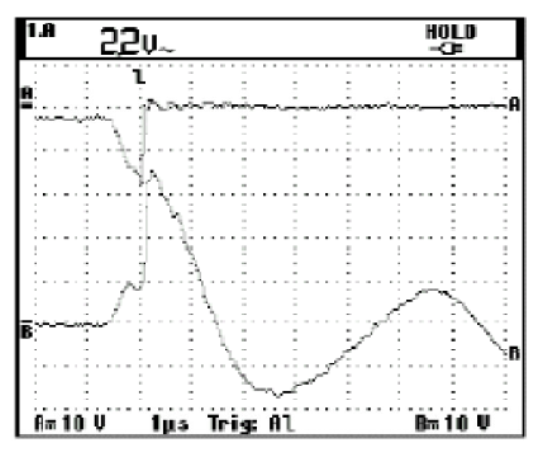
Rotor ground current, in motors without good high frequency bonding to the drive, can be detected by measuring the shaft voltage at one end. And high frequency circulating current, in larger motors (over 100 hp/75 kW), can be detected by simultaneously measuring shaft voltage at both ends of the motor, as shown in the figure at the right. The shaft voltage goes negative at one end (top), and positive at the other. At 2 divisions from the left, the voltage at the negative end arcs through the bearing and returns to zero, but the voltage at the opposite end remains positive.
The Bottom Line
Measuring shaft voltage and examining the waveform will tell you whether current is arcing through the bearings. In Part Two, we will look at two other methods of assessing bearing current in motors on drives, and see how they compare to shaft voltage testing.
AEGIS Rings also come with a 2-year extended warranty against bearing fluting damage. No other form of protection against VFD-caused bearing damage offers a warranty like this.
To learn more about AEGIS shaft grounding and best practices for electrical bearing protection, sign up for a training. We offer monthly live training webinars, and we can also visit your facility to review your exact application.
Shaft Grounding for Overhead Cranes
Overhead cranes play a significant role in shipping and manufacturing, handling massive loads with precision. However, their motors face a persistent challenge. Stray shaft current can lead to electrical bearing damage. Without proper protection, crane motor bearings fail, requiring repair or replacement, and costly unplanned downtime, especially for large motors.
Why Shaft Grounding is Necessary for Crane Motors
Variable frequency drives (VFDs) have become standard for motors in many industries. They enable precise control of speed and torque, essential in crane applications. However, they also create shaft voltage that discharges through motor bearings. Over time, this electrical discharge causes pitting and fluting damage to bearing surfaces. Eventually, this results in bearing failure.
For container port cranes or other overhead crane systems, motor failure creates massive downtime and productivity losses. Repairing or replacing a large damaged motor often takes 16 hours or more. The operational ripple effects can disrupt entire facilities.
Some attempts to address this issue use insulated bearings or grounding brushes. Insulated bearings usually work well, but are quite expensive. Grounding brushes require regular maintenance and may fail in dirty environments where grease and debris are common. These solutions often fall short of solving the problem entirely.
AEGIS® Shaft Grounding Rings: A Reliable Solution
 The AEGIS Shaft Grounding Ring was developed to get around shaft grounding brushes’ shortcomings. For large and medium voltage motors, AEGIS® PRO Rings solve these challenges for motors in demanding applications like overhead cranes. These rings safely channel harmful stray current away from motor bearings. Their six circumferential rows of conductive microfibers provide millions of discharge points to eliminate stray voltages effectively.
AEGIS rings are available both as solid rings and in a split-ring design that makes installation straightforward for in-service motors. The mating halves of the ring can be opened and then closed around the shaft without decoupling the motor from its driven equipment.
AEGIS Shaft Grounding Rings have been proven effective in the real world, in millions of installations. A detailed case study shows how AEGIS® rings resolved chronic motor failures at Pacific Container Terminal.
Case Study: Stopping Chronic Crane Motor Failures
At Pacific Container Terminal, port cranes were experiencing constant bearing damage in their 650-horsepower DC motors. Bearings would fail within one to two months due to shaft voltage arcing through them. Each repair required up to 18 hours of downtime per motor, which resulted in substantial costs.
Initial solutions included insulated bearings and carbon grounding brushes. Neither option fully resolved the problem. Reed Electric eventually installed AEGIS® PRO Rings on the inboard ends of the motors while using insulated bearings on the non-drive ends to block circulating currents.
The results were immediate and impressive. After the installation of AEGIS® rings, the first motor ran without issues for over three months, which was far better than before. Reed Electric overhauled five more motors with the same setup. None showed further damage to their bearings. Encouraged by this success, plans were made to retrofit all remaining crane motors at the terminal with AEGIS® rings.
Long-Term Benefits for Overhead Cranes
Overhead cranes must perform reliably in demanding conditions, in ports and elsewhere, where even brief downtime can disrupt operations. AEGIS® PRO Shaft Grounding Rings offer a proven solution to reduce risk of motor failure and help keep maintenance costs in check.
These rings are trusted worldwide to handle the challenges of crane shaft grounding. To explore how AEGIS® solutions can benefit your equipment, contact us for more information.
AEGIS Rings also come with a 2-year extended warranty against bearing fluting damage. No other form of protection against VFD-caused bearing damage offers a warranty like this.
Why Use Shaft Grounding Rings on Electric Motors?
Electric motors are the heartbeat of many industries. From manufacturing plants to office buildings, these machines keep operations running smoothly. But motors face a hidden enemy: shaft voltage when powered by variable frequency drives (VFDs). This voltage damages motor bearings and can lead to premature failure, causing costly unplanned downtime.
Understanding Shaft Voltage in Electric Motors
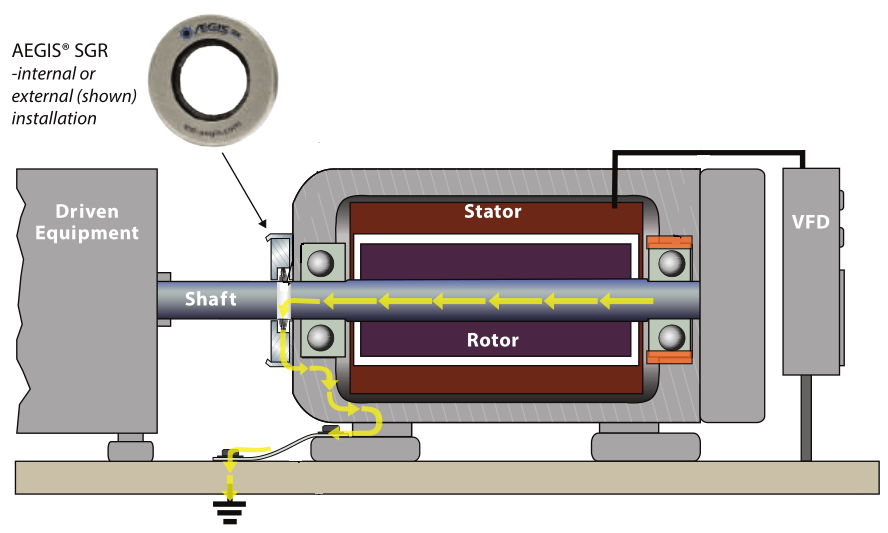
When you run motors directly online, the input voltage is balanced – the voltage in each of the three phases cancels, so the net voltage is zero. But when you use a VFD to control a motor, the three phases do not cancel, so there is a net voltage. This voltage imbalance produces a voltage on the rotor, called shaft voltage. Shaft voltage seeks to discharge to ground. Without a proper path to ground, its voltage takes the path of least resistance — usually by arcing through the motor bearings.
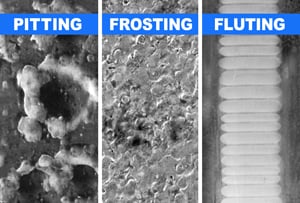
Although each discharge arc is tiny, there can be tens of thousands of them per second, and each one creates a tiny pit in the smooth bearing surface. Over time, these microscopic pits can lead to more severe damage. You’ll notice increased vibration, noise, and, eventually, bearing failure. In critical systems, this failure can halt entire production lines, leading to enormous losses.
The Purpose of Shaft Grounding Rings
The purpose of a shaft grounding ring is to provide a safe path to ground for shaft voltage, bypassing the bearings. Installing a shaft grounding ring protects the bearings from electrical damage. The ring encircles the motor shaft with conductive microfibers, offering 360-degree coverage. This design diverts the voltage directly to ground, preventing it from passing through the bearings.
Shaft grounding rings are virtually maintenance-free and designed to last for at least the L10 life of the bearings. Temperature, humidity, or other environmental factors do not significantly affect them. This makes them suitable for a wide range of industrial settings.
Preventing Bearing Failure
Bearing failure isn’t just a mechanical issue; it’s a financial one. Damaged bearings can halt production lines and disrupt services. By using shaft grounding rings, you reduce the risk of bearing failure.
Regular maintenance and monitoring can only go so far. Without addressing the root cause of shaft voltage, electrical bearing damage will continue to be a problem. Shaft grounding rings offer a proactive solution.
Applications That Benefit
Many applications, in many industries, can improve reliability by installing shaft grounding rings:
- HVAC Systems: Heating and cooling units in commercial buildings, hospitals, and universities rely on motors that need protection.
- Manufacturing Plants: Fans, pumps, grinders, mixers, and everything else electric motors drive can cause unplanned downtime if their motor bearings fail.
- Water Treatment Facilities: Continuous operation is critical, and motor failure can have serious consequences.
- Electric Vehicles: Motors in EVs also suffer from shaft voltage, which causes electromagnetic interference and bearing damage.
- Energy Sector: Both wind turbines and traditional generators are subject to electrical damage to bearings and gearboxes.
Shooting grounding rings contributes to more efficient and reliable operations by safeguarding motors across these industries.
Protect Your Motors with Shaft Grounding Rings
Shaft grounding rings play a crucial role in maintaining electric motor health. They offer a simple solution to a complex problem, protecting bearings from harmful shaft voltage. By understanding the shaft grounding ring’s purpose and implementing best practices, you can protect motors from premature failure and keep your operations running smoothly. For a deeper dive into bearing protection, explore the AEGIS Bearing Protection Handbook, which provides comprehensive explanations and best practices.
AEGIS Rings also come with a 2-year extended warranty against bearing fluting damage. No other form of protection against VFD-caused bearing damage offers a warranty like this.
To learn more about AEGIS shaft grounding and best practices for electrical bearing protection, sign up for a training. We offer monthly live training webinars, and – pandemic restrictions permitting – we can also visit your facility to review your exact application.
Maximizing Bearing Protection with AEGIS PRO Rings
Electric motors are the backbone of many industrial operations. When they fail, the repercussions could be costly and disruptive. One common culprit behind motor failure is bearing damage caused by stray electric current. Understanding how to protect bearings helps maintain the reliability of your machinery.
Why Bearing Protection Is Essential
Variable Frequency Drives (VFDs) are widely used to control motor speed and reduce energy use. However, they produce a common-mode voltage, which induces a voltage across the motor bearings. This voltage tends to discharge by arcing through the bearings. This leads to electrical pitting, and over time the pits can cause frosting fluting, and eventual bearing failure.
Bearing failure doesn’t just mean replacing a component—it can halt entire systems. Unplanned downtime leads to expensive repairs and even more expensive lost productivity. This is unacceptable for industries relying on continuous operation. As a rule, the larger a motor, the larger the consequences of its failure. This has serious ramifications in heavy industrial applications like pulp/paper processing, steel mills, and cement plants.
How AEGIS Rings Address Bearing Damage
AEGIS® Shaft Grounding Rings offer a practical solution to this problem in motors. These grounding rings provide a low-resistance path from the shaft to the motor frame, and bleed voltage off the shaft before it can build up enough to discharge through the bearings.
The AEGIS SGR is a good choice for smaller motors for grounding rings. We recommend the larger AEGIS PRO Series for larger and medium voltage motors.
AEGIS PRO Rings differ in a few ways from the smaller AEGIS SGR. For one, PRO rings have six circumferential rows of conductive microfibers, as compared to SGRs’ two. These fibers create a 360-degree conductive path around the motor shaft. Unlike other products that use brushes or partial coverage, the AEGIS full-circle design ensures consistent protection. The PRO ring’s extra fiber allows it to carry more current than the two-rowed SGR, to protect higher-power and medium voltage motor bearings.
Manufactured in Mechanic Falls, Maine, AEGIS PRO rings adhere to strict quality standards, including ISO 9001 certification. Their robust construction makes them suitable for a variety of applications, especially in environments where reliability is paramount.
Applications of AEGIS PRO Rings
PRO rings are recommended for:
- Large Frame Low Voltage Motors: 500 HP (375 kW) or greater for intermittent duty, or 300 HP (225 kW) for continuous duty
- Medium Voltage Motors
- DC Motors: 300 HP (225 kW) and higher
- Generators
AEGIS PRO Ring Variants: Finding the Right Fit
Choosing the appropriate AEGIS PRO ring depends on your specific application. The series includes several variants designed to meet different needs. All PRO rings are custom-engineered to fit the destination machine.
AEGIS PROSL
The PROSL is ideal for most large motors operated by, and generators excited by, VFDs. It suits shaft diameters from 2.5 inches to 15.75 inches. Its slim design and flexible installation options make it adaptable to most large motors. The PROSL provides high current capacity, making it effective for heavy-duty applications.
AEGIS PROSLR
For motors operating in harsh environments, the PROSLR offers additional protection. It incorporates an O-ring dust and debris barrier, preventing contaminants from interfering with the microfibers. This is crucial in industries where motors are exposed to dirt, dust, or lubricants. The PROSLR offers consistent performance under severe conditions.
AEGIS PROMAX
The PROMAX is the go-to choice when dealing with the most critical and largest motors. The PROMAX has an even more robust design than the other PRO rings, and is designed for shaft diameters from 15.75 inches to 30 inches. Its robust design makes it suitable for the most demanding situations.
AEGIS PROMR
The PROMR combines the PROSL with a second grounding ring for voltage monitoring. This allows for convenient real-time measurement of shaft voltage. It’s a valuable predictive maintenance tool, helping identify potential issues before they lead to failure.
Preserving Your Equipment’s Lifespan
Protecting motor bearings from electrical damage is not just about preventing a specific type of wear. It’s about ensuring the continuous operation of your systems and avoiding unnecessary costs.
For smaller motors, AEGIS SGRs are a reliable and effective solution. For larger motors, the AEGIS PRO rings will do the job. For more information on selecting the appropriate AEGIS ring for your motor, contact us today.
AEGIS rings also come with a 2-year extended warranty against bearing fluting damage. No other form of shaft grounding comes with a warranty like this.
To learn more about AEGIS shaft grounding and best practices for electrical bearing protection, sign up for a training. We offer monthly live training webinars, and we can also visit your facility to review your exact application.
5 Common Missteps When Installing AEGIS Rings — and How to Avoid Them
This article is guest written by eMotors Direct, your trusted AEGIS Shaft Grounding Ring installer in Canada.
AEGIS® Shaft Grounding Rings are essential for protecting motor bearings from electrical damage caused by variable frequency drives (VFDs). However, improper installation can undermine their effectiveness, leaving motors vulnerable to costly damage. In this article, we’ll explore five common mistakes when installing AEGIS Shaft Grounding Rings and provide solutions to ensure a smooth and effective installation.
1. Not Ensuring the Fibers Are in Contact with the Shaft
Why This Is a Problem:
The microfibers inside the AEGIS ring must be in constant contact with the motor shaft to create an effective electrical pathway. If the fibers fail to make full contact, the grounding ring cannot adequately divert electrical currents, putting the motor bearings at risk.

How to Avoid It:
When removing the AEGIS ring from the box, ensure you do not crush the fibers. Inspect the fibers during installation to ensure they are aligned correctly and fully in contact with the shaft. Manually rotate the shaft after installation to check for any inconsistencies in contact.
2. Not Cleaning the Shaft
Why This Is a Problem:
A dirty shaft can impede the grounding ring’s ability to function. Contaminants like dust, paint, grease, or rust increase resistance, preventing the ring from effectively diverting electrical currents, which can lead to bearing damage.
How to Avoid It:
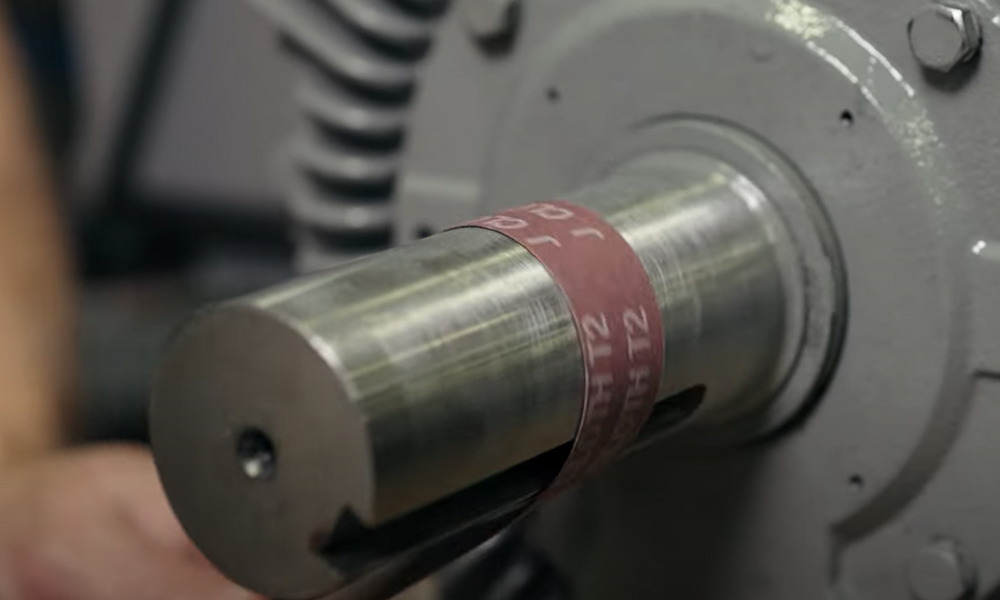
Clean the shaft thoroughly with an industrial-grade solvent or degreaser to remove any dirt, grease, or rust. If there is paint on the shaft, use soft sandpaper to remove the paint from the shaft. Ensure the shaft is dry and free of residue and debris before installing the grounding ring.
3. Reusing Worn-Out Grounding Rings
Why This Is a Problem:
While AEGIS Rings are designed to last up to 200,000 hours (over 20 years) in ideal lab conditions, real-world factors can shorten their lifespan. The conductive microfibers can wear down over time or become damaged during installation, removal, or motor repairs. Reusing a worn or damaged ring reduces its effectiveness, leaving motor bearings unprotected from harmful electrical currents.
How to Avoid It:
Do not reuse previously installed AEGIS Grounding Rings. Replace the ring when the fibers appear damaged or the ring shows signs of degradation, ensuring ongoing protection for the motor bearings.
4. Not Testing the Installation
Why This Is a Problem:
Skipping post-installation testing can lead to undetected issues, such as poor contact or ineffective grounding. Without testing, you may not know if the ring is working correctly, and the motor may be at risk of electrical damage.
How to Avoid It:
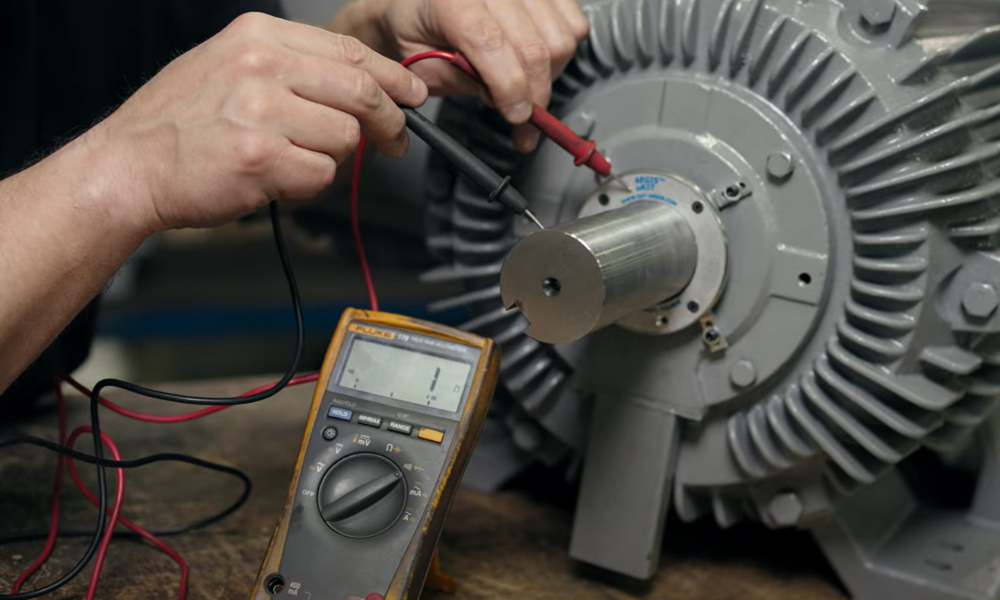
After installation, use a continuity tester or multimeter to verify that the grounding ring is working as expected. Regular testing helps ensure that the ring is properly diverting electrical currents and providing effective protection for the motor.
5. Using Non-Conductive Materials
Why This Is a Problem:
When installing AEGIS Shaft Grounding Rings, using non-conductive thread-lock or adhesives can disrupt the electrical pathway between the grounding ring and the motor frame. Non-conductive compounds act as insulators, reducing the effectiveness of the grounding system and leaving motor bearings vulnerable to electrical damage.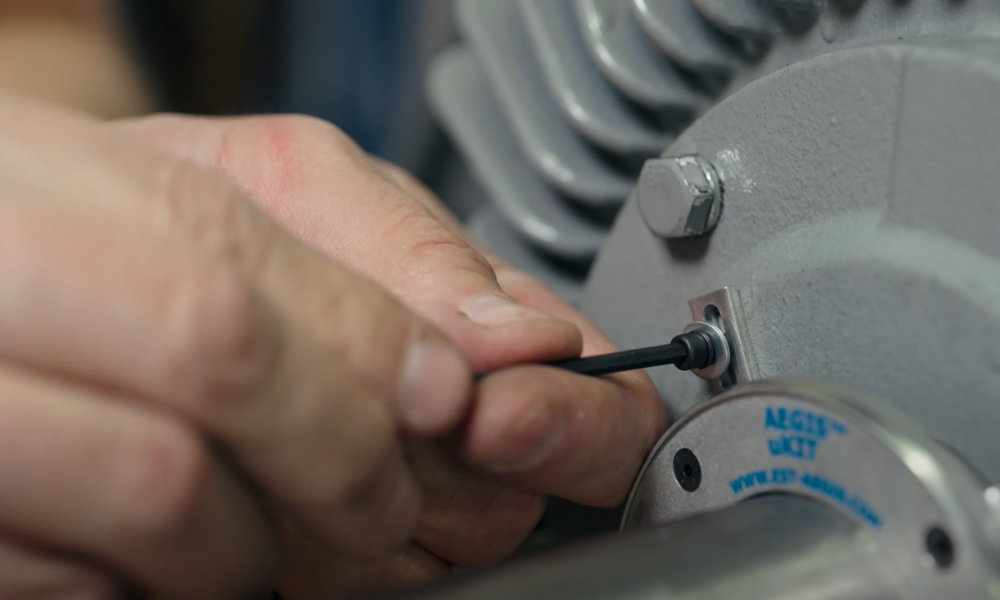
How to Avoid It:
It’s recommended not to use thread-lock when installing AEGIS Rings. Similarly, avoid standard adhesives that act as insulating barriers. Instead, use conductive adhesives or mounting brackets recommended by AEGIS to ensure both secure installation and proper electrical grounding. Always follow the installation guidelines provided in the AEGIS manual to guarantee optimal performance.
Conclusion
Proper installation of AEGIS Shaft Grounding Rings is essential for safeguarding motor bearings from electrical damage. By avoiding common installation mistakes, such as failing to use colloidal silver, not ensuring fiber contact, or not cleaning the motor shaft, you can ensure your grounding system performs optimally.
LEESON SyMAX Motors with AEGIS Inside
Permanent magnet AC (PMAC) motors have many advantages over AC induction motors, including higher efficiency and power density. LEESON® SyMAX PMAC motors have an added benefit: All stock SyMAX motors come with an AEGIS® Shaft Grounding Ring factory-installed.
LEESON SyMAX’s benefits include:

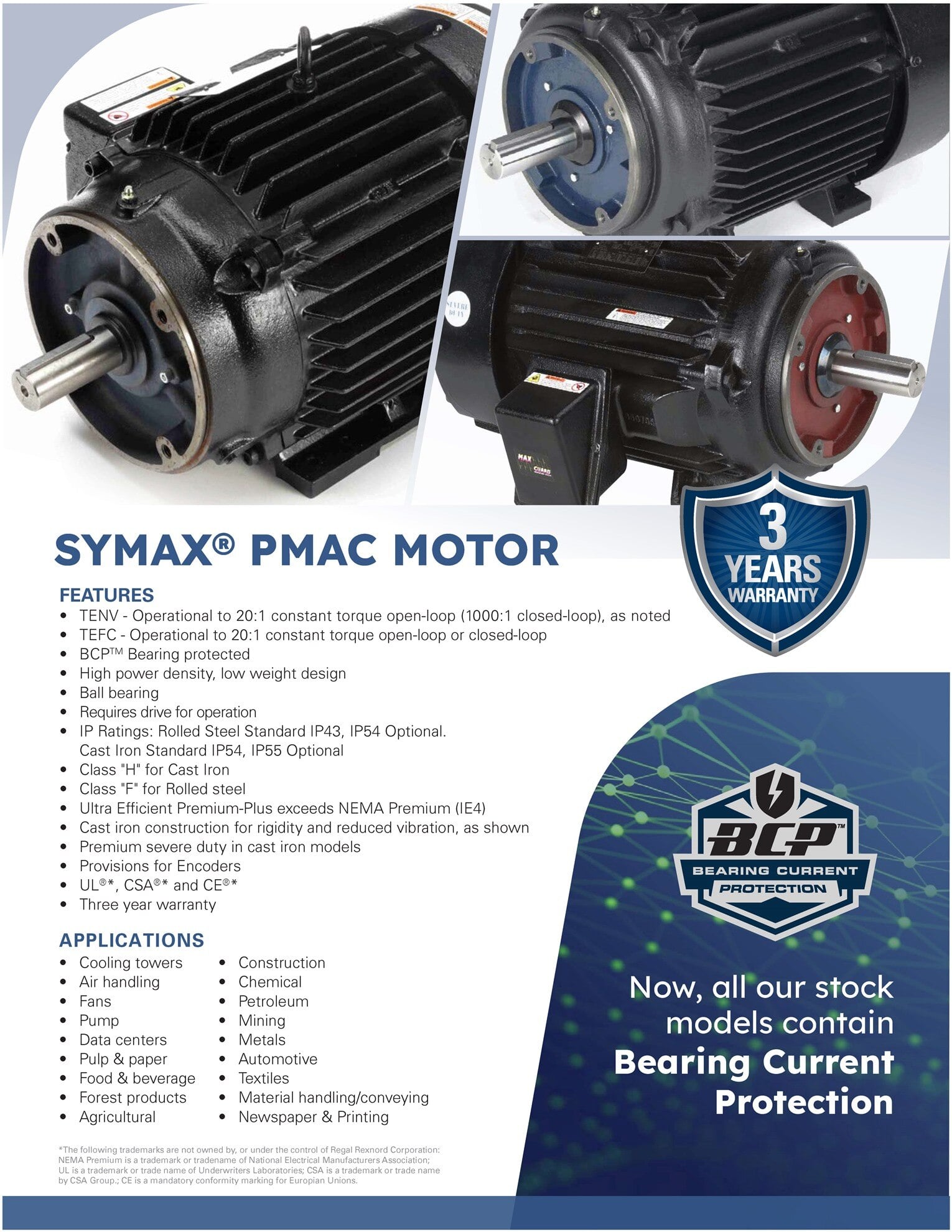
High efficiency, up to IE4: Energy costs are 95% or more of electric motors’ total cost of ownership. SyMAX motors have efficiency 1-3 points above IE3. Higher efficiency means lower electric bills.
Higher reliability, less maintenance: PM motors run at lower temperatures than AC induction motors, so they have longer bearing and insulation lives and require less maintenance.
Drop-in replacement: In most installations, SyMAX motors can be swapped in for existing NEMA and IEC frame motors without further system modifications.
Higher power density: Higher power density than AC induction motors means that you can get more power out of the same frame size, or the same power out of a smaller frame size.
Protection from voltage stress: SyMAX motors have the patented MaxGuard insulation system and an AEGIS ring mounted inside, to protect the motor from damage caused by the drive’s output.
Long Warranty: SyMAX motors come with a three year warranty from LEESON. On top of that, the AEGIS ring inside comes with a 2-year extended warranty against bearing fluting damage.
To learn more about AEGIS shaft grounding and best practices for electrical bearing protection, sign up for a training. We offer monthly live training webinars, and – pandemic restrictions permitting – we can also visit your facility to review your exact application.
Accessories to Improve Motor Reliability
Electric motors are the backbone of practically every industry. From HVAC systems in commercial buildings to manufacturing equipment, they keep operations running smoothly. But what happens when these motors fail? They must be repaired or replaced, while accruing the enormous costs of unplanned downtime. To keep your motors running reliably, protecting them against problems caused by variable frequency drives (VFDs) is crucial.
Understanding the Downsides of VFDs
Variable frequency drives control motor speed, saving energy in applications where motors can be run slower. However, they produce high-frequency electricity that can damage motor components. In particular, they produce a shaft voltage that can discharge through the bearings. This discharge can cause premature motor bearing failure, potentially bringing production to a halt. For facility managers and maintenance professionals, preventing these avoidable problems is a top priority.
The Role of Shaft Grounding Rings
One effective solution to mitigate damage done by VFD-induced stray voltage is the shaft grounding ring. The AEGIS® Shaft Grounding Ring provides a reliable path for stray current, channeling it safely around sensitive motor bearings. By installing these rings, you help your motors reach their natural lifespan without unexpected failures.
Enhancing Protection with Essential Accessories
To enhance motor bearing protection further, consider incorporating supplementary accessories that work in tandem with shaft grounding rings.
Colloidal Silver Shaft Coating CS015
Electrical contact between the shaft and the grounding ring is vital to the ring’s functioning properly. AEGIS® Colloidal Silver Shaft Coating effectively ensures a low-resistance contact. CS015 increases shaft surface conductivity and guards against corrosion that can disrupt the grounding path.
Key Specifications:
- Weight: 15 grams.
- Coverage: Suitable for 20-25 applications on a 3-inch (76mm) shaft diameter.
- Shelf Life: 6 months (contents may separate; stir thoroughly before use).
Before applying, ensure the coating has reached room temperature, and always use personal protective equipment.
AEGIS® High-Frequency Grounding Straps
While shaft grounding rings address voltage on the motor shaft, it’s equally important to manage high-frequency current’s flow to ground. AEGIS® High-Frequency Grounding Straps offer an efficient solution. These straps are made of flat-braided, tinned copper and provide a low-impedance path for stray current, to help get it to ground without causing other damage.
Benefits of Using Grounding Straps:
- Effective Bonding: Electrically bonds equipment to prevent stray currents from damaging sensitive components.
- Versatile Installation: Features a circular hole on one end for easy mounting and a ring terminal on the opposite end.
- Compatibility: Available in various sizes to fit different NEMA and IEC frame sizes.
Installing grounding straps creates a continuous path for high-frequency currents to safely reach ground. This additional layer of protection complements the shaft grounding ring and helps prevent rotor ground current between a motor and its coupled equipment.
An Integrated Approach to Motor Protection
Protecting your electric motors from the challenges posed by VFDs doesn’t have to be complicated. By using shaft grounding rings in conjunction with accessories like colloidal silver shaft coatings and high-frequency grounding straps, you enhance your motor protection strategy. This comprehensive approach prevents avoidable problems and keeps your operations running efficiently.
To learn more about AEGIS shaft grounding and best practices for electrical bearing protection, sign up for a training. We offer monthly live training webinars, and we can also visit your facility to review your exact application.