

Auteur/autrice : AEGIS
Electrical Bearing Protection Q&A Part 13
Part 13 in a series of qustions and answers from our Q&A webinars.
Q1: Can we avoid electrical bearing damage by using conductive grease?
A1: We don’t recommend it, for a couple of reasons. For one, this grease is made conductive by adding conductive particles to it. You don’t want any particulate matter in the bearing: Even very small particles can scratch the races and rollers. For another, these greases have lower electrical resistance than ordinary grease, it’s true. But you still get arcing when shaft voltage discharge occurs. So electrical damage will still be done. Between these two sources of damage, conductive grease is not a viable solution. What we’ve seen is that failure still occurs, whether from abrasion or electrical damage.
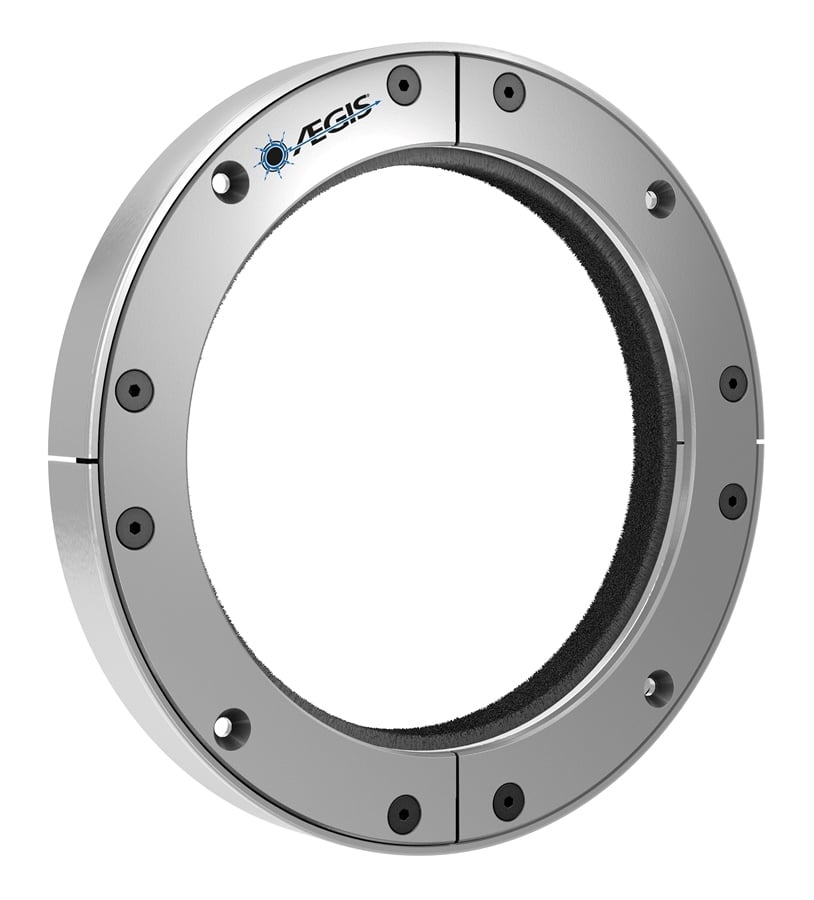 The AEGIS PRO Shaft Grounding Ring
Q2: We had a customer with an SGR on a motor, & he reported that the conductive fibers curled back and no longer maintained contact with the shaft. This motor had an insulated bearing that still ended up with fluting. We’re thinking there was too much current for the SGR to handle. Is there a heavier-duty grounding ring available?
A2: Yes, we do have heavy duty AEGIS® rings, the PRO Series. If your motor is over 600 volts ac, or over 500 hp ac and low voltage, or you have a dc motor over 300 hp, you want a PRO ring. Our standard SGR has two rows of conductive microfiber. The PRO ring has six rows. If you have an SGR on your motor and you see fibers missing or melting or burnt – we don’t see it often, but it can happen – then you should consider a PRO ring. Nuclear & other power generation, larger motors in processing industries, have all had good success record over 10 years.
Those numbers aren’t hard, fast rules. We recommend PRO rings for ac motors at 500 hp and above. But some applications need a PRO at 300 or 400 hp.
Q3: Have you developed AEGIS rings for generators?
A3: Yes, we recommend our PRO rings for generators as well as for large motors. Generators often take our extra-robust rings, the PROMAX series. But PRO rings get used in all kinds of generators: Wind turbines, cogeneration, gas…
Q4: Some VFD panels include inductors/chokes to reduce capacitance’s effects in the motor. How much more effective is the AEGIS grounding system than inductors?
A4: Those inductive filters don’t address the same problems as AEGIS rings. AEGIS rings dissipate motors’ shaft voltage, which is produced by the common mode voltage of the drive’s output. This shaft voltage is a problem in all unprotected motors on drives, no matter what size. AEGIS rings pretty much eliminate the risk of that shaft voltage arcing through the bearings.
Now, chokes or « inductive absorbers » add impedance to the power cables, and they actually reduce common mode current, which is a different thing. It causes problems of its own, and these filters reduce those problems. Just for a few examples, common mode current causes high frequency circulating current in large motors, over 100 hp (75 kW). And they reduce rotor ground current in poorly grounded motors. But they don’t do all that much for small, well-grounded motors.
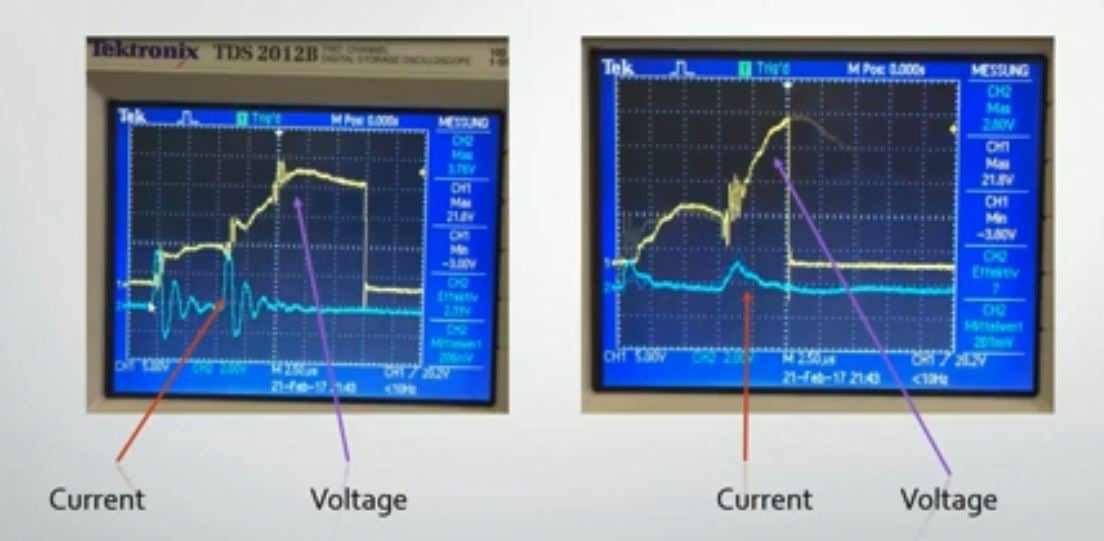 Shaft voltage (yellow) without and with an inductive filter (left and right, respectively). The shaft voltage builds up and arcs through the bearing regardless of the inductor.
Most importantly, these filters don’t reduce common-mode voltage. So they don’t reduce shaft voltage, so they don’t remove the need for an AEGIS ring. Every motor on a drive, whether it’s small or large, whether it has an inductive filter or not, is going to have shaft voltage and need an AEGIS ring.
Q5: Do AEGIS rings eliminate static electricity in textiles & paper on rollers?
A5: Yes. What kind of ring you’d need would depend on just how severe the static is. But our company actually got its start making antistatic brushes. They use the same, or similar, conductive microfibers as our AEGIS rings.
AEGIS Rings also come with a 2-year extended warranty against bearing fluting damage. No other form of protection against VFD-caused bearing damage offers a warranty like this.
To learn more about AEGIS shaft grounding and best practices for electrical bearing protection, sign up for a training. We offer monthly live training webinars, and – pandemic restrictions permitting – we can also visit your facility to review your exact application.
Takeaways from the 2021 DoE Motor System Market Assessment (Part 2)
In our first look at the 2021 MSMA, we saw that there are billions of dollars in potential energy savings that could be realized by use of variable frequency drives. In this installment, we’ll look at how businesses deal with motor system failure.
If there was ever any doubt, the report confirms that unplanned downtime due to system failure is a fact of life. Industrial facilities lost 47 hours per year on average. Commercial facilities lost three hours. Since a factory might value uptime at $10,000 per hour, 47 hours is a significant expense.
Every business needs a plan to deal with this eventuality. But according to the MSMA, surprisingly few do. Or if they do, the survey respondents didn’t know it. 43% of industrial, and 78% of commercial, facilities did not know of a repair/replace policy. (These responses are labeled « UTC » in the pie charts.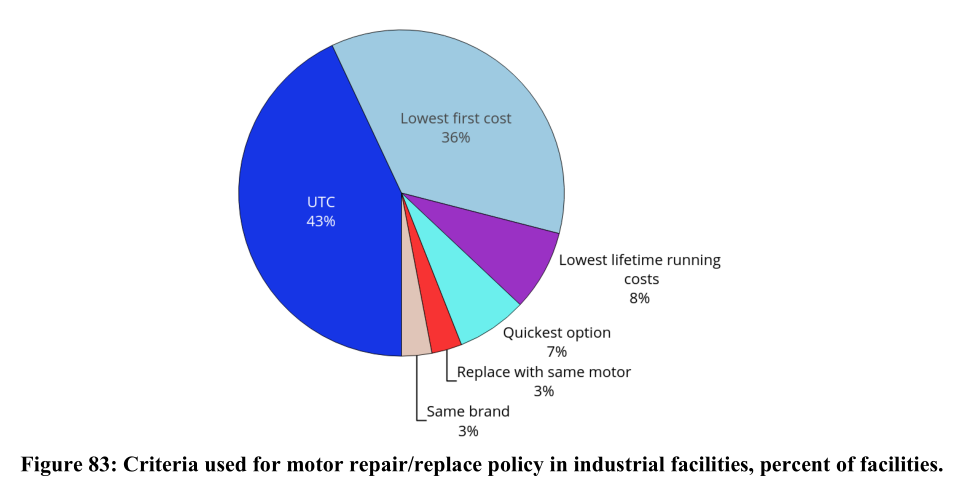
Of those facilities with repair/replace policies, most are short-sighted. The most common policies are to choose the replacements that are least costly or can be gotten the quickest. Only 8% of industrial facilities, and less than 1% of commercial, consider the lifetime cost of the replacement.
The purchase price of a motor is less than 5% of its total lifetime cost. The vast majority of the cost is for electricity. So looking at sticker price instead of lifetime cost for energy is an expensive policy. More-expensive premium efficiency motors often have payback periods ranging from months to a few years… And motors often last for decades!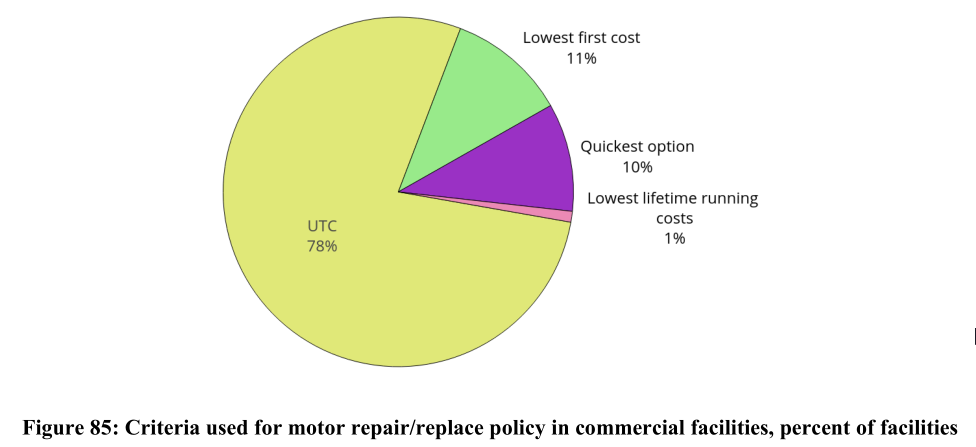
That is not to mention the additional savings enabled by VFD-control, in variable load applications. VFDs often save up to 30% when running fans and pumps. Using a drive increases the purchase price, but the energy savings quickly pay for themselves… Provided, of course, that the motor bearings are protected from the drive by an AEGIS Ring.
In summary, repair/replace plans are critical to help businesses recover quickly in the event of unplanned downtime due to motor system failure. Too many businesses either do not have one, or their staff is unaware of it. Given this, developing a long-sighted repair/replace plan is a great way to save money in the future and get a leg up on the competition, who likely just knee-jerk purchase the cheapest or quickest option. For motors on drives, electrical bearing protection like an AEGIS Shaft Grounding Ring helps protect future savings from the cost of downtime and motor repair/replacement.
AEGIS Rings also come with a 2-year extended warranty against bearing fluting damage. No other form of protection against VFD-caused bearing damage offers a warranty like this.
To learn more about AEGIS shaft grounding and best practices for electrical bearing protection, sign up for a training. We offer monthly live training webinars, and – pandemic restrictions permitting – we can also visit your facility to review your exact application.
Electrical Bearing Protection Q&A Part 12
Part 12 in a series of questions and answers from our Q&A webinars.
Q1: How critical is it to use colloidal silver paint on the motor shaft?
A1: Using colloidal silver is a best practice for shaft grounding. Because silver is so conductive, it helps electrons (charge) move off of the shaft into the grounding ring’s fibers. This improved conductivity lets the shaft voltage come down even lower. With an AEGIS ring and no colloidal silver, the shaft voltage will be between one and five volts. Adding colloidal silver will bring that down to under one volt.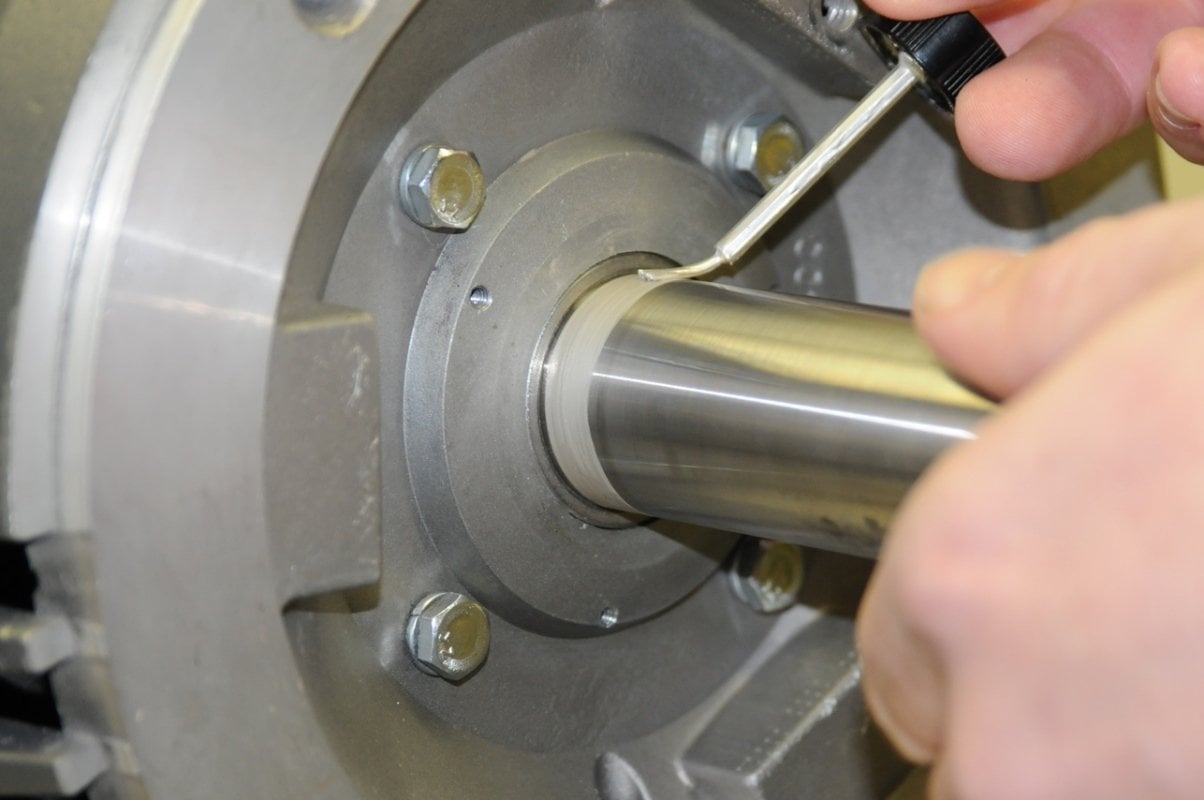
Colloidal silver also helps protect the shaft surface against oxidation and corrosion. It is possible for a nonconductive oxide layer to form on the shaft, which prevents the AEGIS ring from working. Colloidal silver prevents this kind of oxidation.
With that said, an AEGIS ring alone is usually enough to get shaft voltage down to safe levels. With few exceptions, you don’t need colloidal silver. The exceptions are given in the best practices from the AEGIS Handbook. Some vertical motors, some larger motors, and all medium voltage motors really do need colloidal silver, along with an appropriate AEGIS ring.
Q2: How often does colloidal silver need to be applied?
A2: We recommend cleaning the shaft and reapplying colloidal silver every six months. If you can do that: Great. If you can’t do every six months, because of your production schedule or other factors, then you should do it as often as you can.
Q3: How do you know when a shaft grounding ring needs replacement?

A3: Typically, they don’t. Usually if the ring is properly installed, it will be all set. You will get premature wear if the ring is improperly sized or installed such that it loses shaft contact.
Overgreasing can be a big problem. The microfibers can sweep aside small amounts of grease, but they are overwhelmed by large quantities. We have seen too many rings clotted with grease because of some loose cannon with a grease gun and an itchy trigger finger. You definitely want to use a light touch when regreasing motors. Aside from interfering with AEGIS rings, overgreasing causes lots of other problems, too.
But the single best way to tell whether a grounding ring is working is through shaft voltage testing.
Q4: What about monitoring for electrical bearing damage with a discharge pen detector?
A4: We’ve found that discharge pens are not very accurate with small motors. They do give a more accurate count in motors over 100 hp, but it’s not as clear-cut as measuring shaft voltage.
AEGIS Rings also come with a 2-year extended warranty against bearing fluting damage. No other form of protection against VFD-caused bearing damage offers a warranty like this.
 To learn more about AEGIS shaft grounding and best practices for electrical bearing protection, sign up for a training. We offer monthly live training webinars, and – pandemic restrictions permitting – we can also visit your facility to review your exact application.
Takeaways from the 2021 DoE Motor System Market Assessment (Part 1)
In January 2021, Lawrence Berkeley National Laboratory released the first of three volumes of a report commissioned by the Advanced Manufacturing Office in the Office of Energy Efficiency and Renewable Energy at the US Department of Energy. The 250-page Motor Systems Market Assessment, Volume 1 summarizes attributes of the enormous base of installed motor systems in the USA, broken down into Industrial and Commercial applications. Volume 2 will review the supply chains for motors and drives, and Volume 3 will examine energy savings opportunities.
We will be looking at the report’s findings on the use of variable frequency drives (VFDs) and other load control devices, in this and other blog posts. For now, while we wait for Volume 3, we will try to estimate the potential total savings that VFDs might offer.
The first question we ask is, what proportion of motor systems could benefit from variable frequency control? As we’ve discussed previously, VFD control only saves energy when motors don’t need to run full bore. The MSMA reports that 27% of industrial motors run at variable load between 40 and 75% of the maximum. For motors in commercial settings, 35% are run at load factors from 40-75%. (Both of those figures, 27 and 35% are in terms of the total power used, not a number of motor systems.)
The total amount of energy expended on industrial motors is just under 547,000 GWh, and the commercial figure is 532,000 GWh. So the two sectors use about 148,000 and 186,000 GWh, respectively, on motors running at partial load. That’s a lot of energy! The next question is: How many of these motors are already being run on variable frequency drives?
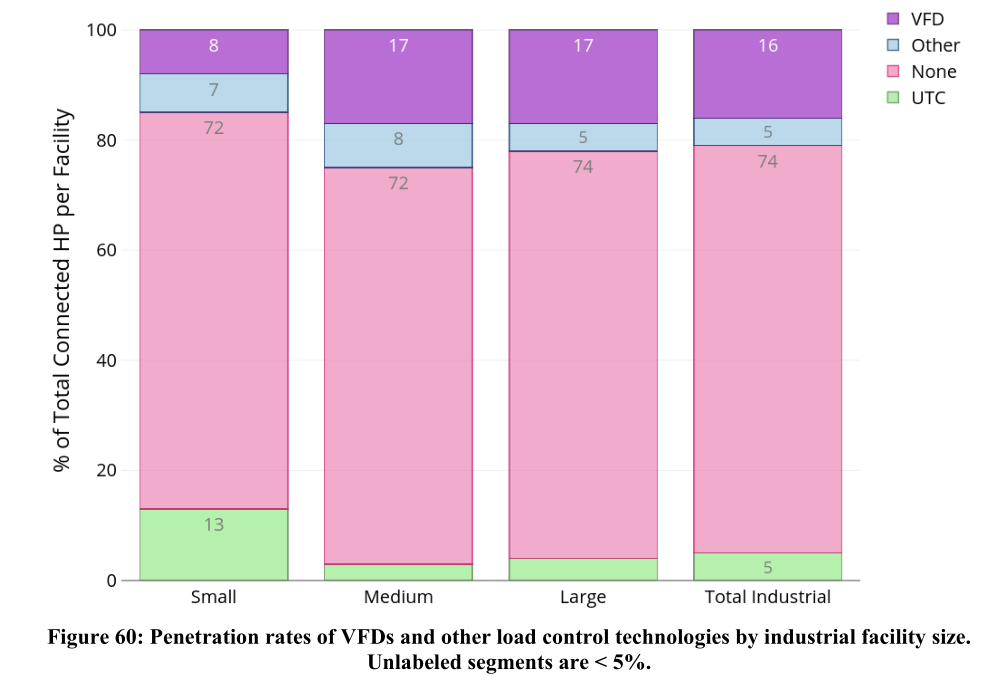 VFD adoption in commercial facilities, by facility size and in total.
The answer – Not enough! For the industrial sector, only 23% of the total motor power is used with any kind of load control. Even if every one of those drives is included in the 27% at medium load factor, that still leaves 4% of 148,000 GWh, about 5900 GWh. Assuming an average electricity rate of 10 cents per kWh, those 5900 GWh have a value of $590 million dollars. When they drive motors at reduced speed, VFDs can save up to 30% on energy, so that is $177 million in potential savings. Spread among all industrial facilities (about 180,000), that is on average about $1,000 each.* That is not a colossal amount of waste per building, but it is significant, and in aggregate it is a very significant amount of energy going to no good use.
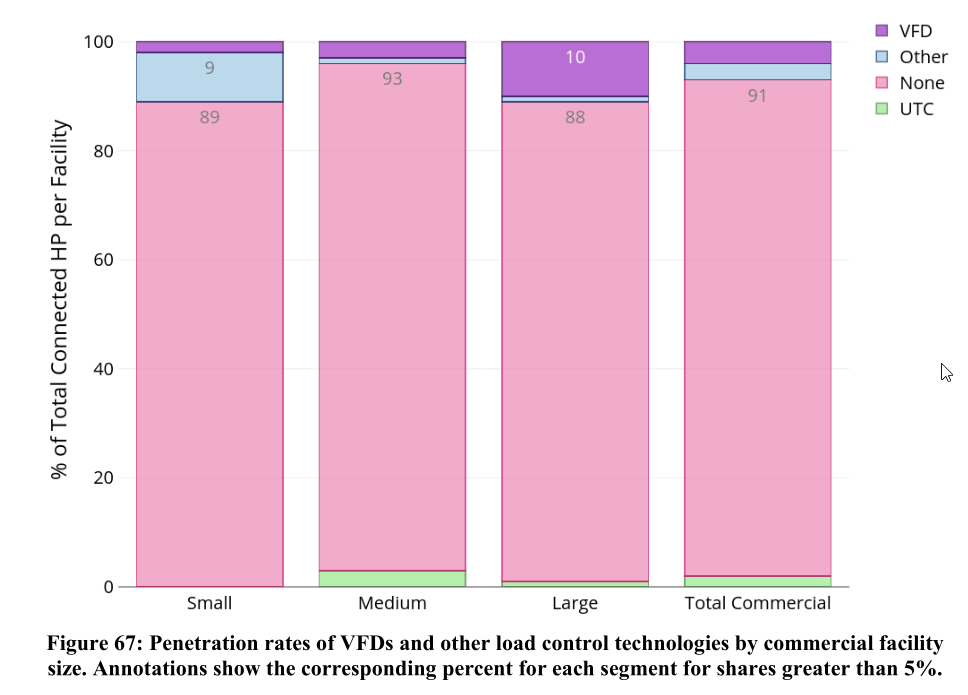 VFD adoption in the commercial sector, segmentation as above.
The situation is more extreme in the commercial sector, where only 4% of motor system capacity uses VFDs, and 91% of it has no load control at all. Assuming that every one of the drives in operation is running a motor at 40-75% and repeating the above analysis, the total waste is $5.1 billion. Even spread out across all of the commercial facilities surveyed – roughly two million – the cost of this waste is $2,500 each. Since, as shown in the figure, more VFDs are used in larger facilities, smaller facilities would pay proportionately more. This would give this waste an even bigger effect on their bottom lines.
The analysis put forward here is admittedly simplified, but it demonstrates the point: Huge amounts of money could be saved by using variable frequency drives to control reduced-load motor systems. As we have discussed, VFDs still save money even after factoring in more-frequent repairs due to electrical bearing damage. Of course, VFDs offer the biggest savings when they operate motors adequately protected with AEGIS® Shaft Grounding Rings.
AEGIS Rings also come with a 2-year extended warranty against bearing fluting damage. No other form of protection against VFD-caused bearing damage offers a warranty like this.
To learn more about AEGIS shaft grounding and best practices for electrical bearing protection, sign up for a training. We offer monthly live training webinars, and – pandemic restrictions permitting – we can also visit your facility to review your exact application.
*Calculation: We assume that all drives are already in use in the 27% of motor capacity at medium load factor. That leaves 4% of reduced load energy use that could be reduced by use of a drive: 148,000 GWh x 4 % = 5,920 GWh. Assuming an average price of 10 cents per kilowatt-hour, 5,920 GWh x 0.10 $/kWh = $590 M wasted running at partial load. VFD savings are up to 30%, so the savings VFDs could offer on 5,920 GWh is $590M x 0.3 = $177M. The data cover roughly 170,000 industrial facilities, so the average savings per facility would be $177,000,000/170,000 ≈ $1,000.
Electrical Bearing Protection Q&A Part 11
Part 11 in a series of questions and answers from our Q&A webinars.
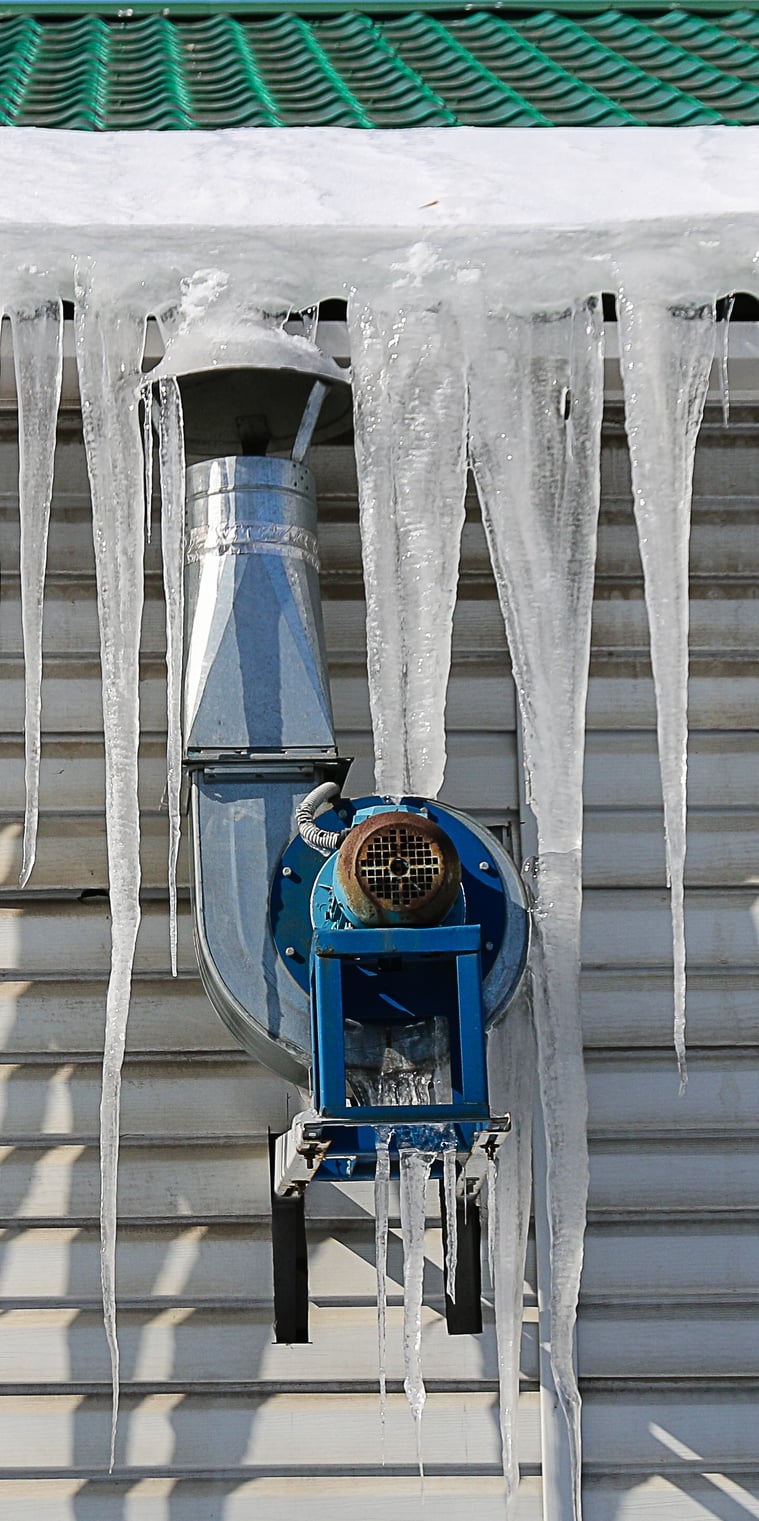 Q1: What are the high and low temperature ratings for AEGIS® Rings?
A1: We know for a fact that they work from -112 up to 410°F (-80 to 210°C). Those are the lab-tested values. But the rings didn’t fail over that whole range, so we don’t know what the true limits are. We actually got a question recently from an engineer about the Mars Rover. Now, the average surface temperature of Mars is -180°F (-63°C). There’s certainly nowhere on Earth that’s too cold for AEGIS rings to work.
At the hot end, we know of them being used in some pretty hot ovens. If you have an extreme application, just give us a call and talk to our engineers.
Q2: What is the maximum speed capability of the AEGIS ring, and can the motor reverse direction without damaging the fibers?
A2: It depends on the shaft diameter. We have small shafts on high-speed routers at 32,000 rpm. But what counts is the surface speed; for a given rpm, the bigger the shaft, the bigger the surface speed. 1800 & 3600 rpm are typical; you usually don’t have large shafts at tens of thousands of rpm.
If you’re ever concerned that AEGIS won’t work, call us.
As for reversal: We’ve been testing this for years, and they’re still going. I think we’re up to 40 million reversals, with almost no wear. The fibers are slightly overly long, and they do wear slowly, but only to the level of the shaft at most.
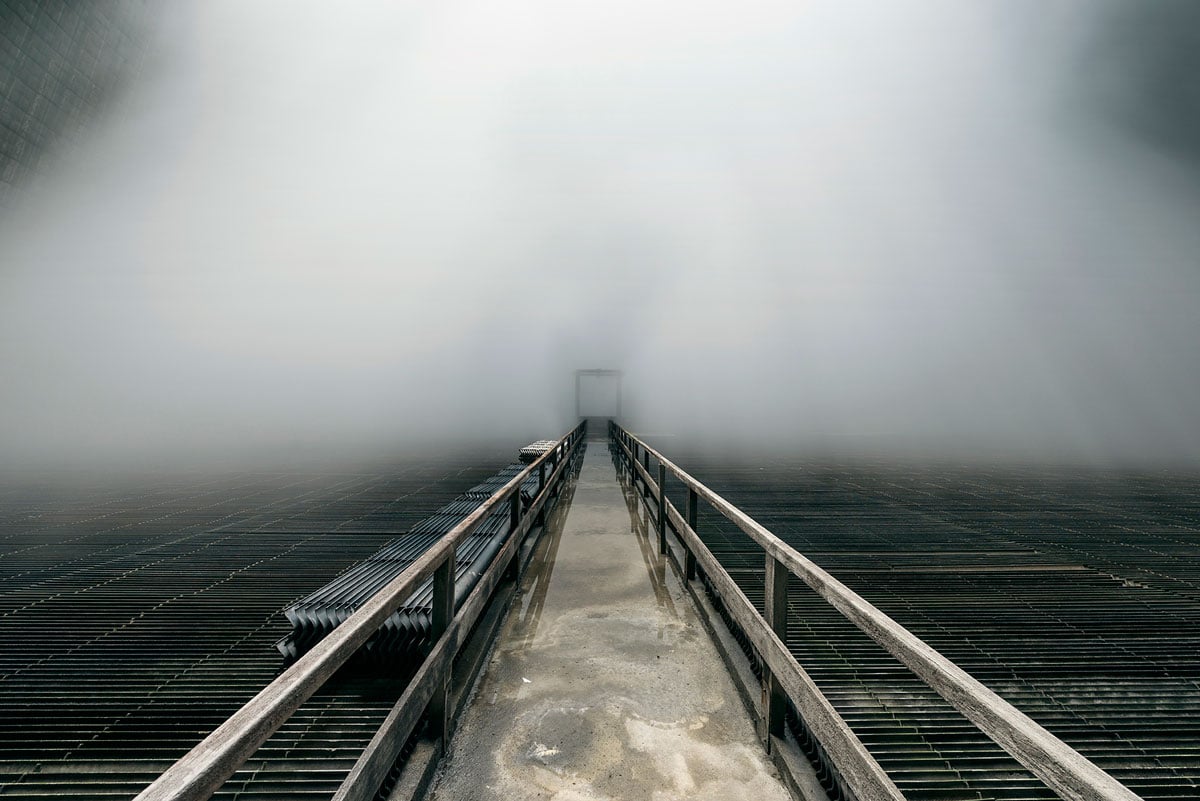 This cooling tower is not too moist for internally mounted AEGIS rings. Photo © Reginald van de Velde.
Q3: How does a high-moisture environment affect the ring’s performance?
A3: If the humidity’s not condensing, there’s no effect at all. The ring does not like to be immersed in water, though (or any liquid). So if the ring is likely to get wet, it should be installed internally, like in these Marathon and US Motors cooling tower motors.
For most applications, the bigger risk will actually be the shaft oxidizing due to humidity. So in a very humid environment, especially if the ring is mounted externally, you should probably use our colloidal silver shaft coating.
Q4: If you’ve got a motor with under 100 hp, that is not controlled by a drive, is there any need for an AEGIS ring?
A4: No, small motors run across the line do not need shaft grounding. But, if there’s ever any chance that the system might be upgraded to use a drive, then it might be wise to include AEGIS shaft grounding just so you will be all ready for the change when it happens.
AEGIS Rings also come with a 2-year extended warranty against bearing fluting damage. No other form of protection against VFD-caused bearing damage offers a warranty like this.
To learn more about AEGIS shaft grounding and best practices for electrical bearing protection, sign up for a training. We offer monthly live training webinars, and – pandemic restrictions permitting – we can also visit your facility to review your exact application.
Zürich University for Applied Sciences on Motor Bearing Currents
In 2017, the School of Engineering at Zurich University of Applied Sciences (ZHAW) began a long-term study of electrical bearing damage. Whereas most prior research had focused on large motors on drives, this research focused on smaller motors.
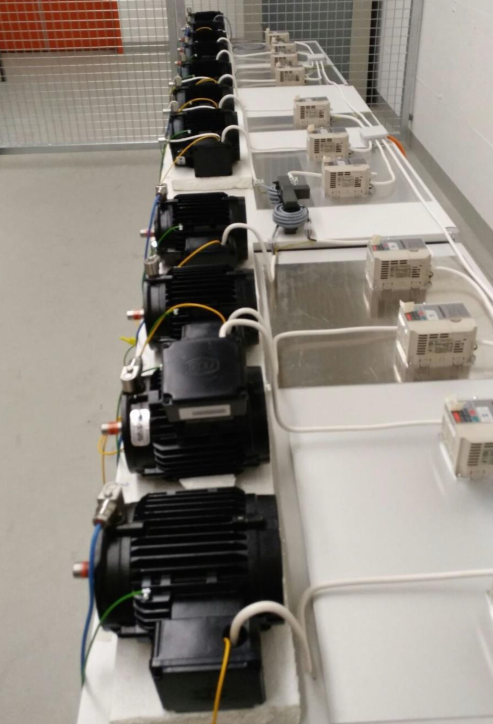 This project was commissioned by the BFE, the Swiss Federal Bureau of Energy. The research consisted, in part, in running 11 identical 2 hp (1.5 kW) motors on drives for 10 months, and then cutting and examining their bearings. Each of the 11 motors was equipped with different types of protection (or lack thereof) against electrical bearing damage. Among other options, these protective measures included specialized VFD cable, common mode chokes, insulated bearings, and AEGIS Shaft Grounding Rings.
Before going into the test results, we should review the three types of VFD-caused bearing current. EDM current, aka shaft voltage discharge or rotor discharge current, is a problem in motors of all sizes. High-frequency circulating current is a problem in larger motors, over 100 hp/75 kW. And rotor ground current is a problem in poorly grounded motors of all sizes.
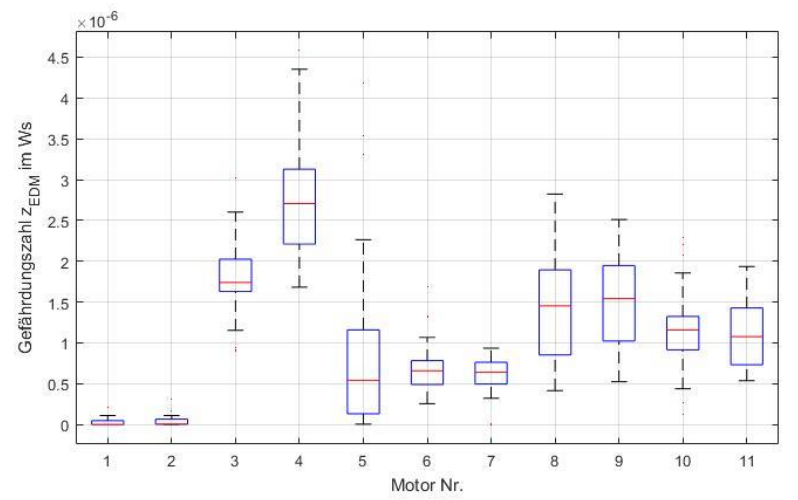
Because these were small motors, circulating current was not a problem. The researchers found that both shaft grounding rings and insulating both bearings prevented damage from EDM and rotor ground current. (Grounding the motor shaft alone would not protect coupled equipment’s bearings from rotor ground current.) Common mode chokes reduce rotor ground current but do not decrease EDM current – and can worsen it. Likewise, improved grounding and special VFD cabling prevent rotor ground current but do not affect EDM current.
|
The EDM « risk number » for each of the 11 motors. (Low risk number is good.) The least at-risk motors are #1, with insulated bearings, & #2 with an AEGIS ring. The next two are at risk: #3 has a well grounded frame, and #4 and 5, a common mode choke. #6-11 have various levels of shaft and frame grounding.
What is their final recommendation for preventing bearing currents in small machines? EDM current can be mitigated by effective shaft grounding (such as AEGIS Shaft Grounding Rings) or two insulated/hybrid bearings. The good high-frequency grounding of the motor frame can prevent rotor ground current.
AEGIS Rings also come with a 2-year extended warranty against bearing fluting damage. No other form of protection against VFD-caused bearing damage offers a warranty like this.
To learn more about AEGIS shaft grounding and best practices for electrical bearing protection, sign up for a training. We offer monthly live training webinars, and we can also visit your facility to review your exact application.
Electrical Bearing Protection Q&A Part 10
Part 10 in a series of questions and answers from our Q&A webinars.
Q1. How do I implement a plantwide program to adopt AEGIS shaft grounding on all of our VFD-fed motors?
A1. We run into that every week. It’s one thing for us to tell you, « This is the solution. » But then how do you implement that solution? You’ve got dozens or hundreds of existing motors. Some of them already have bearing problems, and some don’t. Obviously, the ones with problems need to be repaired and have AEGIS added or to be replaced with motors with AEGIS factory-installed.
But you don’t want to stop there. Every motor on a drive is at risk.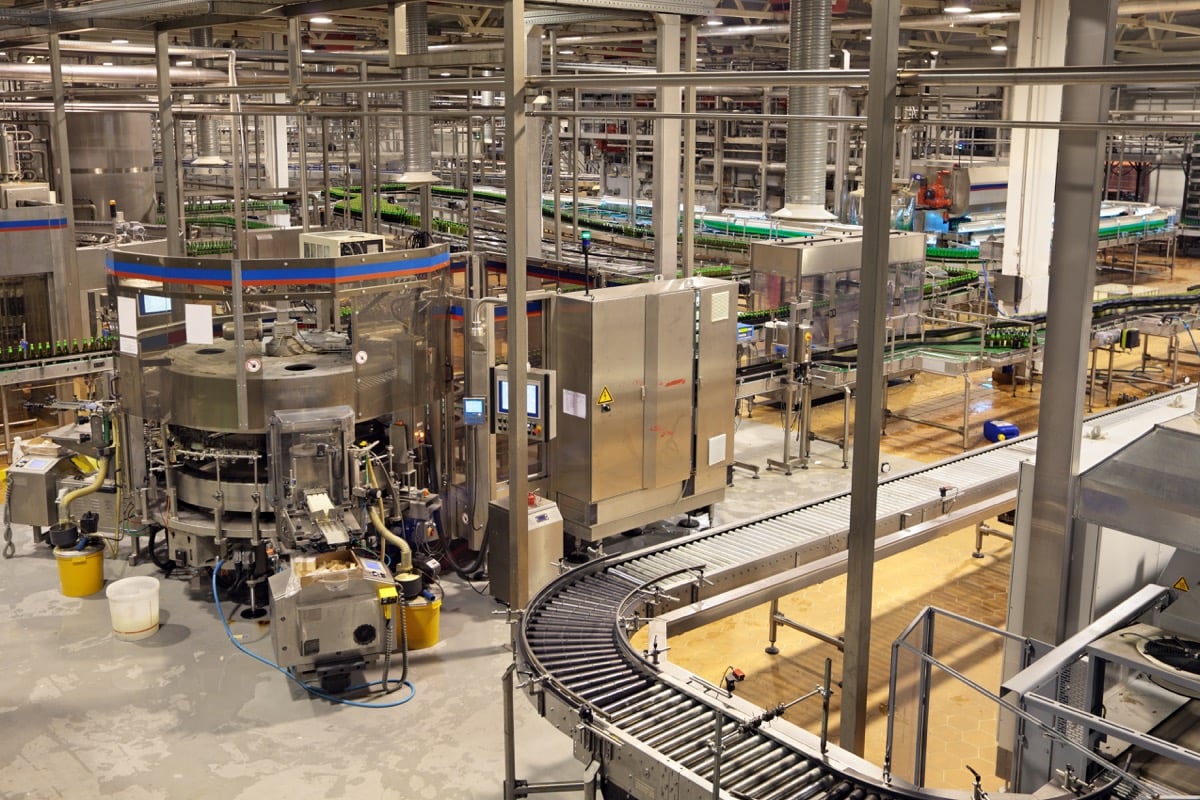 And it’s way more cost-effective, even for 1-2 hp motors, to use shaft grounding and avoid the cost and hassle of replacement. Suppose you’ve got a $400 2 hp motor that fails once a year. OK, that’s $400/year for a new one. If you swap in a 2 hp motor with AEGIS, that’s a bigger expense in Year One… But then that motor doesn’t need to be replaced, not for electrical bearing damage. AEGIS rings are usually good for 100,000 hours. That’s quite a few years where you’re spending $400 less each year. Now multiply those savings by every motor you have on a drive, and that adds up.
There are two philosophies on how to implement the program. Some companies just replaced or put rings on all of their motors at once. But usually it’s phased in. One way to do it is to get a small inventory of motors with AEGIS, and as in-service motors fail or need work, repair or replace them with AEGIS-installed motors. Then you continue the acquire & swap out process until every motor on a drive has a ring.
And if you ever try to implement this and get hung up on something, give us a call. Our Regional Sales Managers would be happy to talk to you or visit your plant and help you phase this in.
Q2. I know that larger motors on drives are subject to high frequency circulating currents. Do they still have problems with shaft voltage discharge (EDM) current?
A2. The short answer is Yes. When a three phase motor is on a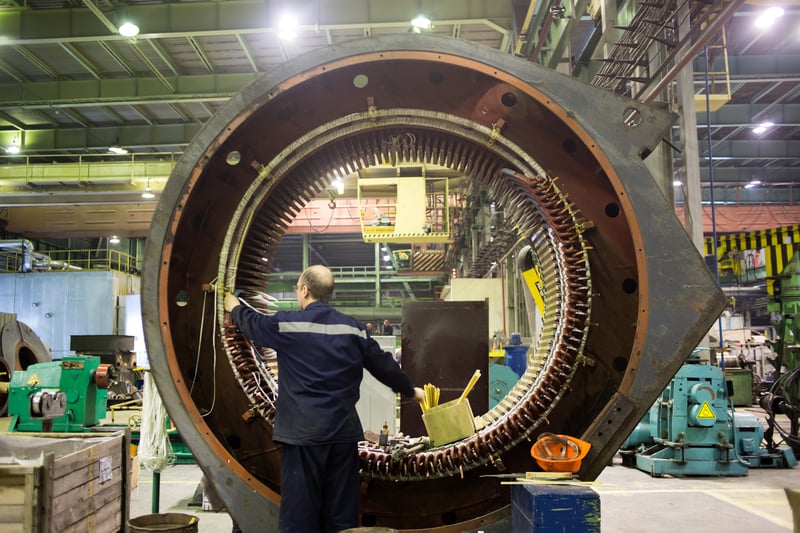 drive, the voltage in the three phases will never cancel out. There will always be some extra voltage in the motor windings. And that extra (« common mode ») voltage is always going to charge up the rotor and create a shaft voltage. Now, we say « shaft voltage, » but the real problem is that you have a voltage across the bearings. And if the shaft voltage is bigger than a few volts, it’s going to arc through the bearings and damage them.
It’s true that circulating currents are actually a bigger problem than shaft voltage in these large motors. You can interrupt (stop) circulating currents with one insulated bearing. Protecting one bearing from circulating current protects the other too. But insulating one bearing won’t protect the other bearing from EDM bearing current from shaft voltage discharge. So to minimize the risk of electrical bearing damage in these motors, you need one insulated bearing and good reliable shaft grounding like an AEGIS ring. (And grounding of the motor frame to prevent rotor ground current, but that’s another issue.)
AEGIS Rings also come with a 2-year extended warranty against bearing fluting damage. No other form of protection against VFD-caused bearing damage offers a warranty like this.
To learn more about AEGIS shaft grounding and best practices for electrical bearing protection, sign up for a training. We offer monthly live training webinars, and – pandemic restrictions permitting – we can also visit your facility to review your exact application.
Electrical Bearing Protection Q&A Part 9
Part 9 in a series of questions and answers from our Q&A webinars.
Q1: Variable frequency drives can operate at different carrier frequencies. What is the best frequency to use to avoid electrical bearing damage?
A1: A little background: The carrier frequency determines how often the drive switches on and off. You typically use high carrier frequency to avoid audible noise. Basically, the carrier frequency causes the motor to vibrate (make sound). The higher the frequency, the less you can hear the resulting sound. But the higher the carrier frequency, the more often the drive switches the phase voltage on and off (Figure 1). Every time a phase switches, there’s a pulse of common mode current. This common mode current causes destructive rotor ground current, and high frequency circulating current in larger motors. So high carrier frequency can increase electrical bearing damage.
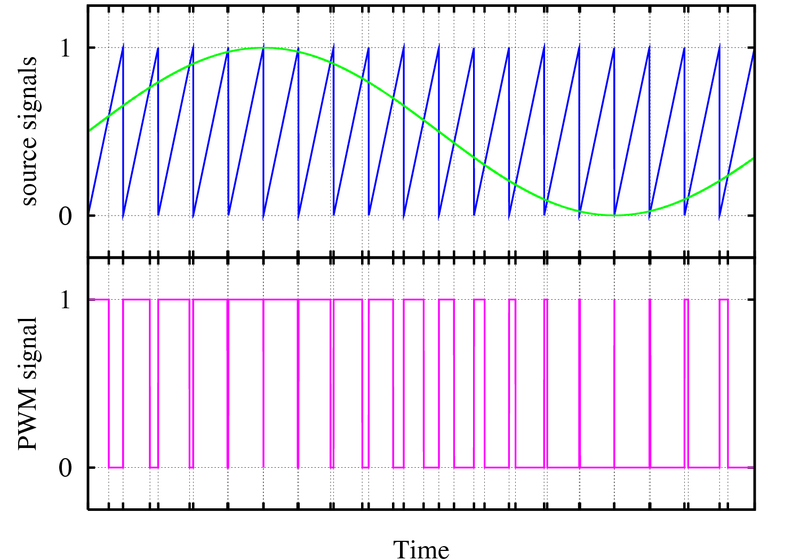 Whenever a wave of the desired output frequency (green) is above a triangle wave of the carrier frequency, the drive will be switched on. The higher the carrier frequency, the more often it switches on and off.
But that doesn’t mean low carrier frequency prevents damage. The carrier frequency doesn’t affect the common mode voltage so much. It’s the common mode voltage that capacitively couples from the motor stator to the rotor to produce shaft voltage. This is the biggest problem in small, well-grounded motors. Changing the carrier frequency doesn’t affect the level of the shaft voltage (only how frequently it changes). If the shaft voltage gets high enough, it will arc through the bearing, regardless of the frequency.
So the short answer is: There is no ideal carrier frequency that will prevent damage. Some people say that lower frequency reduces damage, but we’ve never seen a case where a user reduced the frequency and the problem went away.
What you need is good shaft grounding like an AEGIS ring and good motor grounding or motor-load bonding with a high frequency grounding strap. These will dissipate shaft voltage, and stop it from arcing through the bearing, and prevent rotor ground current. If the motor is over 100 hp/75 kW, you should also have one insulated bearing to interrupt high frequency circulating current.
Beyond that, you can set the carrier frequency to be high enough not to make too much noise.
Q2: What is the influence of motor speed on bearing current magnitude?
A2: We haven’t seen that speed is a major factor. It plays in, but it’s not the biggest player in the field. If a motor system is going to have a problem, it will have it whether it runs at 1500 rpm or 3000 rpm. It might be a matter of having bearing failure in five months instead of six.
Q3: What size of peak to peak shaft voltage should we be worried about?
 Low amplitude shaft voltage discharge
A3: There’s no hard and fast answer, unfortunately. We normally say 10V peak-peak. But we’ve seen situations with only 2V peak-peak, but about 100,000 discharges per second. This was in an MRI cooling system. It wreaked havoc on their system after six months. But this is exceptional: normally, 2V peak-peak is totally fine.
In a motor without shaft grounding, you sometimes see low amplitude shaft voltage discharge. This seems to be because the grease is contaminated with metal and carbon particles that make it more conductive. So there’s still arcing going on, but it happens at lower voltage. Damage accumulates, but because the voltage is low, it accrues fairly slowly at this stage.
We like to see shaft voltage under one volt peak. But every system is different; we’ve seen systems with 40-60V peak-peak and adding an AEGIS ring only brings it down to 2V. That’s a win. The energy in a bearing discharge grows with shaft voltage squared, so that’s a massive reduction of potentially damaging energy. If you can eliminate most of the shaft voltage, that’s almost always enough.
AEGIS Rings also come with a 2-year extended warranty against bearing fluting damage. No other form of protection against VFD-caused bearing damage offers a warranty like this.
To learn more about AEGIS shaft grounding and best practices for electrical bearing protection, sign up for a training. We offer monthly live training webinars, and – pandemic restrictions permitting – we can also visit your facility to review your exact application.
The AEGIS Online Catalog and Product Selector
We are excited to announce the new AEGIS® online catalog. You can easily locate the part you need, from Shaft Grounding Rings, to high frequency grounding straps, to Shaft Voltage Tester oscilloscopes. See for yourself in our catalog!
You can search by part number, shaft size, or motor frame size (NEMA or IEC) to find what you are looking for. If you’re not sure where to start, the product selector will walk you through from start to finish. You can also browse by category: Shaft Grounding Rings, Shaft Voltage Testing, and Accessories.
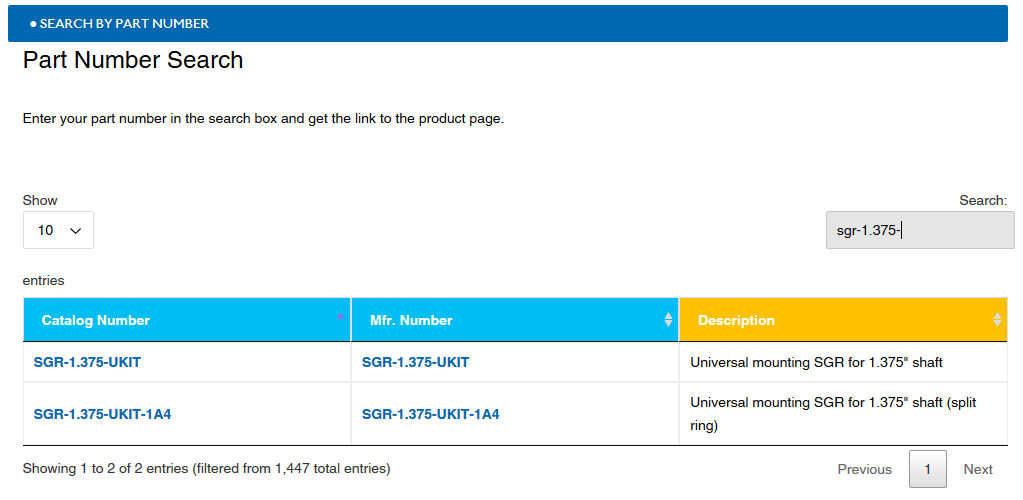 You can search for any part by part number…
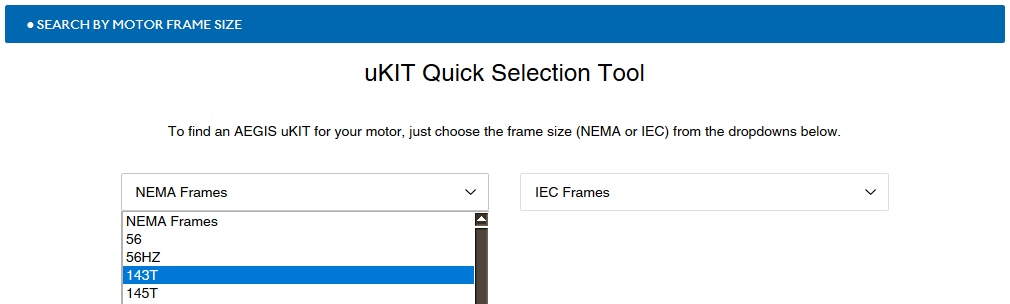 Or for a uKIT based on motor frame size…
 … Or search by motor shaft diameter.
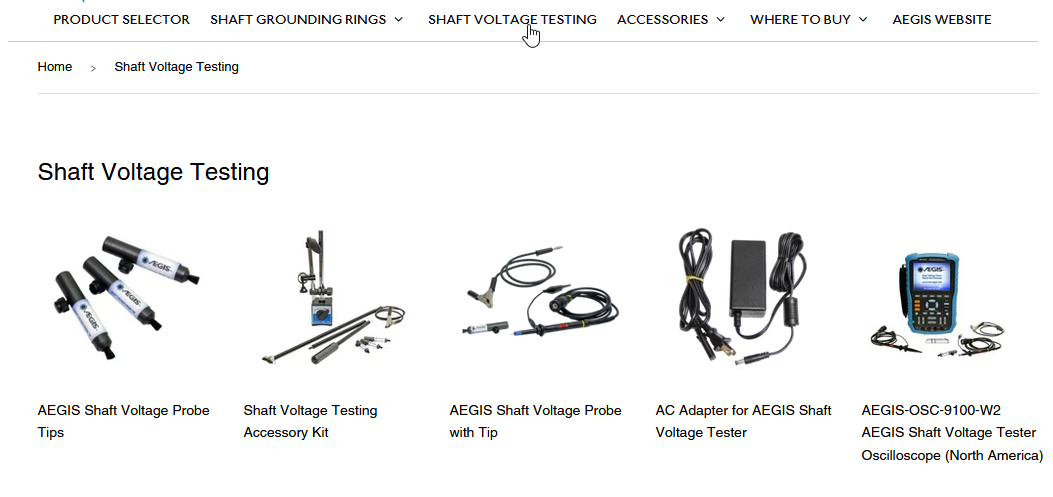 You can also browse our products by category.
To learn more about AEGIS shaft grounding and best practices for electrical bearing protection, sign up for a training. We offer monthly live training webinars, and – pandemic restrictions permitting – we can also visit your facility to review your exact application.
University Finds Big Savings with Electrical Bearing Protection
In 2016, a midwestern American university had a problem. Their HVAC motors running on variable frequency drives (VFDs) had serious bearing problems. First, the affected motors would make a loud high-pitched noise. Then the bearings would fail entirely. As repair costs mounted, their Facilities Department requested Engineering to investigate.
During their investigation, Engineering used an electrical discharge detector and found moderate to severe electrical discharge in every motor on a VFD. Worse, discharge was also found in the pumps coupled to these motors. Motor repair or replacement gets expensive, but pumps are typically more expensive than the motors that drive them.
Rather than assuming that the VFDs were to blame, Engineering first looked into the repair logs. Did motors on drives need more repairs than motors run on line power? Indeed they did. In fact, almost no repairs had been made to pumps or motors that were not equipped with VFDs. The evidence was clear: VFDs were causing the damage.
This raised the question: If drives cause so much damage, are they even worth using? The answer is yes. In the three buildings surveyed, the university spent an average of $14,000 per year on repairs. But in those same buildings, the drives gave annual energy savings of over $63,000. Deducting repair costs, the average savings was still $49,000.
But the engineers knew they could do better. So they recommended 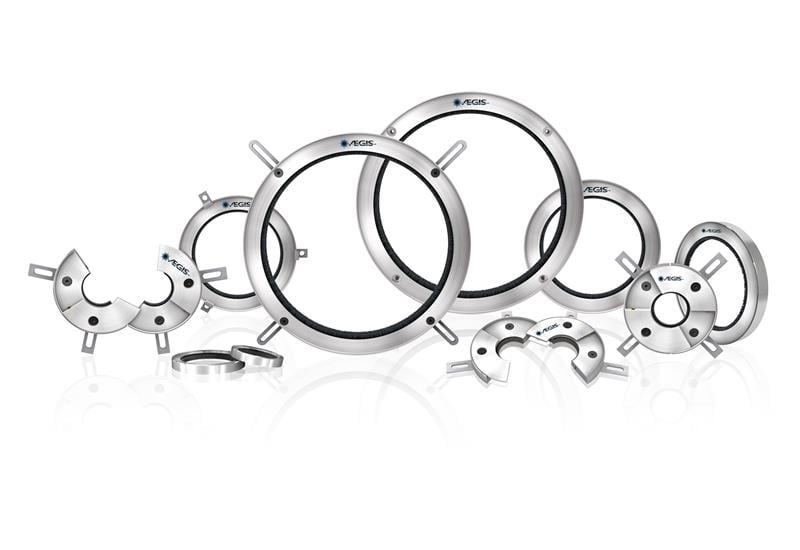 requiring electrical bearing protection for all motors on VFDs. This would include AEGIS® Shaft Grounding Rings for motors of all sizes. Larger motors, above 100 hp/75 kW, would also receive one insulated bearing. AEGIS Rings protect motor and pump bearings from shaft voltage discharge. And an insulated bearing protects motor bearings from the circulating currents that occur in larger machines.
With this protection, the bearings of a drive-fed motor are far less likely to require repair. So specifying electrical bearing protection on all VFD-fed motors will drastically decrease annual repair costs. With repair costs minimized, VFDs will deliver even more of the savings they promise.
AEGIS Rings also come with a 2-year extended warranty against bearing fluting damage. No other form of protection against VFD-caused bearing damage offers a warranty like this.
To learn more about AEGIS shaft grounding and best practices for electrical bearing protection, sign up for a training. We offer monthly live training webinars, and – pandemic restrictions permitting – we can also visit your facility to review your exact application.