

Auteur/autrice : AEGIS
WEG Explosion Proof Motors Now Offer an AEGIS Option
In less than sixty years, WEG Electric has grown from being a local Brazilian motor manufacturer to a diversified global powerhouse. WEG has a reputation for innovation, and it’s no wonder: They invest 2.5% of their revenue in R&D. Through this massive engineering commitment, WEG is able to make motors that run cooler, last longer, and are easier to install.
You can see their investment paying off in their Explosion Proof motors.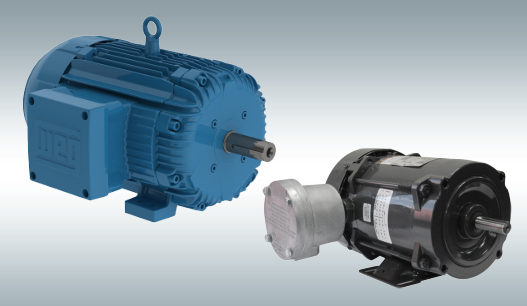 All of these motors are factory-tested to be sure they satisfy the UL or CSA specification for hazardous locations. In fact, they not only meet those specifications’ requirements, but exceed them.
For instance, WEG now offers AEGIS® Shaft Grounding Rings as an option inside their explosion proof motors. Shaft grounding protects motors against electrical bearing damage caused by VFD operation. AEGIS rings are the only shaft grounding device that can be installed inside an explosion proof motor. While all explosion proof motors include protections against explosion, most do not have protection against stray bearing current.
You can find WEG’s explosion proof motors in their catalog (pp A-114 through A-119).
WEG also offers AEGIS rings on non-hazardous duty motors. AEGIS rings come standard inside several lines of stock motors, and can be added internally or externally as a mod to most others.
These are just two more examples of WEG’s devotion to continuing improvement.
AEGIS Rings also come with a 2-year extended warranty against bearing fluting damage. No other form of protection against VFD-caused bearing damage offers a warranty like this.
To learn more about AEGIS shaft grounding and best practices for electrical bearing protection, sign up for a training. We offer monthly live training webinars, and we can also visit your facility to review your exact application.
Permanent Magnet AC Motors Need Shaft Grounding
Permanent magnet ac (PMAC) motors are an increasingly popular substitute for induction motors. They are 2-4% more efficient than induction motors, and also have higher power density. That is, for a given hp rating, a PMAC motor is 1-2 frame sizes smaller than an induction motor. Or equivalently, PMAC motors pack more horsepower into a given frame size.
Although they are more expensive than induction motors, PMAC motors save so much energy that they usually pay for themselves within two years. And those savings keep adding up over the motor’s entire lifetime, which can be 20 years or more.
Unlike induction motors, PMAC motors cannot be started on line power. They must be run by variable frequency drives (VFDs). VFDs have the same upsides and downsides for PMAC motors as induction motors. On the plus side, they offer precise control with smooth speed changes and energy savings from running at reduced speed. On the other hand, VFD output creates a voltage on PMAC motor shafts, and that voltage can discharge through the bearings. This arcing through the bearing causes bearing damage and premature failure. For both induction and PMAC motors, the solution to bearing arcing is the AEGIS® Shaft Grounding Ring.
Some have argued that shaft voltage is not a problem in PMAC motors, because of their larger airgap. But that’s not true: Lab testing has proven that PMAC motors are at risk of electrical bearing damage.

A few years ago, Electro Static Technology visited a well-known manufacturer of PMAC motors to test their shaft voltage. The results were clear: PMAC motors are subject to shaft voltage levels high enough to cause electrical bearing damage. Here are some readings from that testing. All of these readings have a voltage scale of 2 V/div. In figure 1, we see the motor’s shaft voltage.
Without Shaft Grounding
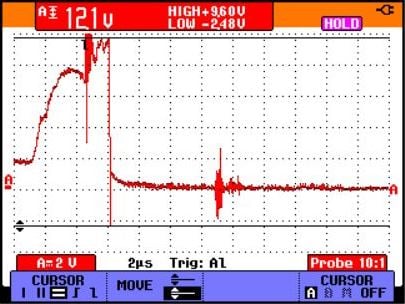
The peak-to-peak voltage is 14.8V, which is high enough to cause damage. But the timescale in this image is too large to see whether discharge is occurring. In Figure 2, we zoom in to a smaller timescale. Here we see a slow buildup of shaft voltage followed by a sudden drop. This is the « smoking gun » of electrical discharge. So this reading shows an arc through the bearing. This proves that PMAC motors are at risk.
WITH AEGIS Shaft Grounding
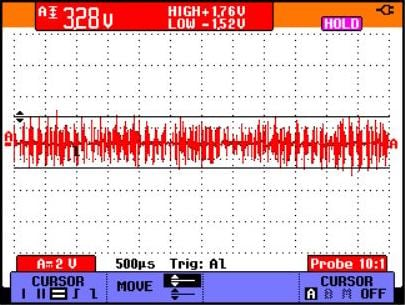
We also tested an AEGIS Shaft Grounding Ring on the PMAC motor, as shown in Figure 3. Here, the peak-to-peak voltage is reduced to 3.28 V. This voltage is too low for bearing arcing to occur, so this is a safe level.
In summary, testing has shown that PMAC motors are at risk of electrical bearing damage, but they can be protected with an AEGIS Shaft Grounding Ring.
Marathon Motors has begun protecting their SyMAX® line of PM motors by installing AEGIS rings at the factory. AEGIS shaft grounding rings are available in all SyMAX motors, and come standard in some.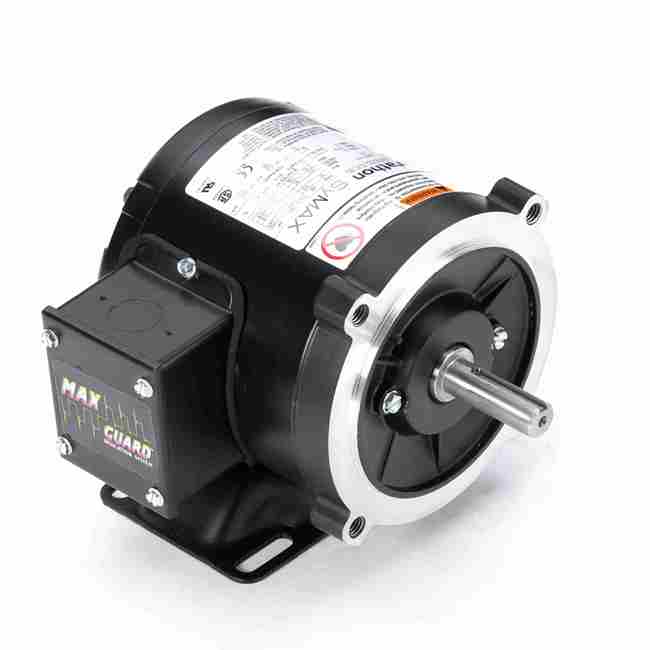
AEGIS Rings also come with a 2-year extended warranty against bearing fluting damage. No other form of protection against VFD-caused bearing damage offers a warranty like this.
To learn more about AEGIS shaft grounding and best practices for electrical bearing protection, sign up for a training. We offer monthly live training webinars, and – pandemic restrictions permitting – we can also visit your facility to review your exact application.
Shaft Grounding for Pharmaceutical Motors
The pharmaceutical industry uses electric motors for hundreds of purposes. To name only a few, they power the HVAC that warms, cools, and filters air; the pumps that move refrigerants and other liquids; and the grinders, mixers, and fillers that  compound the product. Some of these motors may be general duty, but others must be washdown rated or explosion-proof. What all of these motors must be, though, is reliable.
The cost of unplanned downtime is always high in manufacturing. In pharmaceuticals, it is astronomical. In late 2010, Novartis had a plant shutdown that may have cost it $560 million. That’s half a billion dollars.
With costs like these, anything that maintenance staff can do to reduce the risk of shutdown is a good investment. Case in point: Shaft grounding rings for electric motors controlled by adjustable speed drives. Without shaft grounding, these drives cause electrical bearing damage and premature failure. Motor failure in a critical process can put a major kink into a production line.

The most reliable shaft grounding product is the AEGIS® Shaft Grounding Ring. AEGIS rings are also the only shaft grounding product with a 2-Year Extended Warranty. AEGIS rings can be installed on in-service motors, but they are also available factory-installed on general purpose, washdown duty, and even explosion proof motors. Whatever kind of motor you need, it’s probably available with an AEGIS ring factory-installed.
AEGIS rings are an integral part of a full reliability strategy. Whatever the application, if a motor is on a variable frequency drive, it should have AEGIS shaft grounding.
AEGIS Rings also come with a 2-year extended warranty against bearing fluting damage. No other form of protection against VFD-caused bearing damage offers a warranty like this.
To learn more about AEGIS shaft grounding and best practices for electrical bearing protection, sign up for a training. We offer monthly live training webinars, and we can also visit your facility to review your exact application.
Should You Use a Variable Frequency Drive?
There is a lot of hype about using variable frequency drives (VFDs) to control motors, both pro and con. On the one hand, they can provide large energy savings. On the other, they can damage the motors they control, and other equipment. Many of the arguments for and against deal with extreme examples, and there are not a lot of balanced considerations out there. motorsatwork.com has two good, unbiased articles on this: « Does every motor need a drive? Three questions to ask before buying another VFD » and « Does every motor need a drive? When NOT to use a VFD ».
It’s important to realize that the question is not, « Are VFDs good or bad? » The 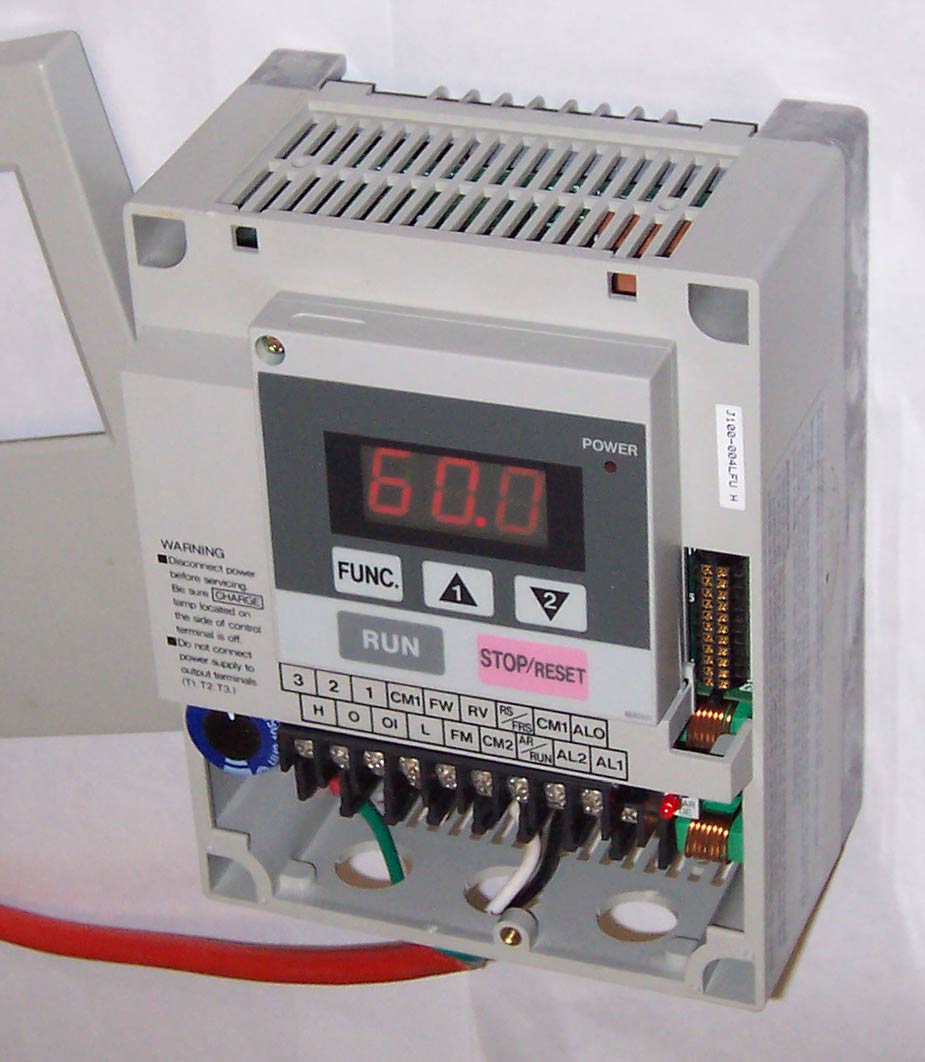 question is, « Does it make sense to control this motor, in this situation, with a VFD? » You need to ask this question about every motor you consider a VFD for. Here are some things to consider when you answer that question.
You should use a drive if…
- Your application requires precise control. If you need smooth control, or for multiple motors to act in sync, a drive can do that.
- Your application involves frequent starts and stops, like some conveyor applications. VFDs can act as soft starters, and smoothly ramp their motors up to the desired speed. On-line power, motors start at full speed, causing mechanical stress and destructive inrush currents.
- Your application has a variable load. This comes up a lot in HVAC and pumping. VFDs can run motors at reduced speed, saving lots of energy in variable torque/power applications.
- You are currently running online power with a mechanical throttle. Running a motor at full speed and throttling the output is like driving with one foot on the gas and one on the brake. It’s hugely wasteful. Switching to VFD operations will save significant energy and money.
You should not use a drive if…
- The motor’s load is constant, and its output is unrestricted. If the motor is running at full speed with no damping or throttling, you won’t save any energy by switching to a VFD. In fact, you would actually lose some efficiency. VFDs are not 100% efficient themselves. And not all of the power they put out is actually usable because it contains harmonics. This also adds to losses.
- Your application needs very low or very high speeds. Overly low speeds can cause overheating; high speeds cause mechanical damage. Instead of a drive, you should use a gearbox or other converter.
- Your motor is old. Motors from before the early 2000s are unable to stand up to VFD output. They will overheat at low speeds or their insulation will fail. Newer motors are designed to withstand VFDs’ voltage pulses. (Provided they have shaft grounding rings, and possibly insulated bearings.) Additionally, since motor efficiencies are higher now, it might make sense to replace the old motor and get a VFD.
- You have power quality issues. VFDs can exacerbate existing problems with harmonics, voltage sag, and assorted transients. (In VFDs’ defense: they do improve power factor.)
- The VFD and motor cannot be located close enough together. If the motor and drive are too far apart, the motor will be at higher risk of electrical damage. Manufacturers’ recommendations vary from 100 to 250 feet maximum. (Line reactors may mitigate this effect.)
So there you have it! If you do decide that VFD control does make sense, be aware that VFDs create motor shaft voltage that causes electrical bearing damage and premature failure. In motors under 100 hp, an AEGIS® Shaft Grounding Ring will protect the bearings by bleeding off shaft voltage before it can arc through the bearings. In larger motors, circulating bearing currents are also a problem, so the best practice is to install an AEGIS ring and insulate the bearing at the opposite end of the motor from the ring.
AEGIS Rings also come with a 2-year extended warranty against bearing fluting damage. No other form of protection against VFD-caused bearing damage offers a warranty like this.
 To learn more about AEGIS shaft grounding and best practices for electrical bearing protection, sign up for a training. We offer monthly live training webinars, and – pandemic restrictions permitting – we can also visit your facility to review your exact application.
Another Reason to Use VFDs for Motor Control
Most articles about the benefits of variable frequency drives (VFDs) focus on two things: Energy efficiency, and fine control. Which is fair enough. VFDs can save energy by only providing as much power as a motor needs. Think fans blowing at half speed, or an unloaded conveyor belt. Speaking of conveyor belts, VFDs can control torque when the load changes – like suddenly adding a heavyweight to a conveyor. So VFDs also allow smooth, steady operation under changing load.
But VFDs also limit inrush current, which rushes through the motor when it’s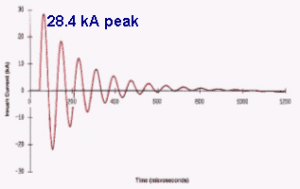 first energized. When a motor is started on line voltage, the inrush current may be two to ten times the normal operating current. This can cause electrical and mechanical damage to the motor (and coupled equipment). Jerry Muehlbauer of Marathon Motors compared this effect to « starting your car while on jack stands: Put it in gear, start the engine, place a brick on the gas pedal, and then push it off the jack stands. This results in uncontrolled acceleration & huge mechanical stress on the transmission and engine. » [Editor’s warning: Do not try this.]
When a motor is started on a VFD, the drive slowly and smoothly increases the current from zero up to the normal operating level. This avoids all of the stress inrush currents cause.
There are other ways to protect motors from inrush currents. Some of them are cheaper, but none offer VFDs’ other benefits. So the choice depends on the price difference and how important VFDs’ energy savings and smooth operation are to you.
If you do opt for VFD control, be sure to also protect the motor bearings from the VFD itself. VFDs produce voltage on the shafts of the motors they control. This voltage can discharge by arcing through the bearings, causing electrical bearing damage and premature failure. You can prevent this failure by using AEGIS® Shaft Grounding Rings to bleed off the shaft voltage before it can arc through the bearings. (For motors over 100 hp, the best practice is to install one insulated bearing to interrupt circulating currents, along with an AEGIS ring.)
AEGIS Rings also come with a 2-year extended warranty against bearing fluting damage. No other form of protection against VFD-caused bearing damage offers a warranty like this.
To learn more about AEGIS shaft grounding and best practices for electrical bearing protection, sign up for a training. We offer monthly live training webinars, and – pandemic restrictions permitting – we can also visit your facility to review your exact application.
Protecting VFD-Driven Motors In Ski Resorts
Ski resorts use tremendous amounts of energy in their day-to-day operations. All ski resorts must transport skiers from the base of a mountain to its peaks or to the start of various slopes or trails, without 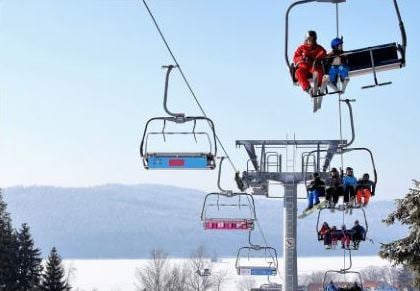 jerkiness. To improve control of lift operations, many resorts are installing variable frequency drives (VFDs). VFDs can smoothly adjust the speed of chair lifts, gondolas, carpets, and high-capacity trams to accommodate varying passenger loads, weather conditions, and other factors. In addition to giving precise control, these drives can also save energy when they run snowmaking pumps or HVAC equipment.
For most ski resorts, lift and snowmaking operations account for more than 80% of total energy costs.
Although VFDs can yield smooth operation and energy savings, they can also damage the motors they control. They create stray voltages on motor shafts, and this voltage can discharge by arcing through the bearings. These arcs cause pitting, fluting, and eventually premature failure. Without bearing protection, the benefits from of VFDs can be canceled by the high costs of downtime and motor repair/replacement.
AEGIS® Shaft Grounding Rings solve this problem by providing a low-resistance path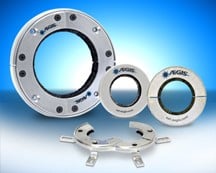 from the motor shaft to the frame. So shaft voltage discharges through the AEGIS ring, instead of through the bearing. This protects the bearings and motor against premature failure and protects the user from the costs of downtime and motor repair or replacement. (Larger motors also require one insulated bearing, to protect against the second cause of electrical bearing damage.)
AEGIS rings can easily be mounted on in-service motors. They’re also available factory-installed on hundreds of motors from manufacturers like Baldor/ABB, Marathon, WEG, US Motors, and more. You can search all motors with AEGIS at industrialmatrix.com.
AEGIS Rings also come with a 2-year extended warranty against bearing fluting damage. No other form of protection against VFD-caused bearing damage offers a warranty like this.
To learn more about AEGIS shaft grounding and best practices for electrical bearing protection, sign up for a training. We offer monthly live training webinars, and – pandemic restrictions permitting – we can also visit your facility to review your exact application.
Conveyor Motors on Drives Need Bearing Protection
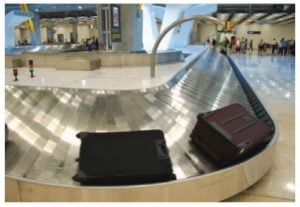 Variable frequency drives, or inverters, are often used to control conveyor motors. In some cases, the drive is used as a soft starter. Conveyors often stop and start frequently. Frequent starts and stops online power are bad for motors. Firstly, large inrush currents cause thermal damage. They also cause torque spikes (jerking), which can break belts. With a drive, speed can smoothly be brought up from zero to the full operating speed. VFDs also afford precise speed control. This is especially important in applications like food and beverage processing and bottling. This ability also helps prevent sudden changes in speed when a large weight is suddenly added to or removed from a conveyor.
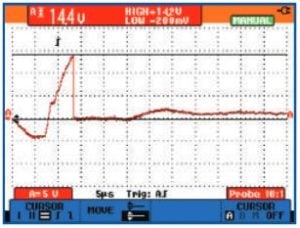
Shaft voltage on a conveyor motor. The sudden drop in voltage at left indicates an arc
through the bearing.
But these drives have their downsides, including electrical bearing damage. Drives generate voltage on motor shafts, and that voltage causes arcing through the bearings. This can cause premature bearing failure, and unplanned downtime while the motor is being repaired or replaced. For motors under 100 hp (75 kW), the solution is the AEGIS® Shaft Grounding Ring.
AEGIS rings bleed off the shaft voltage before they can arc through the bearings. Several major motor manufacturers have product lines with AEGIS rings factory-installed. AEGIS rings can also be added as a mod, and can always be retrofit onto motors.
A few years back, we visited a large Midwestern airport to check their conveyor motors for shaft voltage. We checked two NEMA Premium® motors that were rated « inverter ready, » but did not include shaft grounding. Both of them showed high shaft voltage, and one showed clear signs of arcing. As a test, we installed AEGIS rings on both motors. The shaft voltage was reduced from about 15 volts (peak to peak) to a safe level of 3 volts, and there was no sign of further destructive arcing.
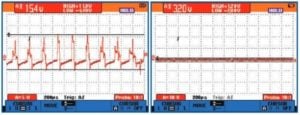
Shaft voltage on a conveyor motor at Michell Field Airport, before and after installing an AEGIS ring.
The scale is the same in both images.
The results were clear: AEGIS rings allow conveyor motor users to get the benefits of inverter control, without the risk of premature bearing failure.
AEGIS Shaft Grounding Rings also have a 2-year extended warranty against bearing fluting damage. No other form of shaft grounding offers a warranty like this.

To learn more about AEGIS shaft grounding and best practices for electrical bearing protection, sign up for a training. We offer both live webinars and on-site lunch-and-learn trainings.
To learn more about AEGIS shaft grounding and best practices for electrical bearing protection – for motors and generators – sign up for a training. We offer monthly live training webinars, and we can also visit your facility to review your exact application.

AEGIS Shaft Grounding Rings will be on display at the WEFTEC 2019 Technical Exhibition in Chicago this September 23-25th. Stop by Booth 7453 and meet the team, see a live demonstration of how AEGIS rings reduce shaft voltage, and pick up a copy of the Bearing Protection Handbook. See you at the show!
Testing for Bearing Current
In the June, 2019 issue of Electrical Apparatus Magazine, a reader asked the editors: Is there any standard test to show whether or not any damaging shaft/bearing currrents are present in a motor? The short answer is No. But we’d like to take a few moments to expand on why there’s no practical way to measure bearing current directly, and to explore the viable alternatives.
By definition, bearing current is the flow of current from the shaft, through the bearing, to the motor frame. But a bearing is not normally conductive. When current manages to pass through, it’s in the form of an arc. This arcing damages the bearing by roughening it. (Hence the problem, and our interest!)
In order to measure bearing current, you’d need to insert some type of sensor either between the shaft and the bearing, or between the bearing and the frame, such that all of the bearing current passed through the sensor. There are a few problems with this, but one stands out: This would not be practical to do in the field! It has been done, but only in the lab.
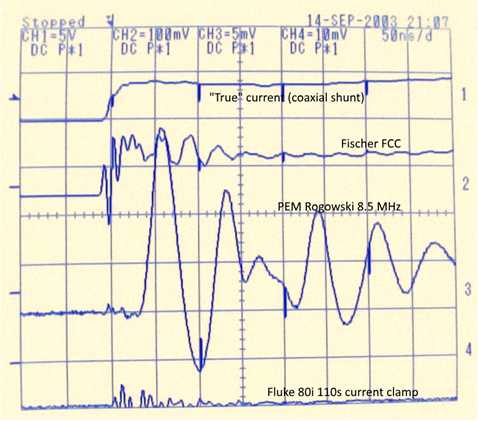
Rogowski coils cannot accurately measure bearing current.
In spite of some misleading marketing, Rogowski coils do not measure bearing current. These are often used on variable frequency drive output to the motor, to measure the total high frequency « common mode » (CM) current going to the motor. While some of this CM current may pass through the bearings, bearing current is only a small portion of the total. The relationship between CM current and bearing current is complicated. You can’t simply say that 1% or 10% goes through the bearings; there are too many variables. Rogowski coils also suffer sensitivity problems with high-frequency bearing current. Standard coils for power frequency current are too slow, and faster coils can overshoot, giving measurements 300-400% too high.
To some extent, bearing current can be measured with discharge detector pens. Bearing currents produce bursts of radio static, and these pens detect those bursts. But in electrically noisy environments, with many motors and drives, these pens can give erratic results. The pens are also sensitive to distance from the bearing. If you detect no discharges, you may be holding the wand too far from the bearing; if you do detect discharges, they might be real, or it might be radio noise from other sources. You can’t be sure without a second type of measurement for confirmation.
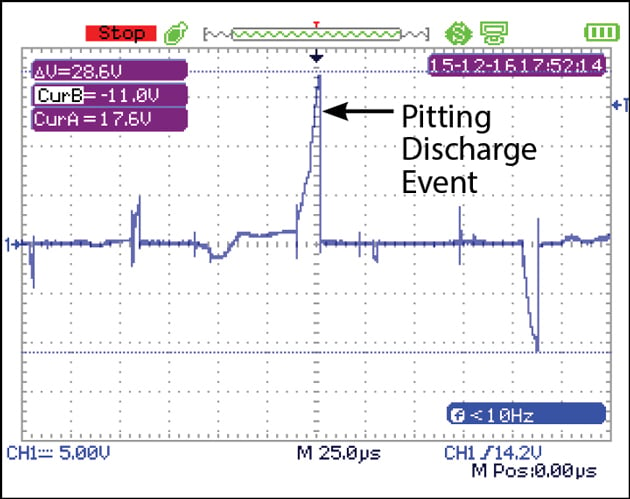
The smoking gun of bearing currents: Voltage builds up gradually, then drops suddenly as an arc blasts through the bearing.
So then what can you measure?
Well, all current is driven by voltage. And you can measure the voltage across the bearing by measuring the voltage difference between the motor shaft and frame, a.k.a. the shaft voltage. You can indirectly measure bearing current by looking for sudden collapses in shaft voltage. These indicate a discharge (arc) through the bearings.
You can measure shaft voltage with any oscilloscope with bandwidth of at least 100 MHz. Multimeters don’t work because shaft voltage changes too quickly. With a scope, you can both see the shaft voltage level, and see when a bearing current occurs.
Gunnar Englund and more recently Fluke have developed devices that can both detect and count shaft voltage discharges. Englund’s Bearing Predictor (Beppe) and Fluke’s MDA-550 both use statistical models to predict whether the bearings will fail prematurely, based on bearing current levels. These are powerful tools, but they are more costly than a standard oscilloscope.
Whatever method you use to measure shaft voltage, the measurement should be made under normal operating conditions, especially rpm, load, and temperature. Motors will show different levels of shaft voltage and bearing current depending on those three factors.
In summary, bearing current cannot feasibly be measured directly. There are practical problems with measuring the current itself, and it’s hard to reliably detect the radio signals it produces. Bearing current must be inferred based on shaft voltage measurements using an oscilloscope. The measurements can be made manually with a general purpose scope, or automatically with a higher-end specialized instrument.
To learn more about AEGIS shaft grounding and best practices for electrical bearing protection, sign up for a training. We offer monthly live training webinars, and we can also visit your facility to review your exact application.
Explosion Proof Motors Available with AEGIS Shaft Grounding Rings
Not just any off-the-shelf motor can safely run in a potentially explosive atmosphere. Explosion proof motors need to be able to contain any sparks or small explosions that might occur within themselves, and prevent them from getting out and igniting a larger explosion. Motor manufacturers have put thousands of hours into designing these motors to be as safe as possible.
There is an additional design challenge for explosion proof motors that will be run by VFDs. These motors need shaft grounding to prevent electrical bearing damage from the drive. Shaft grounding devices are currently considered to be sparking devices. This means that they can’t be installed outside the motor, in a highly flammable atmosphere. And internal installation has its own challenges. A carbon shaft grounding brush can’t be used because it wears. This means the brush must periodically be adjusted or replaced.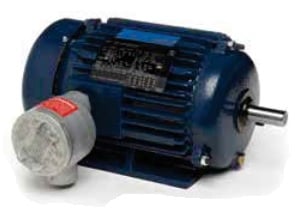
The UL®-accepted solution is to install an AEGIS® Shaft Grounding Ring inside the motor, outside of the flame path. Unlike carbon brushes, an AEGIS ring typically lasts for the lifetime of the motor. AEGIS rings can be installed according to the UL procedures by a number of motor repair companies.
Motor manufacturers can also follow the approved procedures for shaft grounding. In the US, Marathon Motors offers stock explosion proof motors with AEGIS rings factory-installed. And ABB/Baldor offers custom builds of XP motors with AEGIS.
Marathon Motors offers Blue Chip® Hazardous Duty™ NEMA Premium® XRI® motors with AEGIS installed. Models with AEGIS rings have catalog numbers that end « -P ».
In Europe, WEG Electric offers optional AEGIS rings inside the W22Xd line of flameproof motors. These motors comply with the ATEX Directives.
To learn more about AEGIS shaft grounding and best practices for electrical bearing protection, sign up for a training. We offer monthly live training webinars, and we can also visit your facility to review your exact application.
Case Study: AEGIS Grounding Rings Solve Chronic Crane Motor Bearing Failure
Container port cranes need to be strong enough to lift several tons. But they also need enough finesse to lift and lower these huge loads smoothly without too much jerking. This makes these cranes good candidates for control by DC drives. Drives allow constant torque at all speeds and relatively smooth acceleration and deceleration. These benefits come at a price, though. Drives can destroy the bearings of the motors they control, as one Long Beach crane owner learned all too well.
This company did business at the Pacific Container Terminal, where it had 10 cranes, each able to lift 50 tons. Each crane had two 650 HP DC motors to raise and lower the massive loads. Each motor was plagued by chronic bearing failure, with about one failure every month or two. Every time a bearing failed, the 8-ton motor would have to be removed and sent off for repair. On top of the repair costs, each removal also costs 16 hours in downtime.
Reed Electric & Field Service, which replaced the bearing, determined that stray currents caused the failures. The drives were inducing a voltage onto the motor shafts, and that voltage then discharged by arcing through the bearings. Over time, the scars from these arcs roughened the smooth bearing surface, causing friction and further damage. But knowing the cause did not cure the symptom. First, Reed Electric tried installing carbon brushes to no avail. Next, they tried installing an insulated bearing on each motor. However, when they insulated one motor bearing, the other would get damaged instead.
Finally, they hit on a solution: The AEGIS PRO ring. The PRO ring surrounds the shaft with millions of conductive microfibers, providing low-resistance paths from shaft to ground. Shaft voltage dissipates harmlessly through the ring before it can build up high enough to arc through the bearing. (They also installed an insulated bearing opposite the AEGIS ring to interrupt any circulating currents that might occur.)
After installing an AEGIS ring on the first motor, the crane team waited to see what would happen. One month passed. Then two. When three months had passed – longer than any motors had survived in years – they knew they’d got done it. And from then, they began installing PRO rings on the remaining 19 motors.
Reed Electric’s field service manager summarized: « We used to pull the motors out every one or two months. To date, we have installed the AEGIS ring on six motors and haven’t had a single problem with any of them since. We’re going to keep using the PRO ring because it’s working. It’s really doing the trick. »
This case study is based on a previously published article.
AEGIS Rings also come with a 2-year extended warranty against bearing fluting damage. No other form of protection against VFD-caused bearing damage offers a warranty like this.
To learn more about AEGIS shaft grounding and best practices for electrical bearing protection, sign up for a training. We offer monthly live training webinars, and – pandemic restrictions permitting – we can also visit your facility to review your exact application.