

Auteur/autrice : AEGIS
Baldor General Purpose Motors with AEGIS Shaft Grounding
Over the past 100 years, Baldor has become one of the best known and most trusted American brands of electric motor. The Baldor story includes several valuable lessons for all manufacturers. For example, innovation in adversity and selling a product on its strengths: Baldor thrived during the energy crisis of the 1970s, because their motors were more efficient than other brands. In fact, in 1976, Baldor was the first motor manufacturer to include efficiency on the nameplate.
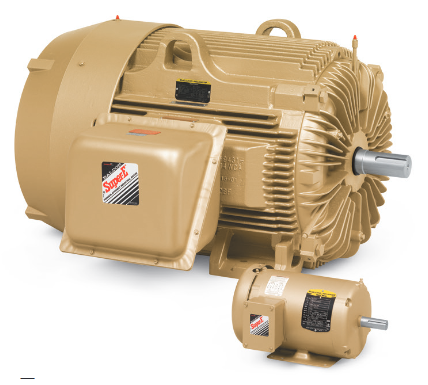 Baldor maintained their motors’ efficiency after their 2011 acquisition by ABB. The Super E® line of general purpose motors includes some of the most efficient motors out there. They are available in NEMA frame sizes from 42 to 500, and power ratings from 1/8 to 450 hp. Available mounting styles include foot mounted and several pump motors: C-face (with and without feet), and JM, JP, and West Coast Pump. These high efficiency motors are ideal for a wide range of HVAC and pumping applications.
In many applications, motors can run even more efficiently at reduced speed. This can be done with variable frequency drive (VFD) control. HVAC and pumping applications, particularly, can save energy with VFD control.
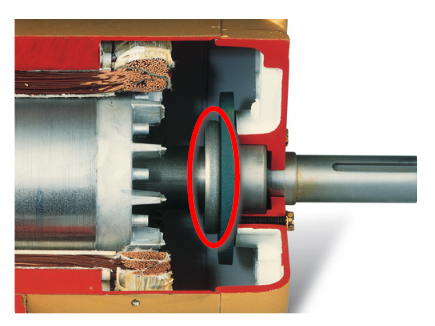
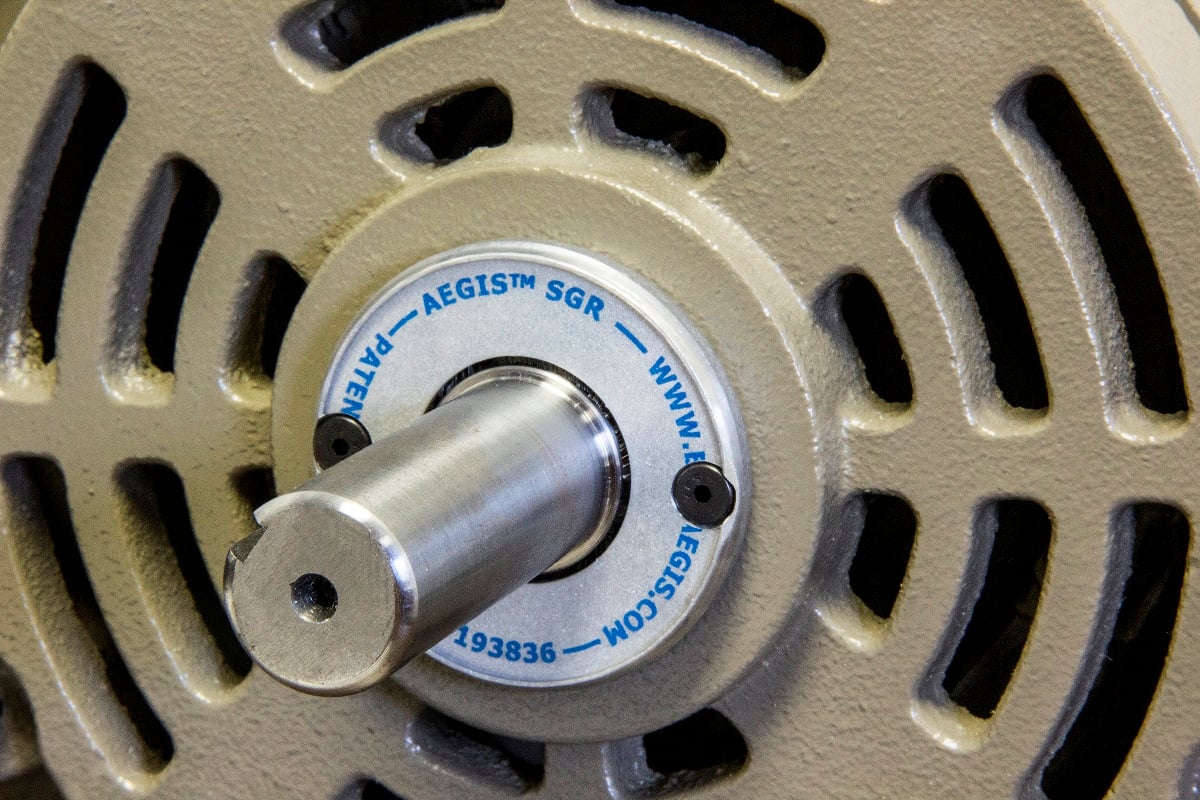
VFDs do present a hazard to motor windings and bearings. So all Super E motors include Class F or H insulation systems and Class B temperature rise to protect the windings, satisfying NEMA MG1 Part 31.4.4.2. And models with « -G » part numbers include an AEGIS® Shaft Grounding Ring mounted inside. AEGIS Rings bleed VFD-energized charge off the motor shaft, preventing it from arcing through the bearings.
Between their insulation systems and their AEGIS rings, Baldor Super E « -G » motors are fully ready for VFD control.
So if you need a premium efficiency general purpose motor that can safely be run on VFD, consider a Baldor Super E Motor with the « -G » suffix.
AEGIS Rings also come with a 2-year extended warranty against bearing fluting damage. No other form of protection against VFD-caused bearing damage offers a warranty like this.
To learn more about AEGIS shaft grounding and best practices for electrical bearing protection, sign up for a training. We offer monthly live training webinars, and we can also visit your facility to review your exact application.
Nidec Unimount Motors with AEGIS
Nidec’s U.S. Motors is one of the oldest and most respected brands of electric motor. They may be best known for their specialty motors, like vertical HOLLOSHAFT®, Vari-Tough® condenser motors, and the severe duty World Motor® family. But U.S. Motors also makes general purpose motors, like their Unimount® line.
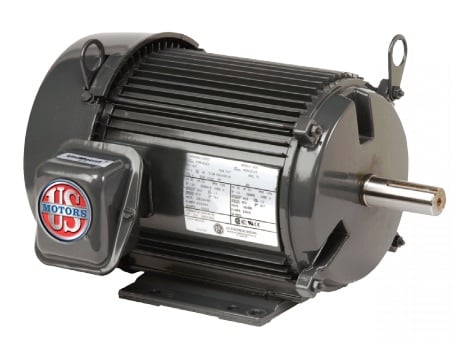 Unimount motors come with a wide range of electrical and mechanical features. They can power pumps, fans, and compressors, by belt or direct drive, or direct connection. And they are well-protected against external and internal sources of damage. They come with a Class F Inverter Grade® insulation system to protect against winding damage from VFD power.
Their bearings are well-protected, too. Unimount motors from 56 to 140 frame have sealed bearings, and from 180 up, they have double shielded bearings. This protects the bearings from contamination from outside. And now, all Inverter Duty Unimount motors over 140 frame are protected against electrical damage by an AEGIS® Shaft Grounding Ring.
A VFD creates voltage on the motor shaft. This voltage can discharge by arcing through the bearings, causing electrical beairng damage. AEGIS Rings create a low-resistance path from the motor shaft to the frame. So rather than building up and then arcing through the bearings, charge drains harmlessly through the ring.
With protection against both external and internal sources of damage, the bearings in Inverter Duty Unimount motors are highly unlikely to fail prematurely. Bearing failure is the largest single cause of motor failure. So that means you can expect a Unimount motor to run reliably for years and years.
AEGIS Rings also come with a 2-year extended warranty against bearing fluting damage. No other form of protection against VFD-caused bearing damage offers a warranty like this.
To learn more about AEGIS shaft grounding and best practices for electrical bearing protection, sign up for a training. We offer monthly live training webinars, and – pandemic restrictions permitting – we can also visit your facility to review your exact application.
Electrical Bearing Protection Q&A Part 2
Part 2 in a series of questions and answers from our Q&A webinars.
Q: Where can I purchase AEGIS rings, and how long does it take to get them?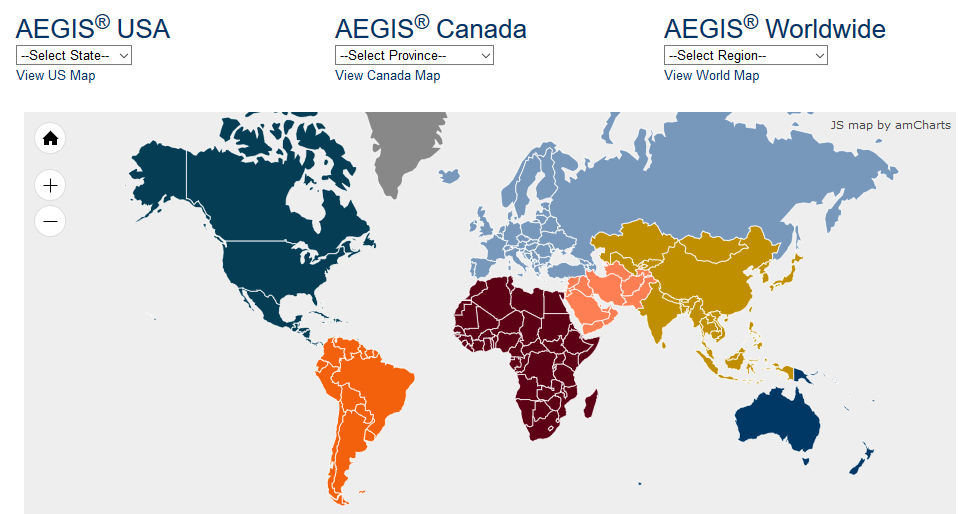
A: We have distributors around the world. You can find your regional distributors here. As for lead time: We make most of our parts to order, and stock parts can almost always ship from Maine (USA) within one business day. We also have a few stocking distributors, like Bartlett Bearing and Midpoint Bearing. They keep a large inventory, and might be able to get you an SGR even faster.
Q: Is it better to put a grounding ring at the drive end (DE) or the non-drive end (NDE) of the shaft?
A: In most cases, it doesn’t matter. It’s usually easier to mount at the DE if you’re mounting the ring externally. The one time it matters is in motors over 100 hp, where the NDE bearing is insulated. In that case, you need the ring at the other end. In the unusual case that the DE bearing was insulated, but the NDE was not, you would have to put the ring at the NDE to keep it opposite from the insulation.
In vertical motors, you want to insulate the top bearing, and mount the AEGIS ring at the lower bearing.
Q: If you have insulated bearings, do you still need AEGIS?
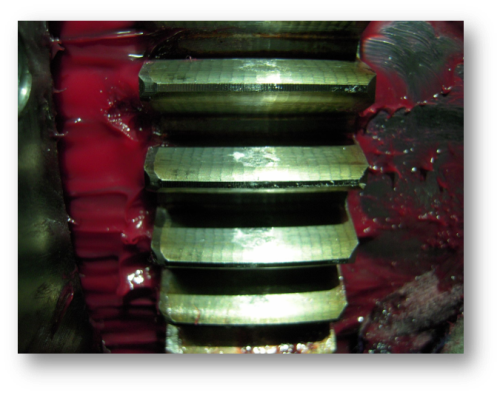 A gear in a gearbox damaged by shaft voltage discharge
A: We recommend it. In high-capacity/high-value and critical applications, you often have two insulated bearings on motors. But with insulated bearings, shaft voltage is still there. It can discharge through coupled equipment.
Example: One company had a 600 hp motor in a paper plant. They had a lot of bearing failure, so they put in two insulated bearings. Then the motor was fine. BUT the shaft voltage was still there, and ended up discharging through & damaging the gearbox! So they protected their $50k motor but had to repair their $250k gearbox. That was even more expensive to repair than the motor was.
Q: What is the safe horsepower range of AEGIS rings, and at what point do you need an insulated bearing?
A: There are two kinds of AEGIS grounding ring: SGRs and PRO Series rings. For ac motors under 600 V and up to 500 hp (375 kW), an SGR is fine. We’ll talk about dc motors separately.
With ac motors over 100 hp (75 kW), you also need an insulated bearing, usually at the non-drive end. That’s because larger motors can get high-frequency circulating currents as well as shaft voltage problems. An AEGIS ring can bleed off the shaft voltage, no problem. And it can protect the bearing it’s mounted at from circulating current, but it can’t protect the other bearing. You need an insulated bearing for that. (Common mode chokes are also believed to help with circulating currents.)
For ac motors over 600 V or over 500 hp, you need PRO rings (and an insulated bearing). These larger motors can get more charge flowing off the shaft, so PRO rings have more conductive fibers to carry more current. Keep in mind that PRO rings are custom parts, so the lead time is longer than for SGRs.
As for dc motors, things are a little different. Small dc motors, 10 hp (7.5 kW) or less, only need an SGR. But any bigger than that, and they need an insulated bearing. And we recommend PRO rings for dc motors over 300 HP (225 kW).
Q: In large motors, why can’t you just use a second AEGIS ring at the opposite end, instead of an insulated bearing?
A: You would think that would work, right? It makes sense that if you had an AEGIS ring at both ends, then circulating currents would just run from frame to shaft through the rings, and leave the bearings alone. We used to think that too. And sometimes it does work.
But sometimes it doesn’t. The problem is that sometimes circulating current will go through the rings and through the bearings. The rings always carry most of the current, but sometimes you still get enough leaking through the bearings to damage them.
That’s why we recommed an insulated bearing for circulating currents, because insulation will stop these currents dead. And we don’t recommend anything that will only probably work. All of our recommendations and best practices, are based on years of experience of what works 99+% of the time.
AEGIS Rings also come with a 2-year extended warranty against bearing fluting damage. No other form of protection against VFD-caused bearing damage offers a warranty like this.
To learn more about AEGIS shaft grounding and best practices for electrical bearing protection, sign up for a training. We offer monthly live training webinars, and – pandemic restrictions permitting – we can also visit your facility to review your exact application.
Electrical Bearing Protection Q&A Part 1
We have been presenting regular training webinars on preventing electrical bearing damage for about two years now. We’ve recently begun hosting question and answer sessions as well, where attendees can ask questions of the AEGIS Expert on Duty. These Q&A webinars have been very popular.
In this new series, we’ll be sharing viewer questions, and our answers, from these webinars.
Q: I’ve done work in a hospital where every pump motor was on an ABB drive. They had a massive bearing fluting problem. Could this be an ABB problem, or just a typical overcrowded hospital mechanical room with inadequate grounding?
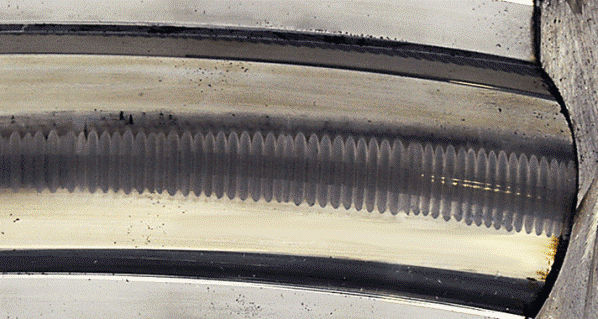 Motor bearing fluting damage caused by VFD power
A: The problem is definitely NOT specific to ABB, or any other manufacturer. Fluting happens to motors on all brands of drive. We don’t know of any exact statistics, but we estimate that something like 50% of all unprotected motors on drives will get it.
Whether electrical bearing damage happens or not is partly random. But there are known contributing factors. Having a poor frame-to-ground connection can definitely make it worse.
As for the room’s ground, a mechanical room should have less than 5 ohms resistance. You should definitely test the ground quality, or have a contractor do it, because if the resistance to ground is too high, then AEGIS rings won’t work. If you had 50 ohms, say, between the room and the building ground, that’s not good.
The next step would be to check the individual motors’ grounds. If those have high resistance, you might try a high frequency grounding strap. Common mode chokes or cores can also help.
Q: Does using a grounding ring also require a grounding strap?
A: Not necessarily, but we recommend it. There are two things going on here. First, there’s current flowing through the ring from shaft voltage, and you want to give it the easiest path to ground that you can.
Second, grounding straps reduce another kind of bearing current, called rotor ground (RG) current. (Some people confusingly call this « shaft grounding current. ») You get RG current when the motor is less well-grounded than the equipment it’s driving. This damages the motor’s bearings and can damage the equipment’s bearings too. In this situation, you want to electrically bond the motor frame and the equipment, and you do that with a grounding strap. This way, current flows from the motor frame through the strap to the equipment, instead of arcing through the motor bearings and moving down the shaft to it.
Q: I’ve found that fluting is more prevalent in motors in older facilities, as opposed to new construction. Retrofitting may overwhelm existing grounds. Do you have any evidence or experience with this?
A: There’s not 100% correlation here, but if you have a 30 year old building & you install drives, you’re going to use what’s already there. Old, degraded grounds will have higher resistance and make stray currents more likely. Contrast this with a new building, where drives are specified upfront. In new construction, the grounding & other systems will be specified to be able to stand up to drive power.
Q: What information do I need to specify AEGIS Shaft Grounding Rings for motors on variable frequency drives?
A: All of the information you need is on our specs page here. The first pdf listed there has our recommended specification language. The second is a copy of the CSI’s Division 23 section 05 13, Common Motor Requirements for HVAC motors, with our best practices added in.
Q: I once specified shaft grounding rings for industrial fans. Due to leadtime, the contractor asked if he could use a magnetic core instead. How do these cores work, & are they a suitable substitute for grounding rings?
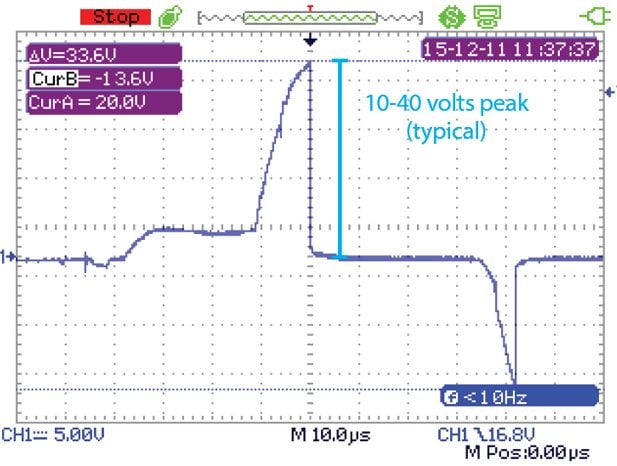 Without shaft grounding, shaft voltage builds up and then collapses by arcing through the bearing. Common mode chokes do not affect this process.
A: These cores are common mode chokes.
This gets pretty technical, so we are going to devote an entire blog post to it. For now, the short answer is:
Chokes reduce rotor ground currents in poorly grounded motors, and high frequency circulating currents in large motors (100 hp/75 kW plus). But they DON’T reduce capacitive shaft voltage, so you still get arcing through the bearings. We’ve got videos of this. The videos show a motor with common mode chokes, and you can see the shaft voltage slowly rise and then suddenly drop, which means that it’s arcing through the bearing. That’s going to cause damage. You don’t see this buildup and discharge with AEGIS rings. AEGIS keeps the shaft voltage too low to arc through the bearing.
As for rotor ground and circulating currents, chokes probably do at least reduce damage. There are unbiased experts who recommend them for these types of bearing current. Some of their manufacturers’ and distributors’ claims are questionable, though, and we should point out that chokes do not come with a warranty against bearing damage.
AEGIS Rings also come with a 2-year extended warranty against bearing fluting damage. No other form of protection against VFD-caused bearing damage offers a warranty like this.
To learn more about AEGIS shaft grounding and best practices for electrical bearing protection, sign up for a training. We offer monthly live training webinars, and – pandemic restrictions permitting – we can also visit your facility to review your exact application.
How Do Shaft Grounding Brushes Compare with AEGIS Rings?
Motors run by variable frequency drives can fail due to electrical bearing damage. Several products have been developed over the past 20 years to deal with this problem. In this article, we’re going to look at just two: Carbon shaft grounding brushes and AEGIS® Shaft Grounding Rings.

Carbon brushes have been around for over 100 years, and are mostly used in dc motors’ commutators. They are an old technology that was repurposed to address a new problem.
AEGIS Rings, on the other hand, were developed specifically to prevent electrical bearing damage.
One obvious difference is size and shape. Carbon brush holders are close to an inch (2.54 cm) thick, while AEGIS rings are only about 3/10″ (7.5 mm) thick. This makes AEGIS rings a much better fit for close-coupled installations.
Carbon brushes are relatively high-maintenance. They use springs in a holder to press the brush against the motor shaft. No matter how ingeniously designed the holder is, the assembly must be inspected and adjusted occasionally to maintain good shaft contact. AEGIS Rings, on the other hand, are all of one piece. The ring holds an array of conductive microfibers around and lightly touching the shaft. No adjustment is needed.
AEGIS Rings also show very little wear. Lab testing estimates a usable lifetime of 200,000 hours. Carbon brushes, on the other hand, do wear. Sometimes, quite a lot. This wear has other drawbacks beyond the need for occasional maintenance and/or replacement.
Firstly, between wear and maintenance requirements, carbon brushes should not be installed inside motors. We have seen bearings fail due to grease contamination by carbon powder worn off of grounding brushes. The dust can potentially damage the windings, as well. AEGIS Rings CAN be installed inside motors. Several motor manufacturers offer lines with AEGIS factory-installed internally.
Because they can’t be installed inside motors, carbon brushes also can’t be used in washdown duty or explosion-proof motors. In contrast, LEESON/Regal Beloit offers washdown duty motors with AEGIS inside, and UL has approved a set of procedures for installing AEGIS Rings inside XP motors. XP motors are also available with AEGIS factory-installed. Marathon Motors (Regal Beloit) installs AEGIS rings in Hazardous Duty™ motors with part numbers ending « -P. » AEGIS rings are available as a mod in WEG and Baldor (ABB) explosion-proof motors.
In fairness, AEGIS Rings are not perfect. Carbon brush manufacturers note that new brushes decrease shaft voltage more than AEGIS Rings. This is true, but only when the carbon brushes are new:
Over the space of a few months, a film called the patina builds up on the shaft. The patina is necessary for the brush to slide smoothly along the shaft and is beneficial for dc charge transfer. But tests have shown that the patina increases the impedance (resistance) for high frequency ac. So as the patina builds up, the brush can less effectively discharge high frequency shaft voltage.
On the other hand, AEGIS Rings hold the shaft voltage steady at less than 5V peak. Moreover, shaft voltage under 5V does not cause appreciable damage. And you don’t need to take our word for it. Among other sources, that 5V limit comes from GKE, inventor of the Bearing Predictor « Beppe » and one of the world’s experts on electrical bearing damage.
So, while no form of shaft grounding is perfect, AEGIS Rings offer several unique advantages that make them the best option on the balance.
 Carbon dust from the shaft grounding brush shown above, with mounting screws for perspective
AEGIS Rings also come with a 2-year extended warranty against bearing fluting damage. No other form of protection against VFD-caused bearing damage offers a warranty like this.
To learn more about AEGIS shaft grounding and best practices for electrical bearing protection, sign up for a training. We offer monthly live training webinars, and we can also visit your facility to review your exact application.
A New Technical Reference for Condition Monitoring
Enhancing System Reliability through Vibration Technology, by James Sylvester, is a 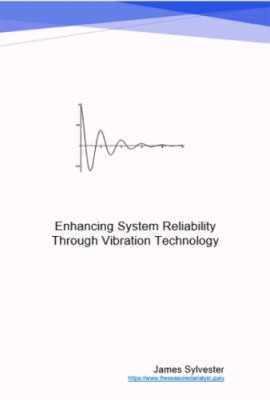 new manual of predictive maintenance techniques. This handbook is written with hands-on mechanical tradesmen in mind. But managers, especially maintenance managers, will also find it useful, particularly the first few chapters.
The book focuses throughout on real-world applications and case studies, rather than theory. As the title implies, the book focuses on vibration analysis. But it also touches upon other nondestructive tests, like thermography, ultrasonic inspection, and shaft voltage testing.
The text is broadly divided into five Parts: Introduction to Condition-based Maintenance; Condition Monitoring Management Processes; Vibration Analysis Condition Monitoring Techniques; Performing Vibration Analysis; and Balancing. There is also an Appendix comprising 17 case studies. The full table of contents is listed on the order page.
In addition to those in the appendix, there are dozens of mini-case studies and applications throughout the other chapters. Further, in keeping with the real-world focus of the book, almost every illustration is taken from a real-life situation. For example, here is electrical bearing damage to a VFD-controlled motor without proper bearing protection:
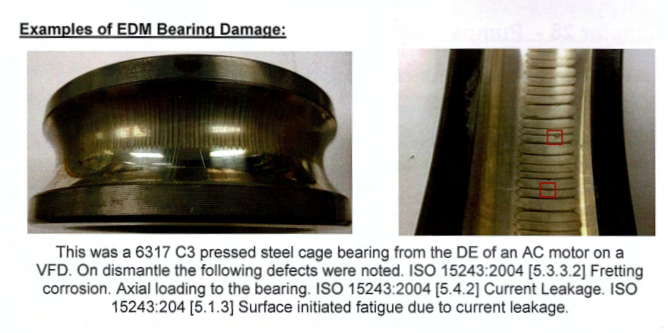
For more detail, see the text’s brochure. Or to order your copy, see the Training Materials page at theseasonedanalyst.guru.
For more information on electrical bearing damage, see the AEGIS® Shaft Grounding Rings or the other articles on this blog.
AEGIS Rings also come with a 2-year extended warranty against bearing fluting damage. No other form of protection against VFD-caused bearing damage offers a warranty like this.
To learn more about AEGIS shaft grounding and best practices for electrical bearing protection, sign up for a training. We offer monthly live training webinars, and we can also visit your facility to review your exact application.
Prevent Downtime with Electrical Bearing Protection
More and more electric motors are being controlled by variable frequency drives (VFDs). VFDs offer many advantages over across-the-line power. Depending on the application, these include
- Reduced inrush current
- Smooth acceleration & deceleration
- Precise speed control
- Adjustable speed and torque
- Reduced need for power transmission equipment (e.g., gearboxes)
- Large energy savings
But drives have their drawbacks, too. Among other things, 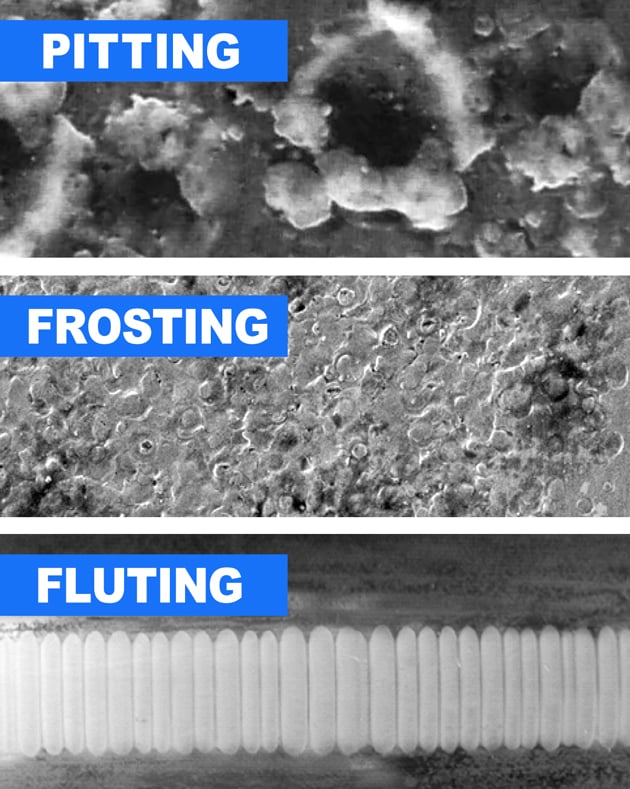 VFD power produces stray currents that cause electrical bearing damage. The damage starts as microscopic pits in the bearing race walls from electrical arcing. Over time, pitting accumulates until the races are “frosted,” and no longer smooth. They eventually develop a ridged pattern called fluting.
By the time a bearing is fluted, failure is imminent, and production must shut down while the motor is repaired or replaced.
There are three types VFD-induced bearing current, and they affect motors of different sizes and in different situations:
- Shaft voltage discharge occurs when the VFD’s output creates a voltage difference between the motor’s rotor and frame. The voltage builds up until it arcs through the bearing. This type of bearing current affects all motors on drives, regardless of size.
- High frequency circulating currents are caused by high frequency magnetic flux inside the motor. They circulate from frame to shaft, through both bearings. These are a problem for ac motors over 100 hp (75 kW) and dc motors over 10 hp (7.5 kW).
- Rotor ground currents occur when there is no low-impedance path from the motor frame back to the VFD. Seeking a low-resistance path, current leaves the frame by arcing through the bearings, moves down the motor shaft into the driven equipment, and then makes its way back to the VFD.
Fortunately, there are solutions to all of these problems:
- Shaft voltage discharge currents can be diverted away from the bearings with an AEGIS® Shaft Grounding Ring. AEGIS rings provide a path of least resistance between the motor shaft and frame, so current travels through the ring instead of through the bearings. Small motors require one AEGIS SGR ring. For ac motors over 600 V or 500 hp (375 kW), and dc motors over 300 hp (225 kW), the larger AEGIS PRO Ring is recommended.
Because shaft voltage discharge is a problem in all motors on VFDs, AEGIS rings are also necessary in the following cases:
- For ac motors over 100 hp and dc motors over 10 hp, using one hybrid, ceramic, or insulated bearing will interrupt circulating currents.
- Rotor ground currents can be dealt with by using special shielded VFD cable or by bonding the motor to the drive and/or its driven equipment with high frequency grounding straps.
AEGIS Rings also come with a 2-year extended warranty against bearing fluting damage. No other form of protection against VFD-caused bearing damage offers a warranty like this.
To learn more about AEGIS shaft grounding and best practices for electrical bearing protection, sign up for a training. We offer monthly live training webinars, and – pandemic restrictions permitting – we can also visit your facility to review your exact application.
TECO-Westinghouse Motors with AEGIS Shaft Grounding
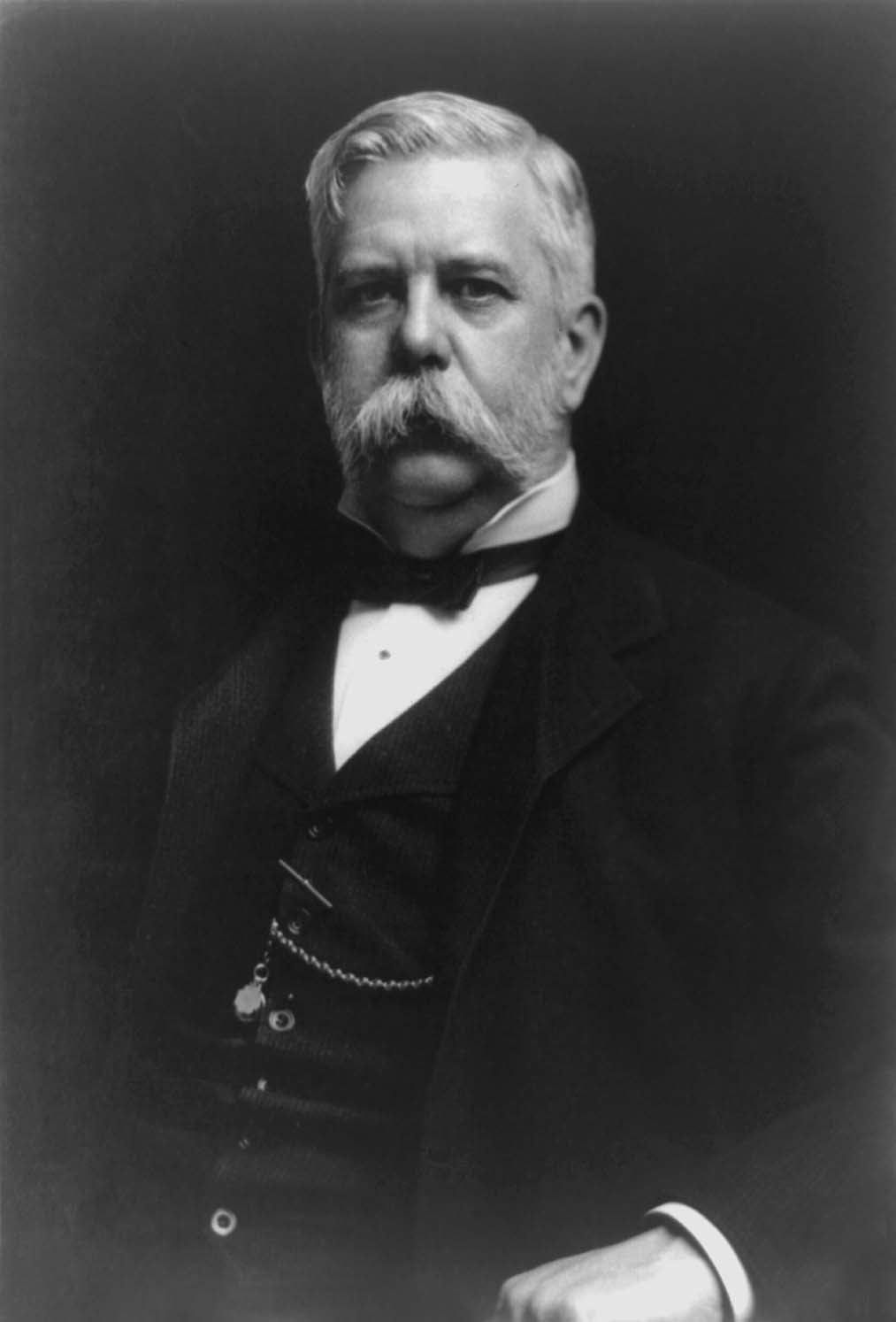 Westinghouse Electric is one of the best-known and longest-lived brands in the world. Westinghouse was founded in 1886 by George Westinghouse, one of the pioneers of ac power (and a principal combatant in the Current War). The company has amassed over 130 years of experience and knowledge in all things electric.
WIn 1997, Westinghouse Electric’s motor division was acquired by Taiwan Electrical Company (TECO) and renamed TECO-Westinghouse Motor Company. The name may be different, but the expertise hasn’t changed. TECO-Westinghouse remains a leading name in electric motor manufacture, from less than one to one hundred thousand horsepower.
Since TECO-Westinghouse’s rebranding, variable frequency drives (VFDs) have become very common. Using VFDs to control electric motors has many benefits, but there are also drawbacks. One serious drawback is that drives can electrically damage the motor bearings. If the motor is not properly protected, this leads to premature bearing failure and downtime.
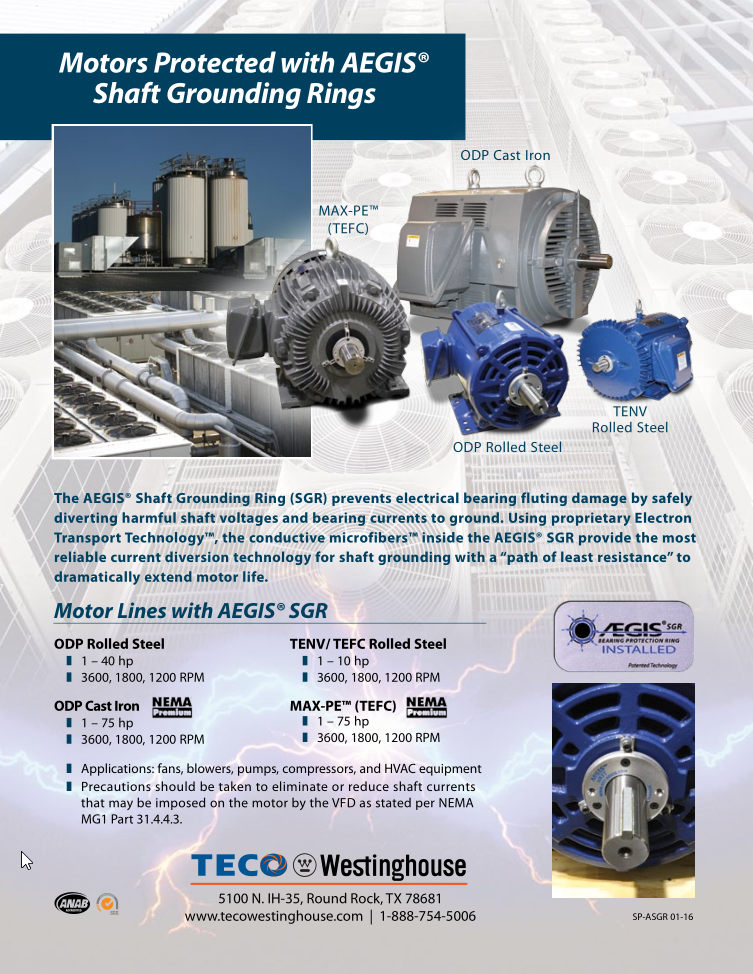 TECO-Westinghouse has been aware of this problem for many years. That’s why they offer motors with factory-installed AEGIS® Shaft Grounding Rings. AEGIS rings bleed stray voltage off of the motor shaft, before it can build up enough to arc through the bearings. AEGIS rings are available standard in the following lines of TECO-Westinghouse motors:
- Open Drip Proof (rolled steel and cast iron)
- Totally Enclosed Fan-Cooled (rolled steel)
- MAX-PETM (NEMA Premium Efficiency)
The next time you need a new motor that will be run on a drive, consider a TECO-Westinghouse motor with an AEGIS ring factory installed.
AEGIS Rings also come with a 2-year extended warranty against bearing fluting damage. No other form of protection against VFD-caused bearing damage offers a warranty like this.
To learn more about AEGIS shaft grounding and best practices for electrical bearing protection, sign up for a training. We offer monthly live training webinars, and we can also visit your facility to review your exact application.
Marathon Motors with Bearing Current Protection
 In its long history, Marathon Motors has seen some changes. When they produced their first washing machine motor in 1913, wireless meant staticky AM radio and « motored vehicles » had not yet displaced the horse-drawn carriage. Now, 100+ years later, most kids have never seen a horsecarriage, but they can use wireless to find a picture of one. So times have changed, but Marathon is still doing what they’ve always done: Making high quality motors to fill the needs of the changing world around them.
One big change has been the shift from powering motors across the line to controlling them with various digital controllers like variable frequency drives (VFDs). VFDs are great for precise control, limiting inrush current at startup, and saving energy, but the pulses of voltage they put out can burn out motor stator windings if they’re not properly insulated. In response to this new development, Marathon developed their patented MAX GUARD® insulation system, which surpasses the most stringent requirements for winding protection.
But the windings aren’t the only part of the motor that’s vulnerable to damage by VFDs. VFD output can also create a voltage difference between the motor shaft and ground. That voltage often discharges through the motor bearings, and this current flow through the bearing causes electrical damage and eventual bearing failure. A failed bearing requires the expense of repair or replacement, plus the greater expense of unscheduled downtime. But not to worry: Marathon has a solution for bearing currents, too.
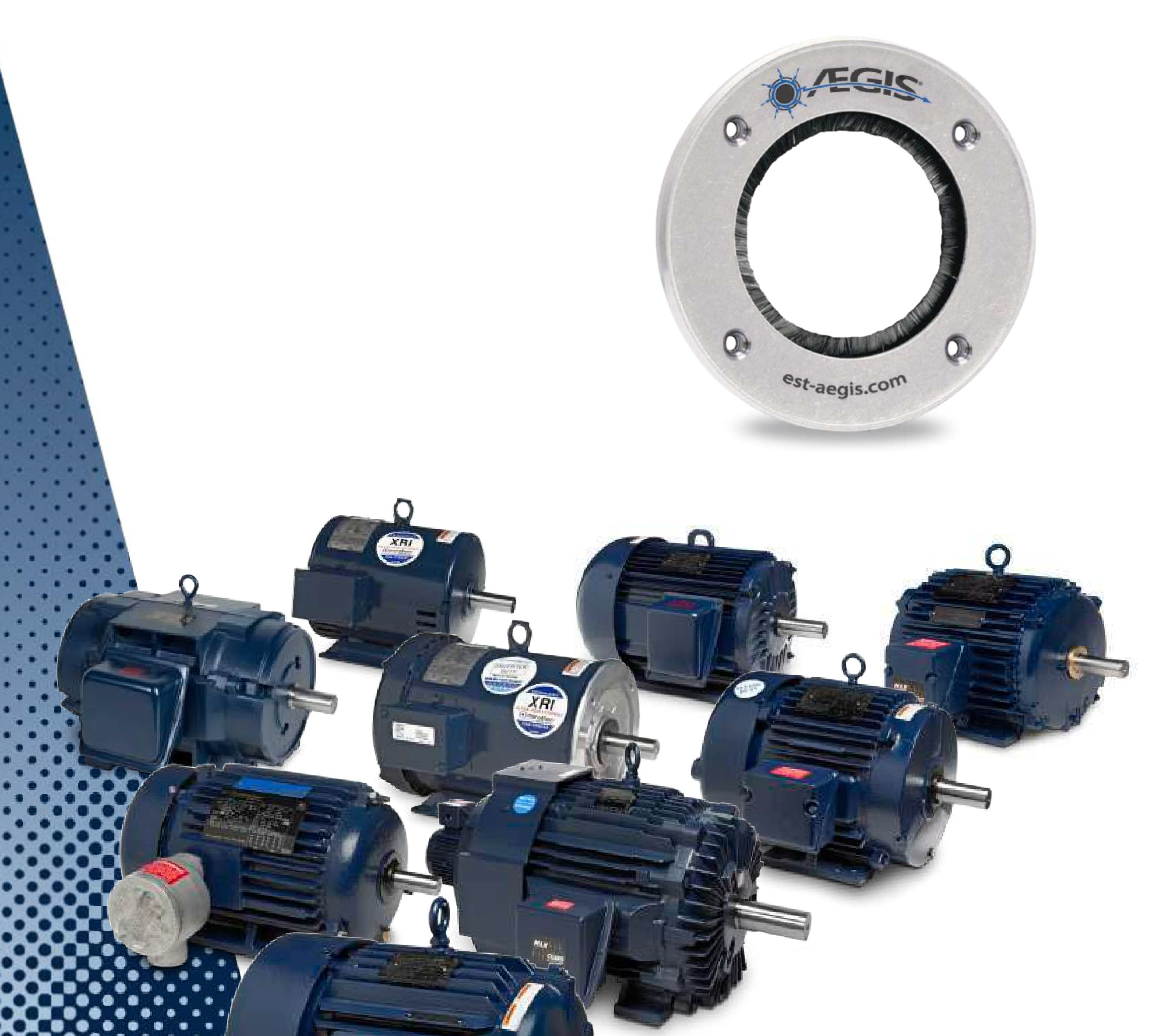
Marathon’s Bearing Current Protection (BCP) usually consists of an AEGIS® Shaft Grounding Ring that gives electric current a low- resistance path between the shaft and frame. Rather than arcing through the bearings, currents flow harmlessly through the ring. AEGIS Rings are available as a mod on all Marathon motors, and are also incorporated standard into many models. AEGIS BCP comes stock in:
- General Purpose NEMA Premium Efficiency XRI Motors in ODP and TEFC frames
- Blue Chip NEMA Premium XRI Explosion Proof Motors
- Blue Max Vector Duty Motors
- Blue Chip NEMA Premium XRI-SD Severe Duty Motors
- Blue Chip NEMA Premium XRI-841, IEEE-841 Motors
- Blue Chip TEAO Cooling Tower Motors
ALL Blue Max Vector Duty Motors and TEAO Cooling Tower Motors include AEGIS. For the other groups, only motors whose catalog numbers end with « -P » have BCP. For part numbers of each motor line, click on the links above. Or you can easily find all Marathon Motors with AEGIS inside at Industrial Matrix.
AEGIS Rings also come with a 2-year extended warranty against bearing fluting damage. No other form of protection against VFD-caused bearing damage offers a warranty like this.
To learn more about AEGIS shaft grounding and best practices for electrical bearing protection, sign up for a training. We offer monthly live training webinars, and – pandemic restrictions permitting – we can also visit your facility to review your exact application.
Geothermal Systems Need Shaft Grounding
When people think of renewable power, wind and solar usually come to mind. But there are other fully sustainable power generation methods. One that’s rapidly becoming more important is geothermal power. There are a few different geothermal generation schemes, but they all involve pumping hot water out from deep in the earth and using its heat energy to spin a turbine. (Geothermal energy can be used for district heating as well.)

Like wind and solar, geothermal energy has low-to-no CO 2 emissions. But geothermal also has the big advantage that it’s always on. The sun goes down, and wind comes and goes, but the center of the earth is always hot. That heat can be used to generate electricity at any time, day or night, breezy or calm. As of 2015, geothermal power produced 12.8 gigawatts (GW) of electricity. By 2020, that total is expected to reach 14.5-17.5 GW.
But geothermal generation also has problems. Good sites can be difficult to find. And the steamy and briny conditions at running plants are corrosive, both to pumps and the motors that drive them. More about those motors: Geothermal plants run 24/7, and demand for electricity (and heat) varies daily (and seasonally). So the pump-driving motors need to be run at variable speed. Faster when demand is high; slower when it’s low. Usually the motors’ speed is controlled by variable frequency drives (VFDs). But VFD operation causes problems of its own.
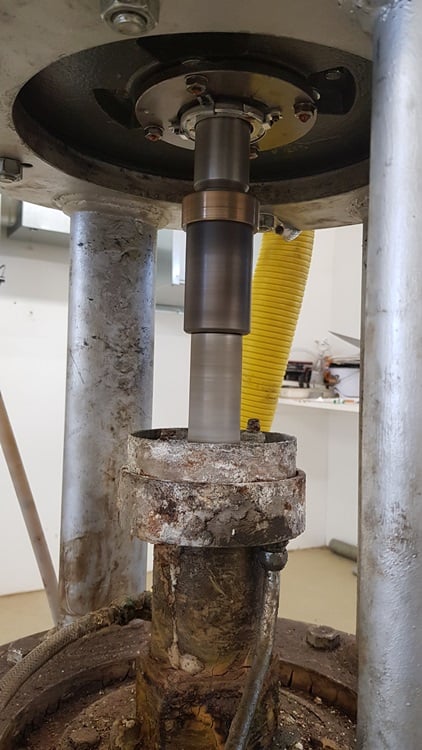
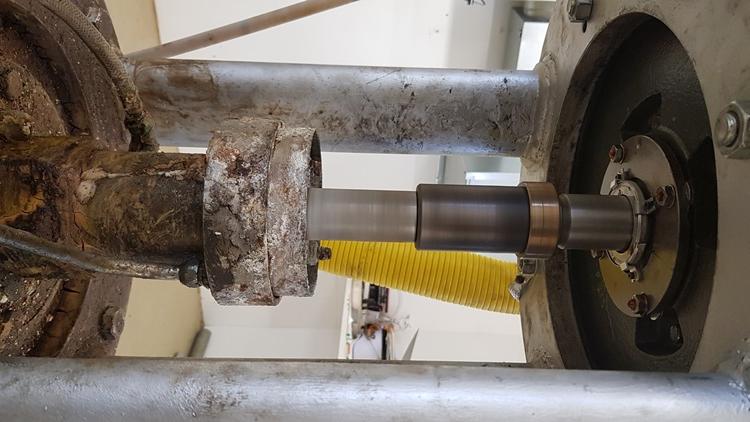
The pulses of power that VFDs put out create voltage on the shafts of the motors they control. If shaft voltage builds up high enough, it will arc through the motor or pump bearings, causing electrical damage. This damage builds up over time, and causes premature bearing failure. When the motor or pump bearings fail, they must be replaced, an expensive operation. The failure may also cause unplanned downtime and massive loss of revenue.
The solution is to provide a low resistance path from the shaft to ground. This is exactly what AEGIS® Shaft Grounding Rings provide. With an AEGIS ring installed, charge flows safely through the ring, instead of discharging through a bearing. For motors up to 100 hp (75 kW), an AEGIS ring is all the electrical protection you need. Larger motors need an AEGIS ring along with one insulated bearing. (The insulated bearing protects against circulating currents, which are a problem in larger motors on VFDs.)
AEGIS rings are available factory-installed in several makes and hundreds of models of motor. AEGIS comes installed inside everything from general purpose to explosion proof to vertical hollowshaft motors from makers like US Motors.
AEGIS Rings also come with a 2-year extended warranty against bearing fluting damage. No other form of protection against VFD-caused bearing damage offers a warranty like this.
To learn more about AEGIS shaft grounding and best practices for electrical bearing protection, sign up for a training. We offer monthly live training webinars, and – pandemic restrictions permitting – we can also visit your facility to review your exact application.