

Auteur/autrice : AEGIS
If You Sell Drives, It’s Smart to Recommend Motors with Shaft Grounding
Variable frequency drive users look to drive manufacturers and reps not only for quality products but expertise. If they don’t find the knowledge to fix any problems they run into, they may go to another brand. But more positively, the more expertise you show, the more you build their loyalty. And if you can stave off any problems they might later run into, so much the better.
One way that drives salespeople and reps already do this is by recommending using inverter-duty motors (with Class F or H insulation) with drives. Drives protect the motor windings from turn-to-turn shorts due to the VFD output’s high dV/dt. Some motors, on some drives, in some applications, will be alright with Class B insulation, but why take the chance?
The Problem of Shaft Voltage
Burnt out windings aren’t the only risk that drives pose to motors. The common mode voltage of the three phases capacitively creates a potential difference between the rotor and motor frame. This so-called shaft voltage can discharge destructively through the bearings, often drastically shortening bearing life. Now, is every motor running on a VFD going to have its bearings fail prematurely? Maybe not, but why take the chance? Why not just avoid the problem altogether?
The best and easiest way to prevent this premature bearing failure is to recommend that your customers use motors with AEGIS® Shaft Grounding Rings factory-installed. AEGIS Rings discharge shaft voltage safely to ground, channeling the discharge currents around the bearings. These long-lived rings protect:
- motors from premature bearing failure
- your customers from the expense of repair/replacement and associated downtime, and
- you from customers understandably angry that their new motor failed after just a few months
Best of all, by warning customers of this problem, and solving it, you will be showing your expertise, and continuing to earn their loyalty.
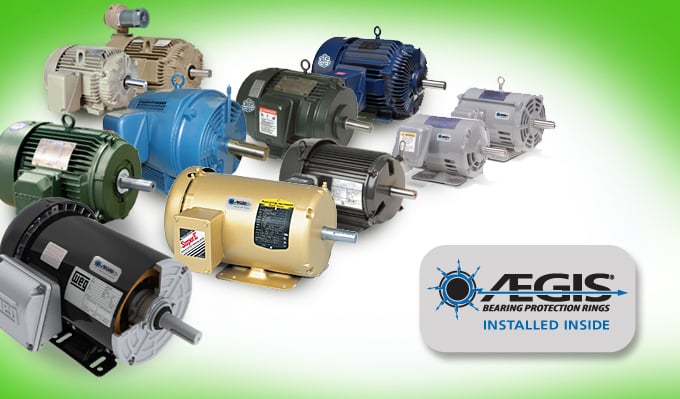 Motors with AEGIS factory installed are available from ABB Motors & Mechanical, WEG Electric, Marathon, TECO, LEESON, GE, and many more
For more on the problem of capacitively coupled bearing current and its mitigation with AEGIS rings, see our Bearing Protection Handbook. Or even better, you can request a Lunch & Learn training, worth one Professional Development Hour.

In medium voltage motors, bearing related failures can account for 41% of faults
The presentation « Medium Voltage Induction Motor Protection and Diagnostics, » published online by the Georgia Institute of Technology in Atlanta is worth the time it takes to study it in detail!
The presentation authored by Yi Du, Pinjia Zhang, and Prof. Thomas G. Habetler from the School of Electrical and Computer Engineering.
This excellent and highly detailed presentation discusses:
- Heat transfer inside motors
- Thermal model-based approaches
- Parameter model-based approaches
- Other approaches
An area of my interest was in the last section of the presentation starting on slide 43 « Overview of Fault Diagnostics for MV Motors » In this slide the authors attributed 41% of medium voltage motor failures to bearing failures, listing among other causes « electrical stress. »
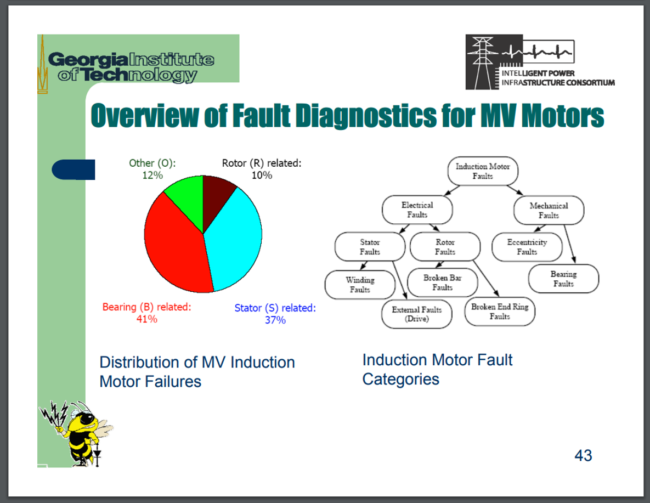 Slide 43 of Du, Zhang, and Habetler’s presentation
There is also an informative flow chart of induction motor fault categories.
Later, on slide 47, the authors include the following statement: « bearing failure is the most common fault for medium voltage motors, » and list the following reasons:
- Reasons for Bearing Failure
- Electrical Stress:
- Stator, rotor or input voltage unbalance causes unbalanced magnetic flux, which induces shaft current, and the potential voltage between bearing and ground.
- Mechanical Stress:
- Friction and rotor eccentricity can cause mechanical failure of bearings.
- Thermal Stress:
- Overheat causes the failure of lubricant, which leads to friction.
- Electrical Stress:
Protecting MV motor bearings and when possible preventing failure modes would directly contribute to improving uptime and reliability, and ultimately save money – which was the subject of my blog post « Why protect medium voltage motors from bearing currents? It saves money!«
Enjoy the read!
Grounding of HVAC motor shafts protects bearings, lowers repair costs
Read the entire story at Healthcare Facilities Today about how preventing VFD-driven motor bearing failure in HVAC motors improves operations and cuts operating costs in hospitals.
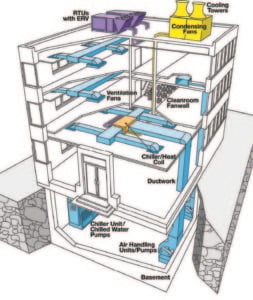 HVAC systems using VFD driven Motors in Hospitals
Energy Efficiency and Sustainable Operations
Maximum energy efficiency is the cornerstone of a long and growing list of building certification initiatives such as LEED, Green Globes, Zero Energy Buildings, Living Building Challenge, and Energy Star for Buildings.
Variable frequency drives (VFDs) are a crucial tool in achieving this energy efficiency. By allowing motors to run at less than full speed, VFDs match HVAC system capacity to changing heating/cooling loads, dramatically reducing energy costs. But VFDs damage the bearings of motors they control – often in as little as three months! To ensure the reliability of VFD-driven HVAC motors and lock in energy savings, proven long-term bearing protection is essential.
VFD-induced currents destroy bearings, kill motors
For years, the actual cause of VFD-induced bearing failure was often misdiagnosed. High peak voltages, fast voltage rise times, non-sinusoidal shaft currents, and parasitic capacitance associated with typical pulse-width-modulated VFDs lead to the cumulative erosion of bearings. Today, the VFD-induced electrical bearing damage is the most common cause of bearing failure in VFD-controlled AC motors.
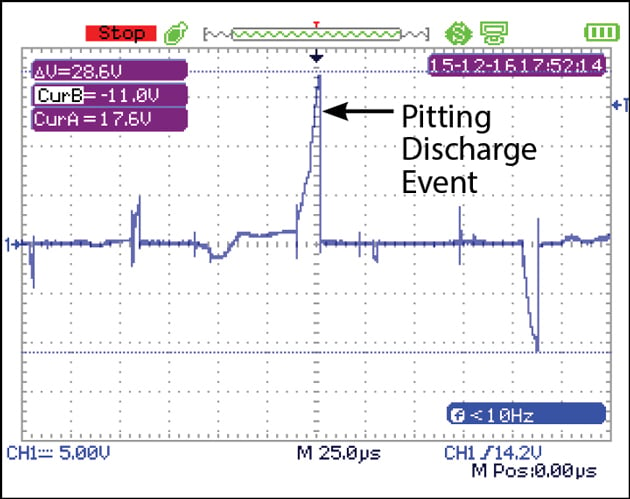 Shaft voltage showing pitting event
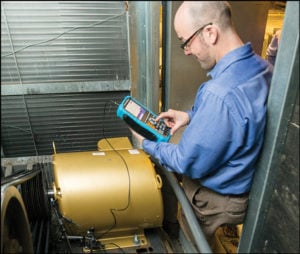 Technician taking shaft voltage measurement in a HVAC system
Without mitigation, voltages repeatedly build up on the motor shaft, then discharge in short bursts along the path of least resistance, which all too often runs through the motor’s bearings. The discharge rate tends to increase with the carrier frequency.

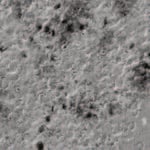 Figure 1: Bearing race with pitting damage
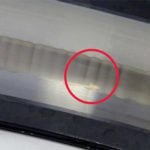 Figure 2: Bearing with fluting damage
Continued discharges result in the pitting [Figure 1] of the balls and race walls through electrical discharge machining (EDM). Concentrated pitting at regular intervals along the race wall causes washboard-like ridges called fluting [Figure 2], a source of vibration and noise that reverberates through ductwork.
By the time such damage can be heard, bearing failure is often imminent.
Shaft grounding proven effective on a rooftop unit
These rings recently proved effective in protecting motors of a packaged rooftop HVAC unit typical of those installed on commercial buildings. The unit’s VFD-controlled motor runs a belt-driven fan. Technicians from Electro Static Technology (the manufacturer of AEGIS Rings) took voltage readings — both before and after installing the ring on the motor’s shaft — using a voltage probe and a portable oscilloscope.
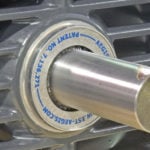 AEGIS Ring installed with Conductive Epoxy (EP2400)
In a continuous 60-µsec trace with the motor running at 3,600 rpm (80Hz output), discharges from the shaft were 44.8 volts peak-to-peak, high enough to cause pitting of the motor’s bearings. After installing an AEGIS Shaft Grounding Ring, follow-up readings at 3,600 rpm showed discharges of only 3.76 volts peak-to-peak, well below levels that damage bearings.
Conclusion
Operations and maintenance costs can account for 60 to 80% of a facility’s life-cycle costs. When HVAC equipment does not have to be repaired or replaced as often, this percentage drops significantly.
VFDs hold the promise of sizable energy savings, but without effective, long-term bearing protection these savings are wiped out by high maintenance costs. By diverting bearing currents safely to ground, AEGIS Rings extend motor life and ensure the reliable, long-term operation of VFD-driven systems, locking in energy savings, and making these systems sustainable.
Why protect medium voltage motors from bearing current? It saves money!
Using variable frequency drives (VFDs) or inverters to control the speed of large electric motors is not only a flexible, cost-effective means of improving process/system control. It can also significantly reduce energy costs, which can be 80% to 90% of the total cost of ownership. The inverter allows for variable speed operation of the motor, increases the control level and operating efficiency of the drive systems to meet the process control requirements, and reduces motor energy consumption – creating energy savings.
Bearing with fluting damage
 Bearing with frosting damage
VFD Drawbacks
But VFDs also have their drawbacks. The high-speed switching output of the inverter can produce a capacitive voltage on the shafts of these large AC motors. Since even relatively low voltage of 10 volts peak can discharge through the motor’s bearings, it is essential to include a highly reliable shaft grounding system to avoid electrical arcing in the motor’s bearings. In unprotected motors, this arcing causes electrical discharge machining (EDM) that blasts pits in bearing surfaces. This EDM process eventually leads to frosting and fluting (washboard-like ridges on the bearing race), and bearing failure.
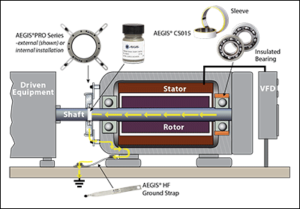 It is not enough to only ground the motor’s shaft, because high frequency circulating currents could also cause electrical discharges in the motor’s bearings. Therefore at a minimum one bearing must be insulated (usually on the non-drive end) in these large motors.
Bearing insulation or a ceramic coated or hybrid bearing will interrupt the circulating current path which would otherwise circulate through the motor’s bearings. Insulation removes this source of bearing failure. But because the capacitively coupled voltage is still there on the motor’s shaft, a shaft grounding ring is still needed, and should be installed on the opposite end (the drive end side).
High Cost of Bearing Failure
 Consider the many costs needed when deciding on bearing protection. Not only is the cost of a motor repair very high, but process downtime and interruptions can dramatically affect the bottom line and erode profits.
While some large motors can be repaired on-site, many must be pulled out of service, loaded onto a truck (often requiring a crane), and transported to a specialist for repair. This process is time-consuming and very expensive, costing many thousands of dollars. And the larger the motor, the higher the cost of replacing damaged bearings.
But the cost of repairing motors often pales in comparison to the staggering costs of downtime and lost production! Larger motors are used typically in high volume processing applications. In these applications, the cost of every minute of lost production is considerable. Over the course of days of downtime, lost production can add up to staggering levels!
 AEGIS PRO Series Shaft Grounding Rings for medium voltage and large low voltage motors
AEGIS® PRO Rings protect medium-voltage motors, generators, and turbines, as well as large-frame low voltage AC motors (500 HP or higher) and DC motors (300 HP or higher).
PRO Rings are available in solid- and split-ring versions for shaft diameters from 2.5 to 31.5-inches (50 to 800 mm). They have six rows of conductive microfibers that encircle the motor shaft entirely, providing millions of contact points that channel harmful shaft voltage away from bearings and safely to ground. A full description and features are in the AEGIS PRO Ring section of the product pages on our website.
How Much Does Downtime Cost? Find Out with Eaton’s Downtime Cost Calculator.
Eaton Electrical published an article today; entitled Downtime can be disastrous. While the article focused on data centers and their need for uninterruptible power supplies (UPSs), the general lesson applies to every business: Downtime, especially unplanned downtime, is so expensive that predictive maintenance programs are a must.
But the most interesting thing about the article was a link to a web app that Eaton developed: The Downtime Cost Calculator. You fill out an interactive form with business-related quantities like annual revenue, number of employees, and so on. Then the application automatically calculates your cost 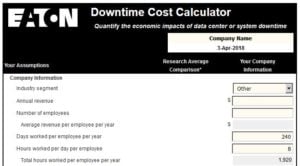 of downtime, broken down into cost per event, cost per hour, and even cost per minute!
This may be a handy tool for today’s busy maintenance manager. At the very least, it will help to make the case that preventive maintenance is a good investment!
Upper managers need to understand that decreasing unplanned downtime – and when possible, preventing downtime in the first place – is key to efficient operations and sustaining profitability in every industry.
One example of downtime prevention is installing bearing protection on motors driven by variable frequency drives (VFDs). VFDs can destroy motor bearings in as little as a few months, potentially shutting down production or HVAC systems. This failure is preventable with AEGIS® shaft grounding rings. AEGIS rings can easily be installed in the field or during motor repair. But the easiest and least expensive solution is to buy motors with AEGIS factory-installed.

Five Reasons You Should Use Motors with AEGIS Shaft Grounding Factory-Installed Inside
1. Motors run on variable frequency drives (VFDs) need protection against bearing current
VFDs are widely used for energy savings. But without bearing protection, those savings can be lost. Because VFD output power is not balanced (i.e., the three phase voltages don’t cancel out), VFDs create a capacitive voltage on the shafts of the motors they control. This shaft voltage will try to discharge to ground by the lowest-resistance path available. Usually, the path of least resistance lies through the bearings, so that’s where discharge will occur, in the form of an electrical arc. These arcs create pits in the bearing surface. Although these pits are individually tiny, arcing can occur thousands of times per second, and each arc creates a new pit. The damage due to pitting is cumulative and can cause bearing failure in as little as a few months.
AEGIS® Shaft Grounding Rings offer a lower-resistance path for this discharge current. Because the bearings have higher resistance than an AEGIS ring, these currents preferentially flow through the ring, not the bearing. Without discharge current constantly flowing through the bearing, the bearing will last as long as it was designed to, and users will be spared the costs of frequent motor repair and the downtime it entails. For an ROI analysis of AEGIS shaft grounding, see this post.
2. Internal installation protects the AEGIS Ring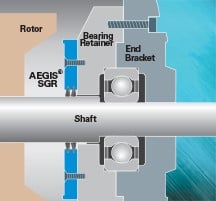
Compared to other methods of shaft grounding, AEGIS rings are highly resistant to contamination and other environmental factors. Nevertheless, excessive amounts of dust, debris, and grease can interfere with the ring’s function, and mounting the ring inside the motor frame protects it from these detrimental influences.
This is especially important in severe environments. In cooling towers, washdown environments, and some potentially explosive atmospheres, internal installation is necessary.
3. Factory installation saves you time
While AEGIS rings are not difficult to install, it’s even easier, and quicker, to buy a motor with a ring already installed.
4. Factory installation saves you money
A motor with AEGIS factory installed will cost less than a similar motor without AEGIS plus the cost of the ring, plus the value of the time it takes to install the ring.
5. You’ve got options
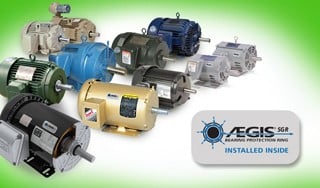
Many of the best-known motor manufacturers offer motor lines with AEGIS factory-installed inside. Baldor-Reliance (ABB), U.S. Motors (Nidec), WEG Electric, LEESON and Marathon (Regal Rexnord), and GE (Wolong) all offer AEGIS inside their inverter duty motors. You can find a full list of motors with AEGIS rings factory-installed here.
If all of that was not enough, AEGIS Shaft Grounding Rings also come with a 2-year extended warranty against bearing fluting damage. No other form of shaft grounding offers a warranty like this.
learn more about AEGIS shaft grounding and best practices for electrical bearing protection, sign up for a training. We offer monthly live training webinars, and we can also visit your facility to review your exact application.
VFD Motor Market Analysis
In GMR Analytics’ VFD Motor Market Analysis report, Global Variable Frequency Drives Analysis, several important market drivers are noted, including global economic growth. « This growth is attributed to the increasing infrastructural activities including construction of hospitals, and educational institutions, strict regulations related to energy efficiency, reduction of life cycle cost, and optimized energy use. »
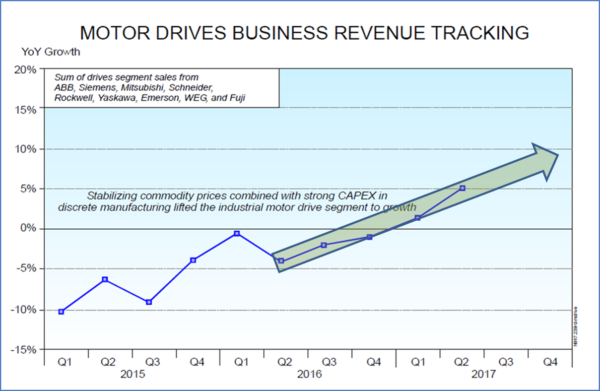 Motor and Drives Market Trend 2017
This growth is evidenced by the number of such projects tracked in the CMD construction database, which saw a five year compounded annual growth rate (CAGR) of 16% between 2013 and 2017 in the US. During those years over 231,000 projects were planned.
 Educational and Hospital Construction Projects between 2013-2017
And because stringent government directives to reduce greenhouse gas emissions have continued to influence the construction market, variable frequency drive (VFD) attachment rates have similarly increased in order to save energy and to meet sustainability targets.
One key question is « What are the current VFD to integral HP motor attachment rates? » This data is not readily available, so we studied several industry reports on integral HP motors to calculate an estimate of the attachment rates for VFDs to integral HP motors.
The actual attachment rates vary in specific global markets. For example, in Asia they were about 21% in 2017, and are expected to grow to 29% by 2021. On the higher side the US VFD attachment rates were about 44% in 2017 and are expected to grow to 60% by 2021. Globally the attachment rate in 2017 was about 31% with a growth expected to reach 42% by 2021.
In some cases, such as air handlers, the attachment rate for VFDs are estimated to be about 80% by some in the industry. Regardless of the specific application, we know that the attachment rates are increasing in many common industrial and commercial equipment categories, including:
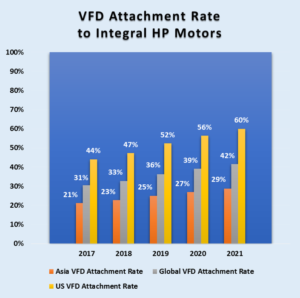 VFD to Motor Attachment Rates
- Fans and air handling equipment
- Air conditioning
- Chillers
- Compressors
- Evaporators
- Pumps
- Refrigeration
- Industrial automation
- Process industries
- Material handling and many others
And it is not only in the high power drives where we see strong growth, but also in low power and medium power drives as well. Average CAGRs for VFDs are expected at 12% between 2017 to 2021.
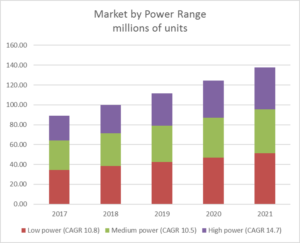 Market Growth in VFD Power Ranges
Motor design and government efficiency standards are also driving this trend. In the US, all electric motors must be NEMA Premium motors, which are not only more efficient but also have winding insulation suitable for VFDs. So one could ask « Does this mean that all motors sold in the US are set up to be operated reliably by VFDs? » The unfortunate answer is no. Motor bearings are often still vulnerable to bearing currents and fluting failure – that is, except for the motor lines which have shaft grounding rings factory installed or added to the motors as a repair or retrofit.
What should be done to ensure motor reliability?
The NEMA Premium motor design requirement does not have a specification for bearing protection. This was likely because initially not all motors were envisioned to run on VFDs, but now with higher attachment rates this situation has dramatically changed. When 40% to 80% of NEMA Premium or IE3 motors run on VFDs, the need for bearing protection built into the motor has become a reliability criterion specified by virtually all designers, consulting and specifying engineers, and even large and small industrial and commercial end users. Of course motors operated by VFDs must also have inverter rated windings, and if they are NEMA Premium they do! This eliminates the problem of winding to winding short circuits caused by insulation breakdown but it does not address the effects that VFDs have on the motor’s bearings.

The bottom line?
Customers WANT this feature built into the motors they purchase or repair.
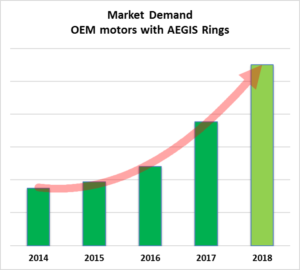 AEGIS Shaft Grounding Ring Demand
Motor manufacturers have stepped up to the plate. Today ABB (Baldor), WEG Electric, Marathon, LEESON, TECO Westinghouse, GE Industrial, and some Nidec motors have product lines with shaft grounding rings as standard catalog items. Others have an option program to add shaft grounding rings to the motors. Demand is growing exponentially for motors with shaft grounding rings installed by the manufacturer; tens of thousands of specifications are written requiring shaft grounding rings for new construction projects, often specifying that AEGIS shaft grounding rings be used because of their long service life and extreme reliability.
Market Trend Conclusions
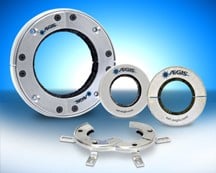
With the attachment rates of motors on VFDs increasing globally and specifically in the US and Europe reaching 60%+ in five years, the shift to a demand for « true inverter duty motors, » those with both winding and bearing protection, continues to become the industry standard. End users are demanding motors that last, with reliability built-in and lower Total Cost of Ownership (TCO) while still capturing energy savings from the VFD. With our customers moving to add AEGIS Shaft Grounding Rings to all new and repaired motors, we are constantly being asked « Why don’t all motors just come with AEGIS rings installed? »
Baldor is now ABB – and their Shaft Grounding Motors with AEGIS Rings Installed are still what you need for VFDs
Baldor Electric Company, a member of the ABB group for more than seven years, will be known as ABB, but their shaft grounding motors with AEGIS Rings installed stay the same!
Greg Scheu, President of the Americas for ABB stated in the announcement “The company will continue to invest in the products it makes here, as well as the people responsible for their manufacture. Our U.S.-based motor and mechanical portfolio will be included within our broader portfolio of ABB Ability™ digital solutions.”
ABB is a global leader in motor and drive technology and ABB’s portfolio of Shaft Grounding Motors, particularly those with AEGIS Rings installed (the Super E line with the part number ending in « -G »), have contributed to the company’s success.
What is a « Shaft Grounding Motor? »
It is described as follows: For an off the shelf solution, to meet an HVAC specification for new construction, or if replacing a motor that has fallen victim to bearing fluting due to shaft currents, Baldor (now ABB) Shaft Grounding motors will ensure a long smooth service life. Shaft Grounding motors feature bearing current mitigation devices (such as AEGIS Shaft Grounding Rings) mounted internally, shielding them from dust and other contaminating elements.
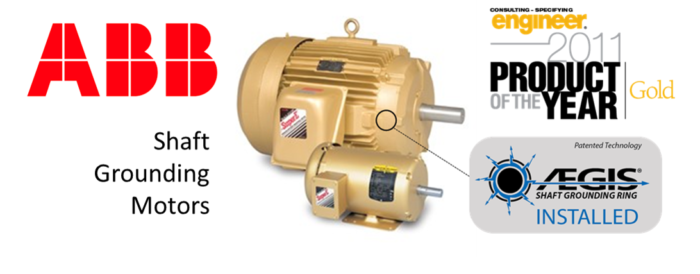
In 2011 the Super-E® Baldor motor with AEGIS Shaft Grounding Rings installed won the GOLD – the top prize for Consulting and Specifying Engineer in their Product of the Year competition. Since then, Baldor (now ABB) has expanded the product line so that shaft grounding motors with AEGIS Rings installed are readily available from stock for any General Purpose or HVAC system or equipment.
ABB has the following catalog motors available « off the shelf » and in stocking locations natiowide:
Super-E Motors with AEGIS Bearing Protection Ring 1-100HP 56 thru 405T
- TEFC Motor list with cross reference and link to the motor’s information page
- ODP Motor list with cross reference and link to the motor’s information page
- C-Face Motor list with cross reference and link to the motor’s information page
- Applications: Heating, Ventilation and air conditioning blower and fan motors, pump motors, and general purpose applications using an adjustable speed drive
- AEGIS Bearing Protection Ring installed internally
- Download datasheet
Super-E Pump Motors with AEGIS Bearing Protection Ring 1-20 HP 143JM thru 256JM
- Applications: Close-Coupled pump motor applications using adjustable speed drives
- AEGIS Bearing Protection Ring installed internally
- Download datasheet
ABB (formerly Baldor), is located in Fort Smith, Arkansas where they manufacture energy-saving, industrial electric motors, drives, mechanical power transmission products and generators. They offer AEGIS Shaft Grounding Rings in their Super-E product line. End-users can buy off-the-shelf motors equipped with a pre-installed AEGIS Bearing Protection Ring. Other motors have an option to install AEGIS at the Baldor MOD-Express department.
“ABB’s strong backing for its operations in the U.S. gives our customers the best of both worlds,” said Scheu. “Our customers can count on us to provide local support, backed by pioneering ABB technology and a global, connected footprint to ensure we partner with them wherever they may be.”
ABB (ABBN: SIX Swiss Ex) is a pioneering technology leader in electrification products, robotics and motion, industrial automation and power grids, serving customers in utilities, industry and transport & infrastructure globally. Continuing a history of innovation spanning more than 130 years, ABB today is writing the future of industrial digitalization with two clear value propositions: bringing electricity from any power plant to any plug and automating industries from natural resources to finished products. As title partner of Formula E, the fully electric international FIA motorsport class, ABB is pushing the boundaries of e-mobility to contribute to a sustainable future. ABB operates in more than 100 countries with about 135,000 employees. www.abb.com
About ABB in the United States
ABB’s U.S. and Americas business is headquartered in Cary, North Carolina. Over the past 10 years, ABB has invested $13 billion in the United States and the company continues to expand and localize its offerings for customers. ABB operates 60 manufacturing facilities and employs approximately 20,000 people across the U.S.
There is more than one way to measure and classify bearing currents
In the article below we are re-publishing an article written by Gunnar Englund who invented the Beppe bearing analyzer.
“All” about EDM in bearings – on one page!
What is it? EDM (Electric Discharge Machining) or Bearing Current can be caused by external current sources – like welding with return path through bearing – or internal currents and voltages caused by frequency inverters with PWM voltage output. Induced shaft voltage is predominant in larger machines while capacitively coupled voltages are at work in smaller (HVAC, mostly) machines [as well as in larger machines]. There is also the Frame Voltage, caused by high impedance in the protective earth wire. Frame Voltage is found in all motor sizes. It depends on the motor cable length and impedance.

What happens? Independent on how the voltage across the bearing is produced, the discharge current always looks the same. A break-down of the oil film between balls/rollers and race-way discharges rotor capacitance and the discharge is over in .02 – .05 microseconds. Discharging the rotor capacitance in such a short time means a very high peak current – often 10 – 100 amperes. This high current heats the steel locally so that a small amount is vaporized and a small crater with diameter .5 – 1 micrometer is formed. After several millions of such craters have been formed, the surface hardness is reduced to such an extent that the balls start to bounce – like car wheels on a dirt road – and the well known wash-board pattern is formed.

Can EDM be measured? If you look at the motor shaft voltage with an oscilloscope, you will see a mishmash of highly irregular signals. Some with low values and some voltage peaks – between 15 and 20 volts, sometimes more. It is possible to “sort out” the extremely fast edges caused by the EDM break-downs, classify them in energy levels and totalize the number of PPS in each level. That does give a number as to how critical the EDM activity in the bearing is and thence predict if the motor bearings will be destroyed by EDM or not.
It can be done with a fast digital oscilloscope. One that, in extreme real time, calculates voltage derivative and trigs and counts when a certain value is exceeded. Such oscilloscopes are rare – and costly. That is why the GKE Bearing Predictor (Beppe) has been designed and put on market. It is a small “Expert System” in a hand-held box and can be used with a minimum of training. The display “speaks” one of four selectable languages and is self-instructing. Just connect and answer a couple of questions – the Beppe does the rest.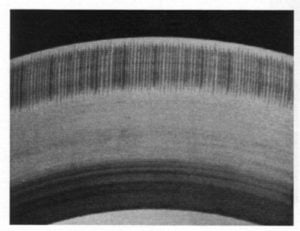
100 nanoseconds, or faster, edges (1/10th of a microsecond) are counted and accumulated in three counters for High, Medium and Low energy. Data are stored and can be transferred to PC memory via USB.
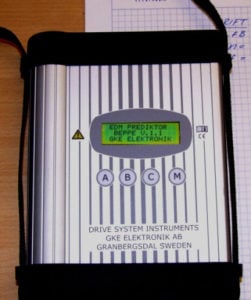
Electro Static Technology, the manufacturer of the AEGIS Shaft Grounding Ring, has had the privilege of meeting and discussing bearing currents with Gunnar Englund. The information in the article above is his own and any questions should be referred directly to him.
WEG Electric Innovation – the W22 Magnet Drive System
WEG Electrics’s new W22 Magnet Super Premium motors meet the IE4 efficiency levels according to IEC standard 60034-30-1. The magnets inserted into the rotor ensure a significant reduction in electric losses, and thus the motor temperature, enabling smaller frame sizes to be utilized. Compared to induction motors of the same output and speed, the weight and volume of the equivalent W22 Magnet Super Premium motors is reduced by as much as 77% (refer to example below). The W22 Magnet motors operate with lower temperature rise even at low speeds.
Applications
Cooling towers, bag filters, paper machines, paper coil winders, conveyors, pumps, looms, direct current (DC) motor replacements, extruders, compressors, fans, etc.
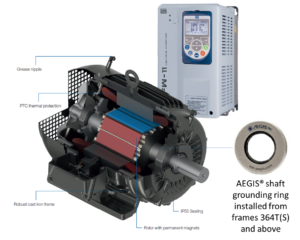 WEG Electric W22 Magnet Drive Motor with AEGIS installed FRAMES 364T and above
The W22 Magnet Drive System composes premium and ultra premium efficiency motors with permanent magnets driven by frequency inverters. Perfect for applications where speed variation, precise control at low speeds, low noise levels and compact design are critical. This technology provides the motor with significant advantages such as higher efficiency and a greater power density per frame. They are driven by WEG CFW11 frequency inverters, which offer constant torque across a wide speed range, operating even at low speeds with efficiency levels above induction motors without requiring forced ventilation. W22 Magnet motors are available in Super Premium (IE4) and Ultra Premium (IE5) versions – the highest efficiency available on the market today. Due to the dedicated software application which incorporates the vector control technology for driving permanent magnet motors, the use of the WEG CFW-11 frequency inverter and W22 Magnet motor is mandatory.
 Efficiency Comparison Chart: Black line is W22 Magnet; Blue line is Induction Motor