

Auteur/autrice : AEGIS
Washdown Motors: More Reliable with AEGIS
Washdown motors are used in industries ranging from food processing to pharmaceutical manufacturing. These motors drive machines that bottle milk, mix molten plastics, and do everything in between. But regardless of the application, all washdown motors must be two things: cleanable and reliable. Cleanable, because many of these products are destined for human consumption. And reliable, because one motor failure in a production line can cost thousands of dollars in downtime, and potentially spoiled batches of product as well.
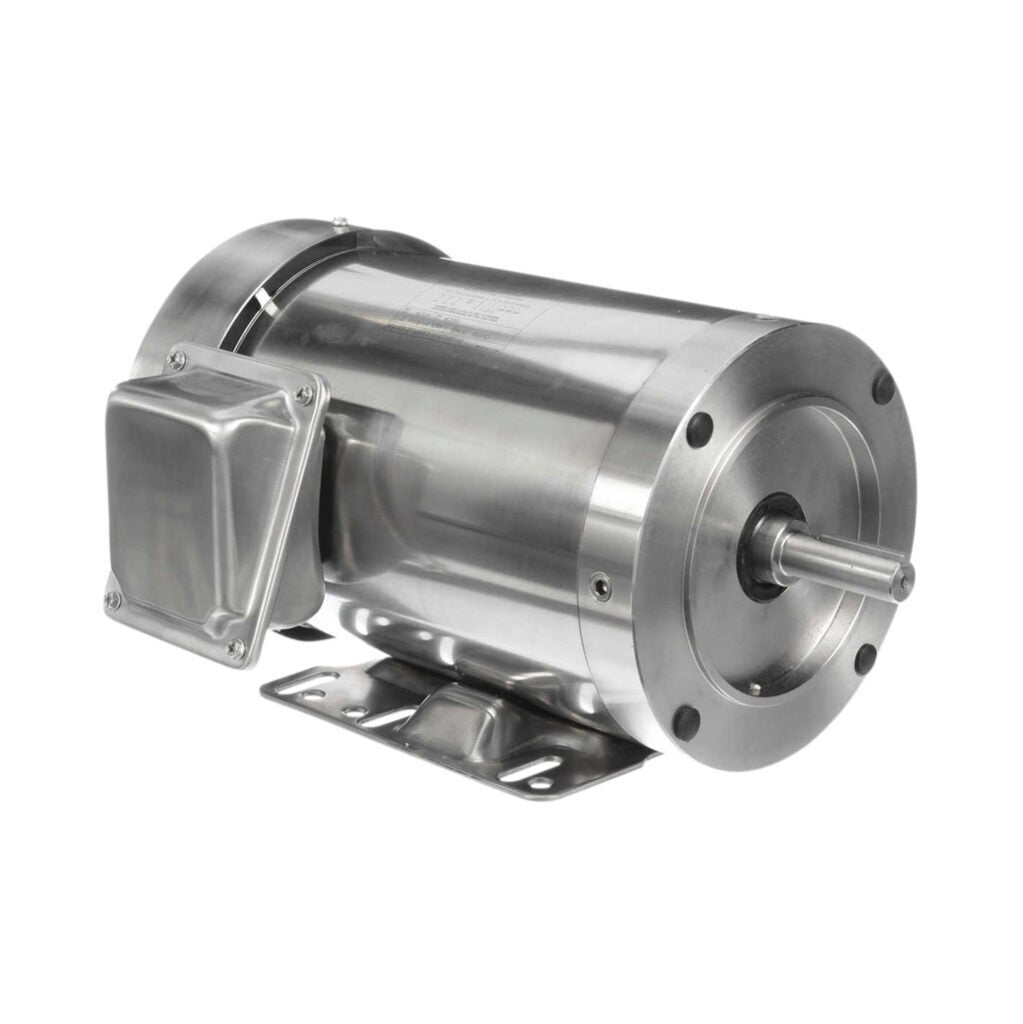 But reliability is hard to ensure in a washdown environment. Heat, humidity, and cleaning chemicals, as well as high-pressure streams of water, all take a toll on motors. Washdown motors sport a number of features to protect against these harsh conditions. Many of these features serve to protect the bearings, like special seals and moisture-resistant bearing grease.
In addition to environmental hazards, washdown motor bearings are also at risk from internal hazards, when motors are controlled by variable frequency drives (VFDs). All motors on drives are susceptible to electrical bearing damage because of the nature of drives’ output. VFD power causes voltage to build up on the motor shaft. Without protective measures, this voltage will discharge by arcing through the bearings, causing damage and eventual failure. A shaft grounding device can make washdown motors more reliable by mitigating this damage. But USDA regulations would prohibit an external shaft grounding brush.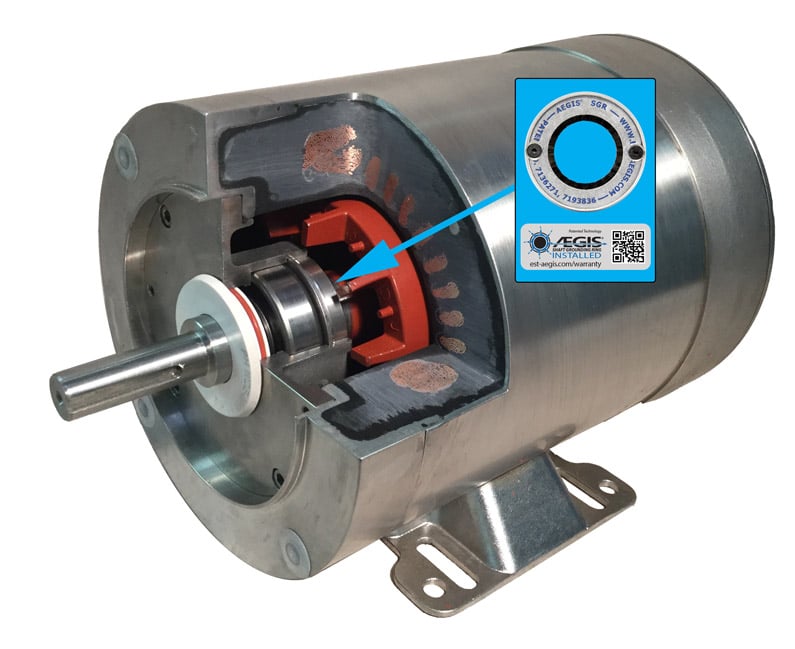
Instead, a washdown motor needs an internally mounted long-lived shaft grounding ring, like the AEGIS® SGR. Unlike spring-loaded carbon grounding brushes, AEGIS grounding rings don’t require adjustment and don’t typically wear out over a motor’s lifetime. So they can prudently be installed inside of motors. AEGIS rings are also the only shaft grounding product to offer a warranty against electrical bearing damage. In fact, they carry a two-year extended warranty, on top of the manufacturer’s warranty.
Washdown motors are available with AEGIS rings factory-installed. For 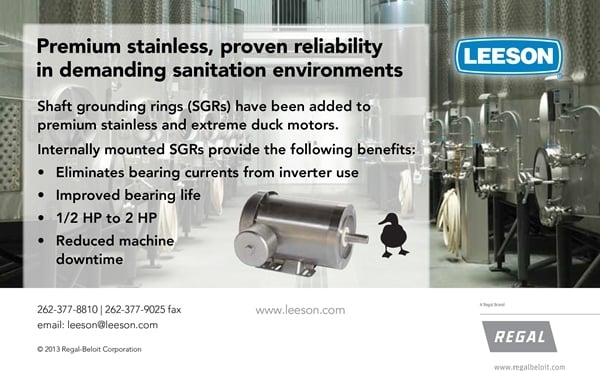 example, LEESON has two lines of stainless Washguard® motors that come with AEGIS inside by default: the Premium All-Stainless and Extreme Duck Ultra lines.
The whole point of a washdown motor is to have a motor that will keep running reliably in spite of the severe cleaning it’s subject to. With that in mind, why would you not want the motor to be as reliable as possible?
AEGIS Rings also come with a 2-year extended warranty against bearing fluting damage. No other form of protection against VFD-caused bearing damage offers a warranty like this.
To learn more about AEGIS shaft grounding and best practices for electrical bearing protection, sign up for a training. We offer monthly live training webinars, and we can also visit your facility to review your exact application.
U.S. Motors Inverter Duty World Motors Now Have AEGIS Inside
U.S. Motors’ World Motor® line of severe duty motors includes some of the toughest motors out there. World Motors come in four lines: HOSTILE DUTY™, CORRO-DUTY®, 841 PLUS®, and Inverter Duty™. All World Motors are designed to stand up to the harsh conditions in applications from paper mills to waste management. Some of their distinguishing features include a large conduit box that can be connected at multiple places on the cast iron frame; large, dual-drilled feet for sturdy and versatile mounting; and longer fins for better cooling. And now the Inverter Duty line includes AEGIS Shaft Grounding Rings.
The Inverter Duty line is an enhanced version of the HOSTILE DUTY line. 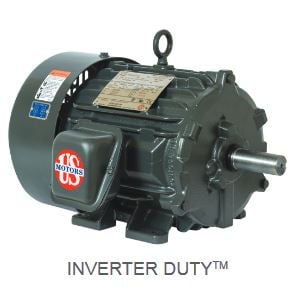 These World Motors include protection against motor damage caused by inverter drives. Inverter Duty motors have an Inverter Grade® Insulation System that meets NEMA MG-1 Part 31. This protects the winding insulation from being damaged by voltage pulses from the drive. The windings are further protected by a Class F thermostat on each phase.
Inverter Duty World Motors also include protection for the bearings. The drive’s output creates a voltage on the motor shaft, and that voltage can discharge by arcing through the bearings. Inverter Duty motors include an AEGIS® Shaft Grounding Ring to protect against this. The internally mounted grounding ring bleeds off the shaft voltage before it builds up enough to cause bearing arcing. AEGIS rings are the only product on the market that offers an extended warranty against the electrical bearing damage caused by drives.
Larger Inverter Duty motors, 100 hp and up, also include one insulated bearing. This protects against a second form of inverter-caused bearing damage.
All of these protective measures make Inverter Duty motors more reliable when run on inverter drives. And the price of a motor is only a fraction of its total lifetime cost. So the upgrade pays for itself in reliability and peace of mind. The motors will just work, and that’s one less thing to worry about!
You can view the catalog pages for World Inverter Duty Motors here.
Of the four lines of World Motors, only Inverter Duty motors include shaft grounding by default. However, an AEGIS ring can be added to any World Motor, or any other U.S. Motor, through U.S. Motors’ mod program. And again: If you’re running a motor on an inverter drive, why would you not upgrade for extra, warranteed, reliability?
The AEGIS 2-year warranty  against bearing fluting damage extends the manufacturer’s warranty. No other form of protection against VFD-caused bearing damage offers a warranty like this.
 To learn more about AEGIS shaft grounding and best practices for electrical bearing protection, sign up for a training. We offer both live webinars and on-site lunch-and-learn trainings.
Specify VFDs for Efficiency, and Bearing Protection for Reliability
In the quest for energy efficiency, more and more engineers are specifying variable frequency drives (VFDs) to control ac motors. According to one large construction database, VFDs were specified in 44% of new construction projects calling for motors in 2018. These drives save large amounts of energy in variable torque applications by running motors at less than full speed. They also enable precise control of motor speed. These are the drives’ two big pros.
But they also have their cons. Unlike mains power, their ac output is not sinusoidal, but pulse width modulated: Each phase comprises a series of dc pulses with fast rise times. Because they are pulsed, the phases are not balanced. That is, the sum of the three phases’ voltage, the common mode voltage, is not always zero. The high dV/dt of the pulses can damage the stator windings, and the nonzero common mode voltage causes a shaft voltage that discharges through and damages the bearings. (For more detail, see this IEEE paper.)
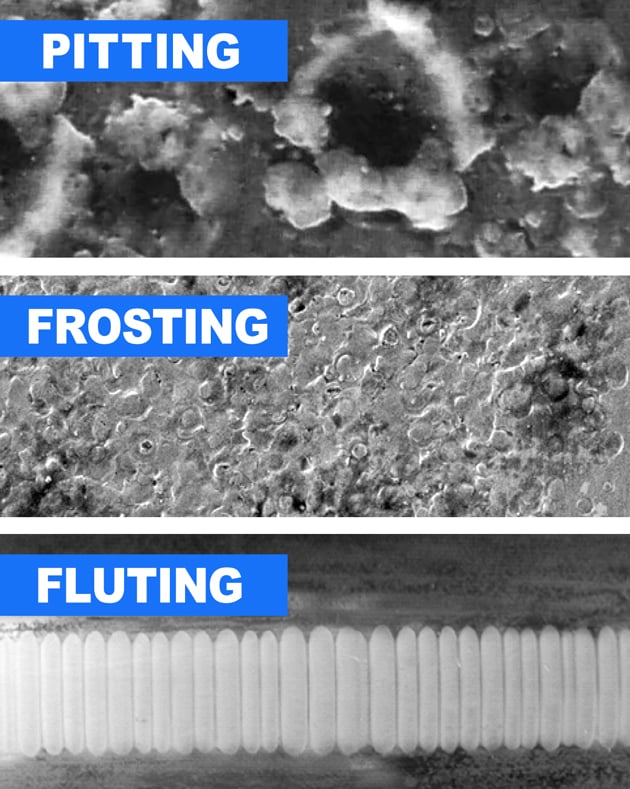
Micron-sized pits are formed by shaft voltage arcing through the bearing. Pits accumulate to form visible frosting, which may in turn produce fluting. (Click to enlarge.)
The bottom line: VFDs’ output can cause motor failure, requiring costly repair or replacement, and potentially even more costly downtime. Imagine a data center with hundreds of VFD-fed HVAC motors failing one after another. And the specifier may be held liable for these losses.
The CSI 2300 Master Spec says (Subsection 1.7, A) that drives shall not impose conditions that can reduce motor life… and NEMA Standard MG1 requires the use of « definite purpose inverter-duty related motors » for use with VFDs. So how can you ensure that you specify adequately protected motors?
The windings can be protected with enhanced insulation, with a higher corona inception voltage. Inverter-ready and inverter-duty motors have Class F or H winding insulation. All NEMA Premium® motors include such robust insulation.
As for the bearings: CSI requires « a shaft ground kit. » Shaft grounding provides a low-resistance discharge path, so shaft voltage dissipates harmlessly through the grounding device instead of discharging through the bearings. The longest-lived and lowest-maintenance shaft grounding device currently available is the AEGIS® Shaft Grounding Ring. AEGIS is also the only shaft grounding product that offers a warranty against electrical bearing damage.
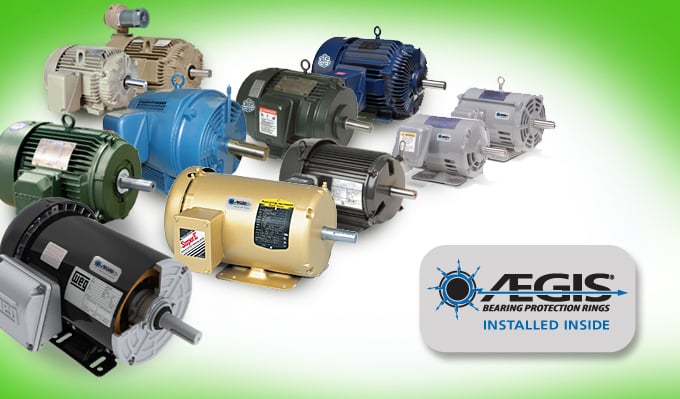
AEGIS rings can be installed on new or in-service motors. But for both specifiers and installers, it is easiest to get a new motor with the ring already installed. Luckily, several of the largest motor manufacturers offer product lines with AEGIS rings factory-installed on stock motors. These include ABB (Baldor), Marathon, WEG, LEESON, US Motors, and TECO-Westinghouse. More information on makes and models is available here and at Industrial Matrix.
For resources on how to specify motors with AEGIS, please see this whitepaper. You might also be interested in the recommended AEGIS specification language or this CSI Division 23 05 13 with AEGIS called out.
AEGIS Rings also come with a 2-year extended warranty against bearing fluting damage. No other form of protection against VFD-caused bearing damage offers a warranty like this.
To learn more about AEGIS shaft grounding and best practices for electrical bearing protection, sign up for a training. We offer monthly live training webinars, and – pandemic restrictions permitting – we can also visit your facility to review your exact application.
Reliable Data Center Cooling Requires Motor Bearing Protection
Variable frequency drives (VFDs) are widely used in data center cooling applications because they offer precise control of motor speed and significant energy savings. Without variable speed control, a motor can either run at full speed or not at all. Most applications don’t need constant full-speed motor operation, so that wastes energy. With VFD control, though, motors are run only as fast as the situation demands. In HVAC applications, this can give energy savings of up to 30%. And 30% of the power for a data center’s cooling amounts to a lot of money saved.

But though savings are great, they aren’t everything. Reliability is even more important in a data center. And VFDs are unfortunately bad for motor reliability. To start with, they can burn out the windings of motors with low-grade insulation. Nowadays, though, most motors come with inverter-ready or inverter-duty winding insulation, which can tolerate the stresses of VFD control. But winding damage isn’t the only risk of VFD control.
VFDs can also destroy the bearings of the motors they control. They do this by generating a voltage between the motor’s rotor and stator frame. This so-called shaft voltage tends to discharge or arc through the motor bearings. This arcing can occur thousands of times per second, and every arc leaves an invisibly tiny crater behind. Over time, these craters accumulate and roughen the smooth surfaces of the bearing. This causes noise, vibration, and eventual bearing failure. The bearings of motors on VFDs can sometimes fail in only a few months.
When a bearing has failed, there are two options. You can replace the bearing, or just buy a new motor. Neither option is especially cheap. And one data center might have hundreds of motors under VFD control. The costs can add up fast, and even cancel out the energy savings from using VFDs.
Clearly, some form of bearing protection is needed. One way to protect the bearings is to ground the shaft with a low-resistance brush. Charge preferentially flows through the device instead of through a bearing.
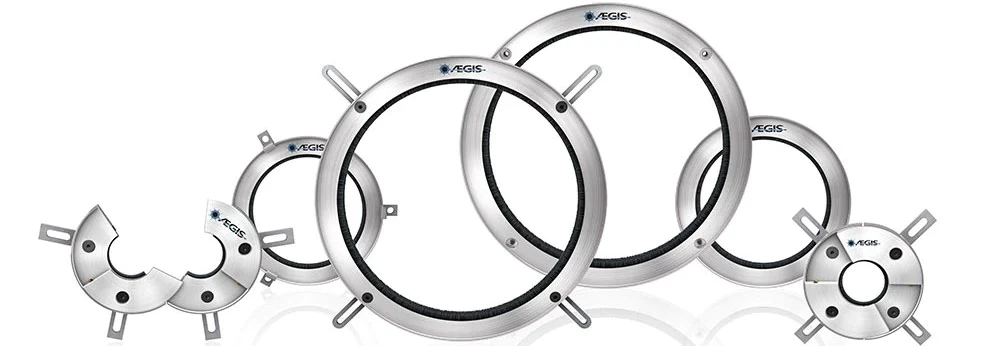
One popular and effective shaft grounding device is the AEGIS Shaft Grounding Ring. AEGIS rings surround the motor shaft with hundreds of thousands of conductive microfibers. The microfibers bleed off shaft voltage before it builds up enough to arc through the bearings. AEGIS rings work in most environments without maintenance or appreciable wear. Testing has shown that they wear only 0.001″ in 10,000 hours of operation. Extrapolating, gives the grounding rings an operating lifetime of 200,000 hours. That’s about twice the L10 lifetime of a typical bearing.
With AEGIS rings installed, VFD-fed motors are safe from electrical bearing damage. By using AEGIS rings, data centers can reap the savings promised by VFDs, without the risk of unexpected repair and replacement costs.
AEGIS rings can easily be installed externally. But since they last so long and rarely need maintenance, they can also be installed inside motors. Internal installation protects the rings from contamination and makes them even more reliable. And buying a new motor with AEGIS installed is the easiest way to get protection.
Several major motor manufacturers have lines of stock motors with AEGIS rings installed internally. These include Baldor-Reliance, WEG, Marathon, LEESON, and US Motors Varitough™ condenser motors.
To learn more about AEGIS shaft grounding and best practices for electrical bearing protection, sign up for a training. We offer monthly live training webinars, and – pandemic restrictions permitting – we can also visit your facility to review your exact application.
WEG Cooling Tower Motors Are Available with AEGIS Installed
Severe duty is standard with WEG W22 motors. There are not many environments more severe than cooling towers, whose heat and moisture can quickly corrode less robust motors. But WEG W22 Cooling Tower Motors are more than up to the task, from their cast iron TEFC frames for efficient heat dissipation, to their doubly sealed bearings, to the Class H-insulated magnet wire that protects the motor windings from damage by variable frequency drive output.
But drives can damage motor bearings as well as windings. That’s why WEG has introduced a mod option to add an AEGIS® Shaft Grounding Ring. Without shaft grounding, motors run by drives may fail due to stray currents arcing through the bearings. But with shaft grounding, those currents pass safely through the grounding ring rather than the bearing.
WEG W22 Cooling Tower Motors also come standard with:
- A stainless steel nameplate, laser etched for high contrast
- Epoxy paint, inside and out
- Umbrella seals for IP55 ingress protection
- Class H impregnation resin & magnet wire, and the remaining insulation Class F
- 1.25 service factor
- Multiple endbell drainplugs to allow horizontal or vertical operation
To learn more about WEG W22 Cooling Tower Motors, see this brochure.
Preventing VFD/AC Drive-Induced Electrical Damage to AC Motor Bearings
The use of variable frequency drives (VFDs) to control AC motors has increased dramatically in recent years. In addition to their low operating cost and high performance, they save energy. Today, the challenge facing system designers and engineers is to minimize damage to AC motors from bearing current. From its first minute of operation, a VFD induces destructive voltages that build up on the motor shaft until they find discharge paths to the frame (and then to ground).
In most cases, the motor bearings present the path of least resistance. Once voltage is sufficient to overcome the resistance of the oil film layer in the bearing, shaft voltage discharges, causing electrical discharge machining (EDM) pits — fusion craters in the race wall and ball bearings. This phenomenon continues until the bearings become so severely pitted that fluting, excessive noise, and failure occur.
Over the years, researchers have proposed many solutions to minimize this damage and prevent premature failure. These range from blocking current flow with bearing insulation, to allowing current to flow without arcing by using conductive grease, to diverting the current by grounding the shaft. No one method is perfect for all motors, in all situations.
The shaft grounding ring is one of the newer and more effective methods. Like older carbon grounding brushes, they provide a low-resistance path from shaft to ground, so current flows through the brush, not the bearings. But shaft grounding rings have several advantages over grounding brushes and other methods of bearing protection.
Read the New White Paper
The AEGIS Training Can Now Be Logged in MyNCEES
The National Council of Examiners for Engineering and Surveying (NCEES) is an American nonprofit group whose mission is to advance licensure for engineers and surveyors. Among many other things, they provide a number of tools to help engineers become licensed, and to stay licensed.

Electro Static Technology has been added to the NCEES CPC Registry
One of these tools is MyNCEES, a web service that allows engineers to store all of the documents that they need for license applications and renewals. One big part of this is continuing education, which they call CPC (Continuing Professional Competency). NCEES maintains a registry of listed providers of CPC courses. So when an EIT or PE takes a course taught by one of these listed providers, they can just log into MyNCEES, select the listed provider from the list, and log all of their CPC hours in the same place.
No need to print certificates of completion, no need to wonder where on your computer you saved those records: MyNCEES logs and stores those records, and, when the time comes for license renewal, it can submit them to the appropriate state licensure boards. MyNCEES takes a time-consuming process and makes it quicker and easier.
So we at Electro Static Technology, manufacturer of AEGIS® Shaft Grounding Rings, are excited to have been added to the NCEES CPC listed provider registry. This means that when most engineers attend an AEGIS Lunch & Learn or take our webinar course, Electrical Bearing Protection Best Practices, they can use MyNCEES to log, store, and submit the course for CPC.
At the moment, the AEGIS training is not valid for continuing education credit in Florida, New Jersey, New York, or Maryland. The licensure boards of these states require courses to be preapproved in order for engineers to get credit for them. We are working on gaining this approval. In the meantime, engineers licensed in the remaining states, and in DC, Guam, the Northern Mariana Islands, and Puerto Rico, can quickly and simply log their AEGIS training using MyNCEES. Find out when our next live webinar is and give it a try!
Protecting VFD-driven Motors in Plastics Production
Today, there are hundreds of types and blends of plastics, and they can be formed, molded, extruded, blown, and otherwise fashioned into a dizzying array of products. Processing equipment must be precisely controlled to ensure the quality, durability, and finish of final products at every stage of processing. This goes for every operation, from the production of raw chemical ingredients; to their blending and polymerization to produce pellets, sheets, or blanks; to the forming of finished products.
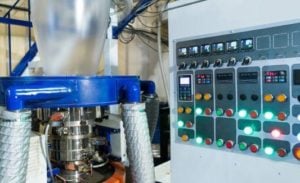
Variable frequency drives (VFDs) can provide the precise control of motor speed and torque required for a broad range of plastics processing applications, whether the motors drive pumps, conveyors, compressors, blowers, or any other equipment.
But VFDs can damage the motors they control. They induce voltage on motor shafts that causes electrical arcing through the bearings. This arcing causes pitting in the bearing, leading to fluting and catastrophic bearing failure. Bearing failure in turn causes unplanned downtime, and the colossal costs of lost production can quickly wipe out any benefits from the use of VFDs. The bearings must be protected to minimize the risk of downtime due to bearing failure.
Plastics production processes typically involve very large runs, and machine failures can shut down production, resulting in costly repairs and huge revenue losses. So when the 300 HP motor for an injection molding machine at a North Carolina plastics plant experienced premature bearing failure, plant engineers wanted to know why. Testing showed that shaft voltage discharge through the bearings was the cause of the failure.
After doing some research, plant engineers learned about AEGIS® Shaft Grounding Rings. Shaft grounding rings give electric charge on the shaft a low-resistance path to ground. So rather than arcing destructively through the bearings, voltage bleeds off harmlessly through the grounding ring. The engineers decided to try an AEGIS Ring.
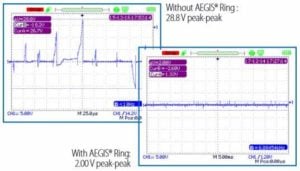 Shaft voltage readings on an injection molder’s motor before and after installation of an AEGIS Ring.
Before they installed the ring, the motor showed shaft voltage up to 25-30 volts (peak to peak). After installation, the shaft voltage was decimated, weighing in at just a couple of volts at most. The ring was obviously working: The shaft voltage had decreased to levels too low to discharge through the bearings.
AEGIS Rings also come with a 2-year extended warranty against bearing fluting damage. No other form of protection against VFD-caused bearing damage offers a warranty like this.
To learn more about AEGIS shaft grounding and best practices for electrical bearing protection, sign up for a training. We offer monthly live training webinars, and we can also visit your facility to review your exact application.
ABB Launches AEGIS Shaft Grounding Ring Option Code VC588 for IEC Motors
ABB’s new Variant Code for IEC Low Voltage Motors (VC588) uses AEGIS® Shaft Grounding Rings installed inside the motors to mitigate the effects of bearing currents. In various publications, ABB has described the phenomenon of bearing current as follows.
Bearing currents can be divided into four different categories:
- Electrostatic discharge currents (EDM)
- Capacitive bearing currents
- Circulating currents
- Rotor ground currents
In detail, the three partial mitigation techniques for bearing currents are:
- Incorporating an insulated bearing at the non-drive end
- Using a common mode filter in conjunction with a VSD
- Earthing and cabling of transformer, VSD, motor, and load-train
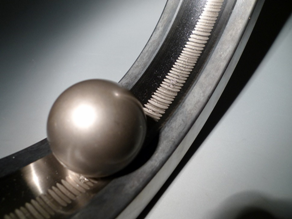
This bearing has been exposed to bearing current. Note the EDM damage to the race track and bearing elements. Photo courtesy of SKF.
How to deal with persistent bearing current issues
The two new enhanced approaches to solving the persistent bearing current problems are:
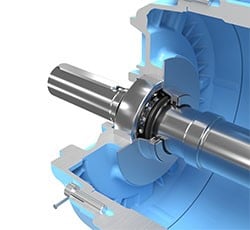
An AEGIS Shaft Grounding Ring is used to solve bearing current problems. Image courtesy of ABB.
- AEGIS Shaft Grounding Rings installed internally
An important new solution for motors in IEC frame sizes 132 to 250is to install an AEGIS Shaft Grounding Ring that directs the current to ground via the ring, rather than through the bearing. This protects the motor itself and the complete installation. The ring can be pre-installed on new motors by specifying the variant code VC588. Or it can be retrofitted on-site.
Note: AEGIS Shaft Grounding Rings can be installed on all sizes of motors. - Insulated bearings at both the drive and non-drive ends
How can you measure bearing currents?
In most cases, it is difficult for operators to measure any bearing current that might be present on a standard motor. But if bearing currents are suspected they can be detected using special equipment operated by experienced personnel. ABB has developed vast experience in carrying out these measurements on motor and drive installations in a variety of different applications worldwide. You also can use the AEGIS Shaft Voltage Tester, an oscilloscope, to measure shaft voltage and clearly detect the EDM discharge pattern.
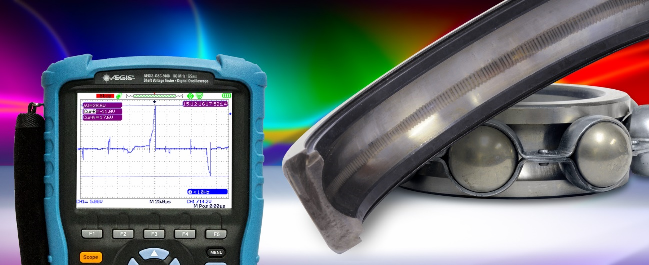
Shaft voltage reading showing bearing current and fluted bearing race, from a motor not protected with an AEGIS Shaft Grounding Ring

No bearing current indicated in shaft voltage, and undamaged bearing race, of a motor protected by an AEGIS ring.
Summary: Bearing currents can be avoided
When bearing current is present, there is no « one size fits all » solution. It is vital for the user and motor and drive supplier to work together to identify the most appropriate solution for the specific application. Ensuring the correct use of grounding and connection cables according to best practice will always be an important first step. New solutions in the form of AEGIS Shaft Grounding Rings in combination with insulated or hybrid bearings are now showing significant promise as a cost-effective way of eliminating the potentially harmful effects of bearing currents.
Announcing the AEGIS Trained Installer Program
We at Electro Static Technology are excited to announce our new AEGIS® Trained Installer Program. This program recognizes and promotes motor repair companies that have distinguished themselves by adopting AEGIS’ best practices for bearing protection.
AEGIS Trained Installers can be found on our website in the Where To Buy section. Motor users who need AEGIS rings installed, but are unable to do the job in-house, will be able to find a local Trained Installer using our searchable database and map. To see the AEGIS Trained Installers in your area, go here, enter your ZIP code or city and country in the search box, and press the Find Installers button.
If you own or operate a motor repair company and would like to become an AEGIS Trained Installer, we encourage you to contact us today!