

Auteur/autrice : AEGIS
Motor Repair Best Practices for VFD-Driven Motors
Motors operated by variable frequency drives (VFD) are vulnerable to premature bearing failure from VFD induced shaft voltages and bearing currents – sometimes within only weeks or months – and the result is costly down time and production interruptions. Avoiding these costs makes economic sense and pays a high return on investment.
VFD-Driven Motors Can Fail From Destructive Bearing Currents – Costing Downtime and Lost Production

 VFDs induce destructive shaft voltages and high-frequency currents which will cause electrical discharge machining (EDM) pitting, fusion craters, and fluting damage to the motor’s bearings and deteriorate the bearing lubrication by allowing electrical arcing to burn the grease.
Cost Avoidance – Follow Best Practices to Ensure Up-time and Reliability
Motor repair best practices will provide bearing protection from these destructive bearing currents by adding AEGIS® Shaft Grounding Ring Technology and, when needed, insulating a bearing to prevent high frequency circulating currents.
- Motors up to 100 HP – Add AEGIS Shaft Grounding Ring to discharge shaft voltages to ground.
- Motors over 100 HP – Add AEGIS Ring at one end and insulate the bearing at the opposite end.
- Detailed recommendations are contained in the AEGIS Bearing Protection Handbook.
Motor Bearings are the Most Vulnerable Parts and the Cost of a Failed Motor Adds Up Quickly
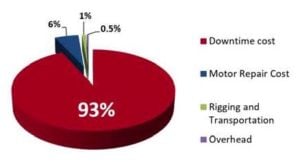
The return on investment in repairing motors and following the AEGIS Bearing Protection Handbook’s best practices recommendations will pay dividends day after day and ensure the most reliable repair to the motor.
AEGIS Rings also come with a 2-year extended warranty against bearing fluting damage. No other form of protection against VFD-caused bearing damage offers a warranty like this.
To learn more about AEGIS shaft grounding and best practices for electrical bearing protection, sign up for a training. We offer monthly live training webinars, and – pandemic restrictions permitting – we can also visit your facility to review your exact application.
3 Facility Case Studies Make the Case for AEGIS Rings
A new preventive maintenance program at a leading New England Ivy League university demonstrates how the push for more sustainable “green” building management has led to a growing awareness of a chronic, widespread problem with HVAC motors — electrical bearing damage and failure.
University Improves Sustainability of HVAC Motors in Platinum LEED® Building
Read and download the case study
 AEGIS Goes to School
Shaft currents induced by VFDs can wreak havoc with bearings, dramatically shortening motor life and causing costly repairs. To mitigate these currents and realize the full potential of VFDs, a reliable method of shaft grounding is essential.
The university maintenance department has already used the AEGIS® ring successfully for fan and pump motors in several new buildings on campus. The AEGIS ring is available in two versions — a continuous ring or a split, and both versions can be installed with either brackets or conductive epoxy. The split ring (used in the university’s retrofit program) simplifies and speeds field installations because it can be installed without uncoupling attached equipment.
Local Motor Shop Helps Kansas Water Authority Solve Bearing-Damage Problem
Read and download the case study
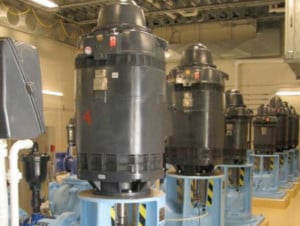 Water Treatment Plant
Electrical engineer Dan Biby of Professional Engineering Consultants (PEC), Wichita, KS, helped design the new Reverse Osmosis Water Treatment Center for the city of Hutchinson, Kansas. With the capacity to pump 10 million gallons of drinking water daily, the plant is the solution to a groundwater contamination problem.
“We use the [AEGIS] rings on all of our jobs to eliminate downtime, replacement, and installation costs. Installing rings can prevent these problems altogether. And the cost is insignificant when compared to total project cost.”
Pumps lift contaminated water from beneath an industrial area and remove most of its volatile organic compounds (VOCs) through reverse osmosis and aeration. The water is then diluted with uncontaminated water from wells across town before being pumped to the city’s supply towers. All of the pump motors are controlled by VFDs that provide adjustability in flow rate and pressure.
Making Motors Sustainable at Time & Life Building
Read and download the case study
 Time and Life
New York City
A preventive maintenance plan that reduces the total life-cycle cost of operations in a prominent building at the heart of New York City serves as a good example of how the push for more sustainable, green, building management has led to a growing awareness of a chronic, widespread problem with HVAC motors – electrical bearing damage.
Once installed, the AEGIS SGR requires no maintenance. Unlike conventional shaft grounding brushes, its conductive microfibers work with virtually no friction or wear; are unaffected by dirt, grease, or other contaminants; and last for the life of the motor regardless of rpm. Test results show surface wear of less than 0.001″ per 10,000 hours of continuous operation and no fiber breakage after 2.5 million direction reversals.
AEGIS Rings also come with a 2-year extended warranty against bearing fluting damage. No other form of protection against VFD-caused bearing damage offers a warranty like this.
To learn more about AEGIS shaft grounding and best practices for electrical bearing protection, sign up for a training. We offer monthly live training webinars, and – pandemic restrictions permitting – we can also visit your facility to review your exact application.
Facility Managers Know: Motor Downtime is Disruptive and Expensive!
In any facility, when electric motors fail, the costs can be very high. In any maintenance department, cost avoidance is key to running an efficient and smooth operation. Minimizing disruptions by selecting the right electric motors and accessories is one way to avoid some of these these expensive downtime costs. For example, when an electric motor is controlled by a variable frequency drive (VFD), voltages can be capacitively induced onto the motor’s shaft. This results in pitted and fluted bearings and burnt lubrication. This destructive process results in up to a 90% decreased service life of the electric motor.
 Shaft Voltage Discharge Cycle
A motor that should last 60,000 hours may only last for 6000 unless a motor with a shaft grounding ring is used, with the ring either factory-installed or retrofitted in the field. Most electric motor manufacturers have full product lines of motors with AEGIS® shaft grounding rings factory installed including ABB, WEG, TECO, Marathon Electric, and LEESON. Most will also install them as retrofits.
Whenever a motor is sent to a repair shop, an AEGIS ring may be easily installed during the repair. Alternately, field install kits allow maintenance departments to install AEGIS rings on their own motors.
The key is to ensure that any motor operated by a VFD has bearing protection, whether it’s built-in or added aftermarket, by specifying it ahead of time. What many facility managers and chief engineers do is to add this requirement to their purchasing specification. By doing this the purchasing department will look for the AEGIS shaft grounding ring brand when they make their purchasing decisions.
Here are 15 costs that can be avoided when motors with AEGIS shaft grounding rings are specified:
- Hourly rate of the people who must decouple the motor and remove it from the system. This cost can be quite high especially if the motor requires special lifting or rigging equipment and is in a difficult place to reach. Hundreds of dollars in labor alone can be avoided.
- Any special rigging equipment to lift/transport the motor. This equipment must either be purchased or rented. Even a relatively small 10 HP motor weighs over 250 lbs requiring special rigging equipment. As the motor gets heavier and larger the equipment also gets much more costly.
- Management time costs money in more than one way. First, it takes the manager away from other important activities, and second, they must spend time on the problem. The hourly rate of management spending time on the problem can be avoided.
- Customer service of the facility must take time to notify customers of interruptions in operation. In class, A offices, hospitals, labs, universities, and production facilities, taking time to notify and assist internal and external customers is costly.
- The hourly rate of any administrative time needed to find a replacement motor to purchase. Making calls, finding the correct motor, scheduling the receivable, and more, all take time, which must be paid.
- Spare motors are sometimes kept on-site or off-site. Inventory costs are expensive and add to the facility’s budget.
- Transit costs for the replacement motor when ordered or repaired. Transportation is not free and the bigger the motor, the higher the cost. Expediting when needed adds to the job.
- Receiving costs when motor arrives and is stored. It takes both people’s time and inventory space to receive and store the replacement motor and any equipment needed to replace it.
- Administrative time to inventory and update records. New serial numbers must be tracked, paperwork filled out, and systems updated.
- Hourly cost of people re-installing the motor. As with removal many hours are consumed in re-installing the motor. Costs increase as the size and difficulty increases.
- Any lifting or rigging equipment needed to transport/replace the motor. Just like before this equipment must be rented or owned.
- Alignment and testing of new motor. Some systems are simpler than others, but whether the motor is coupled or drive belts are used, laser alignment, vibration testing, and so on add significant cost to the motor installation.
- Disposal cost of the old motor: It must be stored and disposed of, and even if there is a residual scrap value, that seldom covers the cost.
- PRODUCTION DOWNTIME! Here is a highly variable cost. In a production line the hourly downtime cost can be tens of thousands of dollars. Some processes can run into the millions. If space cannot be used, or hospital beds are left unoccupied, or lab experiments interrupted… You get the idea.
- The actual cost of the replacement motor. Here again, the bigger the motor, the higher the cost!
If Your Motor Is On a VFD, Squealing May Be Electrical Fluting Damage
Shaft Voltage from VFDs Damages Bearings – watch the video to see the shaft voltage that causes pitting in the motor’s bearings and eventual fluting and failure.
PROBLEM: Motor with No Bearing Protection…
Variable frequency drives (VFDs) on AC and DC motors create harmful electrical voltages on the motor shaft. If these voltages build up high enough, they discharge through the motor’s bearings, causing fusion craters, severe pitting, and fluting. Excessive bearing noise and eventually bearing failure is the result.
SOLUTION: Motor with AEGIS Shaft Grounding Ring
The AEGIS® Shaft Grounding Ring prevents electrical bearing damage by giving a path of least resistance to harmful shaft voltage, so they discharge through the ring, instead of through the bearings. The AEGIS Ring’s conductive microfibers™ provide the most reliable and long-lived current diversion of any shaft grounding system.
For more information, download or request a print copy of the AEGIS Bearing Protection Handbook of best practices for bearing protection.
3 Things You Need to Know About UL Recognized Component Mark – Is it Required for AEGIS Rings?
The AEGIS® Shaft Grounding Ring does not require a UL® listing or a UL recognized component certificate and its installation does not alter the UL listing of the product onto which it is installed.
AEGIS shaft grounding rings are designed to be installed by:
- Motor manufacturers on new motors in the factory.
- Motor Repair shops on existing motors and new motors.
- Field maintenance personnel on installed motors.
Here are the 3 things you need to know:
1. Scenario: You are an electric motor repair business or maintenance technician and someone tells you « unless there is a UL RECOGNIZED COMPONENT MARK on the component, it can’t be installed on the motor. » Not true.
- Per information on the UL website, the UL RECOGNIZED COMPONENT MARK is for components that are « to be installed at the factory, not in the field and they may have restricted performance capabilities that limit their use. »
- Some suppliers of spring-enabled carbon block brushes have applied and received the « UL RECOGNIZED COMPONENT MARK. » If this is the case one should ask if their component has any restricted performance capabilities which would restrict their use.
- AEGIS Shaft Grounding Rings do not have a UL RECOGNIZED COMPONENT MARK because it is not required by the motor or equipment manufacturers. The mark has nothing to do with motor repair or field installations and AEGIS Rings have no « restricted performance capabilities. »
- The AEGIS Shaft Grounding Ring is a passive shaft grounding device with no moving parts. They simply sit over the motor’s shaft and the hundreds of thousands of conductive microfibers do the work, discharging shaft voltage away from the motor’s bearings to ground.

2. Is it required that ALL components which go into a motor or system have a UL RECOGNIZED COMPONENT MARK? The simple answer is NO.
- An electric motor is considered a component and most carry the UL RECOGNIZED COMPONENT MARK on their nameplates. That is because they « are intended to be installed in another device, system or end product » [source: UL website]
- Not every subcomponent in an electric motor has a UL RECOGNIZED COMPONENT MARK, and they are not required by the motor manufacturer to have one.
- AEGIS Rings for example, as a subcomponent to a motor, do not need a UL RECOGNIZED COMPONENT MARK.
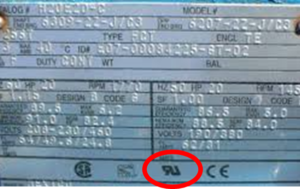 Motor Nameplate with UL RECOGNIZED COMPONENT MARK
3. If a shaft grounding ring does not have the « UL RECOGNIZED COMPONENT MARK » can it be installed on UL Listed equipment or an electric motor by the motor manufacturer? Of course, it can!
- AEGIS Shaft Grounding Rings are factory installed on electric motors manufactured by ABB (Baldor), WEG, Regal, Leeson, TECO, GE, NIDEC, and others. These motors have the UL RECOGNIZED COMPONENT MARK on their nameplates.
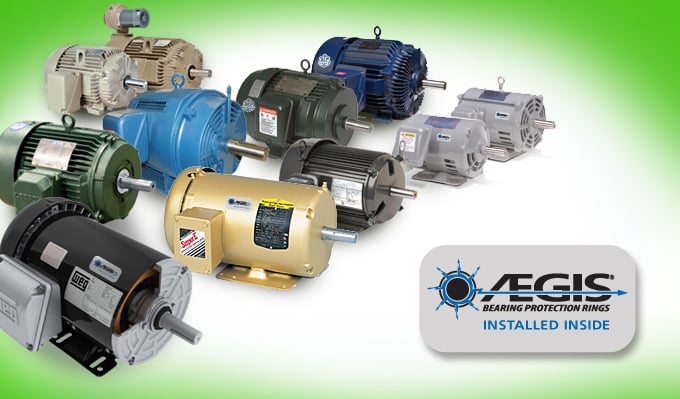 Motors with AEGIS Shaft Grounding Rings Factory Installed
The following is an excerpt from the UL website. Visit the link below for the most up to date information
UL RECOGNIZED COMPONENT MARK
« These are Marks consumers rarely see because they are specifically used on component parts that are part of a larger product or system. These components may have restrictions on their performance or may be incomplete in construction. »
« Components covered by UL’s Recognized Component program are intended to be installed in another device, system or end product. They are to be installed at the factory, not in the field and they may have restricted performance capabilities that limit their use. »
All Shaft Grounding Devices Are Not Created Equal: Insist on the Best
As variable frequency drives (VFDs) have become more common, awareness of the electrical bearing damage caused by VFDs has grown by leaps and bounds. And so has demand for a solution. In the solution department, AEGIS® Shaft Grounding Rings have led the pack. With some still in operation for almost fifteen years, AEGIS Rings have proved their mettle in millions of installations worldwide.
No other protection against bearing currents can boast of a record like that: Neither carbon grounding brush, nor fiber bundle grounding « ring, » nor common mode choke.
But not everyone realizes that all bearing protection is not created equal. That’s why it’s so important that you ask for AEGIS by name. Whether you’re getting a motor repaired and ask for a shaft grounding kit to be installed, or buying a new motor with shaft grounding factory-installed, it’s essential that you be specific. Don’t accept just any form of shaft grounding. Insist on the most effective and longest lasting shaft grounding product out there: AEGIS Shaft Grounding Rings.
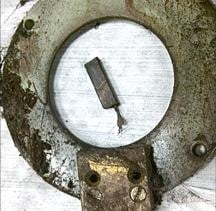
A failed carbon shaft grounding brush
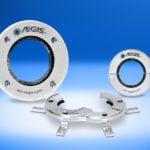
AEGIS Shaft Grounding Rings with 100% circumferential conductive microfibers have hundreds of thousands to millions of discharge points for the most reliable shaft grounding solution

Preventing Downtime and Spoilage in Paper Mills
Protect Pulp and Paper Plant Motors from VFD-Caused Bearing Failure and Prevent Downtime
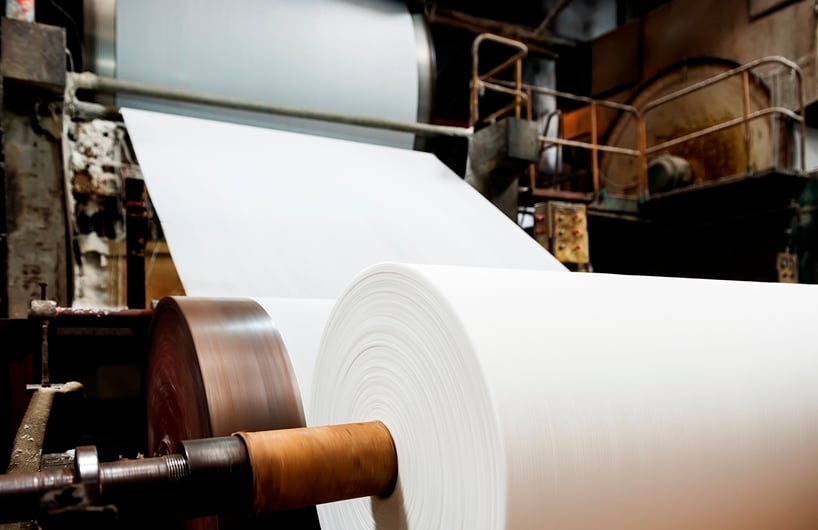
Papermaking is very demanding. To ensure tight control over critical process parameters, many times, variable frequency drives (VFDs or inverters) are used to control motors. These drives control the motors driving all manner of pumps and fans, grinders, winders, re-winders, and a host of related equipment.
Potential (but Avoidable) Pitfalls
But while VFDs allow precise control of motor speed or torque, they also damage motor bearings and cause costly unplanned downtime. These drives create voltage on the shafts of the motors they control—voltage that discharges through the motor bearings. The resulting electrical bearing damage causes bearing failure and stops production.
So, the VFD technology employed to improve papermaking processes also causes damage that shuts them down instead! These preventable bearing failures cost hundreds of thousands of dollars in damaged equipment, repair costs, and lost production.
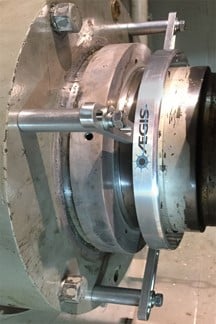 AEGIS PRO Ring installed on Medium Voltage AC Motor
AEGIS PRO Series Ring
AEGIS®Shaft Grounding Rings protect motor bearings (and coupled equipment) by channeling shaft voltage discharge currents away from bearings safely to ground.
The AEGIS PRO Series design provides reliable shaft grounding for large AC and DC motor-driven applications to divert harmful shaft voltage to ground and extend bearing life.
Best Practice
To follow best practices, install the AEGIS PRO Ring on the drive end of the motor, to discharge induced shaft voltage to ground, and insulate the bearing on the opposite end to interrupt high-frequency circulating current. Large motors often have much higher induced shaft voltage and bearing current. The six circumferential rows of conductive microfiber provide extra protection for these high-current applications.
Designed for:
- Large frame low-voltage motors: 500 HP (375 kW) or greater
- Medium-voltage motors
- DC motors: 300 HP (225 kW) or greater
 An AEGIS® PRO Ring protects a calender roller in a mill in Japan
AEGIS PRO Series Rings provide the high current carrying capacity needed for larger and medium-voltage motors. By preventing extremely costly process downtime, AEGIS Rings generate an impressive return on investment.
For smaller HP motors, use AEGIS SGR Rings (with 2 rows of fiber) to discharge capacitively-induced shaft voltage. Note that insulated bearings at the opposite end from the AEGIS ring are still needed on motors over 100 HP, because of the risk of high-frequency circulating current in all VFD-driven motors over 100 HP.
Motors up to 100 HP are not at risk of HF circulating current; therefore, only an AEGIS SGR is needed.
More Information
For a case study on installing AEGIS PRO Series Rings at a paper plant, click here.
At Electro Static Technology, we are so confident in AEGIS Rings that we offer a 2-year extended warranty against bearing fluting damage. No other form of shaft grounding offers a warranty like this.
To learn more about AEGIS shaft grounding and best practices for electrical bearing protection, sign up for a training. We offer monthly live training webinars, and we can also visit your facility to review your exact application.
AEGIS Rings at Techno Frontier with Toshiba in Japan
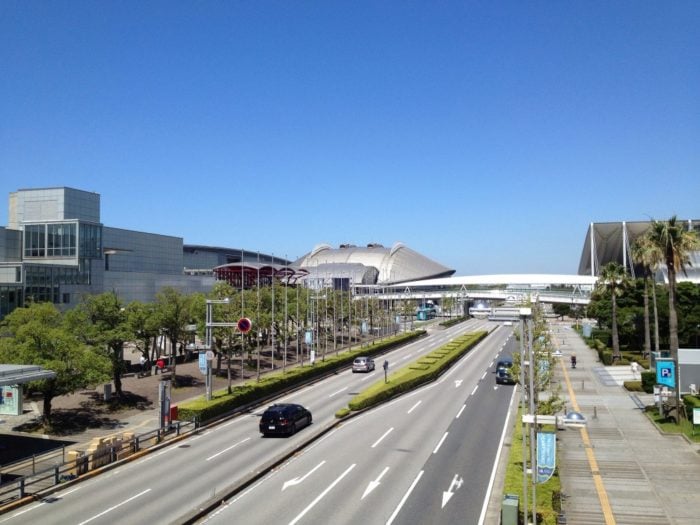
TECHNO–FRONTIER 2018 – AEGIS Rings at Toshiba – Held in Chiba, Japan, and with over 30,000 visitors, the event consisted of 9 professional exhibitions and was the ideal place where visitors could get information about the latest technologies in electronics and mechatronics by directly interacting with many engineers in exhibiting manufacturers.
MOTORTECH JAPAN showcased all kinds of new products and technology, and their application to products related to motors, including various-sized motors, control technology, measuring and analysis technology, and materials. Products and services included motors, drivers & controllers, materials, sensors, related equipment, and measuring tools.
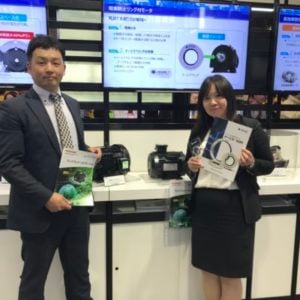 Toshiba’s Asami Shimanaka, Engineer of Motor Drive (right) and Yuta Konishi, AEGIS Product Engineer at Fukuda Corp. (left)
In the wake of increased demands for efficiency and energy savings as well as the greater reliability of industrial motors and drivers, Toshiba has taken the important step to add the AEGIS shaft grounding ring option to their motors lines.
Toshiba was one of the manufacturers showcasing their new industrial motors lines and demonstrated the installation of the shaft grounding rings – an important addition to any motor which is operated by a variable frequency drive (VFD). These Toshiba motors now can have bearing protection built in to improve the reliability of any system where they are installed providing a higher return on investment (ROI) for the customer.
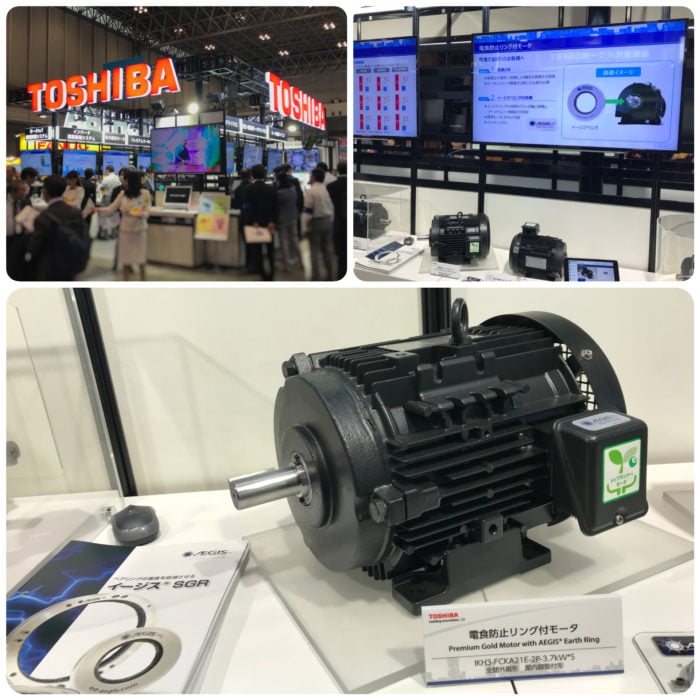 Toshiba Booth at Techno-Frontier with AEGIS Shaft Grounding Ring installed on Toshiba industrial motors.
Find out more about AEGIS® Rings and the Toshiba motors with AEGIS® Rings installed:
 Fukuda Corporation
www.fukudaco.co.jp
Yuta Konishi
Tel: 81-3-5565-6824
Email: konishi@fukudaco.co.jp
Plant Engineering writes about how VFD driven washdown systems save energy and extend equipment life
In the article « Full speed in washdown? Not so fast! » Ron Crutchfield and Gary Jacott of Motion Industries explain the advantages of using variable frequency drives (VFDs) to provide a better way to manage energy and water in washdown systems. Published in the 03/21/2018 edition of Plant Engineering.
In this excellent article Ron and Gary discuss:
- How plants are finding ways to conserve water and energy by using VFDs
- How controlling the flow rate can also extend equipment life
- Real world examples of wash-down scenarios
- How flexibility to provide the volume and pressures can be beneficial through the use of VFDs
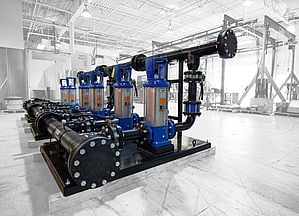 Image from Plant Engineering article
Ron Crutchfield has 35 years of experience as a pump engineer, and is currently senior project engineer for Motion Industries Process Pumps and Equipment in Omaha, NE. Gary Jacott has spent 30 years as an electrical engineer, including 20 years specializing in the industrial automation niche.
Selecting the Right Motor – Reliability Built-in:
One important aspect that was not specifically discussed in the article was the selection of the motor used in the washdown application. Motors operated by VFDs should have both inverter rated Class F or H winding insulation (NEMA Premium has Class F at a minimum), and shaft grounding rings installed to prevent electrical discharges in the bearings.
Whenever a motor is operated by a VFD, the voltage to the motor is a pulse width modulated series of positive and negative pulsed which cause a common mode voltage to be capacitively coupled to the motor’s shaft and can result in bearing discharges. These discharges can also result in catastrophic bearing failure from « fluting » damage, shortened motor life, and expensive repairs and downtime.
|
|
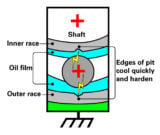 Shaft Voltage Arc in the Bearing |
 Failed Bearing From Electrical Discharges |
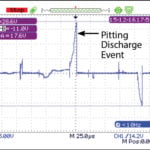
On the bright side, all of these negative effects on the motor’s bearings can be avoided by simply installing a shaft grounding ring on the motor which steers the damaging voltages away from the motor’s bearings to ground. Most motor manufacturers such as ABB (Baldor), WEG, Regal, TECO, GE, and others have motors in their stock list with AEGIS shaft grounding rings installed so selecting a motor to avoid the bearing fluting issue can be quite straightforward.
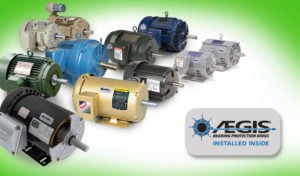 Select Motors with Factory Installed AEGIS from ABB, WEG, Regal, TECO, Leeson, and more
Motors can also be modified by motor repair shops to have the shaft grounding ring installed on the motor during a repair or from the start.
Is there such a thing as a « throwaway » motor? Let’s examine…
When motor failure strikes, decisions must be made. Should the motor be repaired or replaced? Can the downtime be avoided by selecting a better motor?
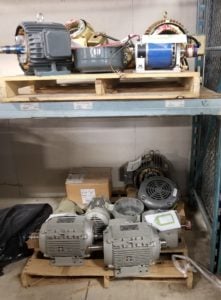 Do you have a pile of failed motors in your facility?
The concept of a « throwaway » motor has come up now and again as has the question of whether it is advisable or « worth the added cost » to add bearing protection in the form of a shaft grounding ring to smaller motors.
The « throwaway » motor concept came from the thought that if the motor was not worth repairing, it should just be replaced when it fails.
In some industries, the range of what is considered a « throwaway » motor is anything under 50 HP or even 100 HP! But what are the total costs connected to a failed motor? What is the price of the new motor compared to the cost to repair? One rule of thumb I have heard is that if the repair costs are more than 60% of the new motor, then it should be replaced.
In the analysis below we look at a small 1 HP motor and its associated replacement costs. Of course as motors become larger, all costs get higher by orders of magnitude. Where a 1 HP motor can cost the facility $4,000 or more, imagine the costs for a 10 HP motor or even a 100 HP. If the motor is critical to a system, reliability becomes even more important.
These are the costs connected to a failed motor:
- Hourly rate of the person/s who must decouple the motor and remove it
- Any special rigging equipment to lift/transport the motor
- The hourly rate of management spending time on the problem
- The hourly rate of any administrative time needed to find a replacement to purchase
- Inventory costs if spare motors are stored on or off site
- Transit costs for the replacement motor when ordered or repaired
- Receiving costs when motor arrives and is stored
- Administrative time to inventory and update records
- Hourly cost of person/s re-installing the motor
- Any lifting or rigging equipment needed to transport/replace the motor
- Alignment and testing of new motor
- Vibration analysis if needed
- Disposal cost of the old motor
- PRODUCTION DOWNTIME!
A failed motor gets very expensive, and it quickly becomes clear that reducing the frequency of failure is well worth the effort.

Is it worth the effort to improve the service life by removing causes of failure?
- The motor must be replaced in any case, so why not with a « better » motor?
- If the motor must be repaired, asking if there is something which can improve its service life makes sense.
- If a new motor is selected, then finding one which lasts longer provides the best return on investment.
- Knowing the cause of failure lets you apply best practices.
- If the bearings failed from fluting damage, installing a shaft grounding ring is the answer.
When the motor is run by a variable frequency drive (VFD), which is more and more likely in today’s systems, the motors are vulnerable to bearing pitting and fluting damage. The good news is that this bearing damage is an avoidable cause of bearing failure, and by the simple addition of shaft grounding rings to motors up to 100 HP (the « throwaway » motors), the problem is easily avoided. Next we will compare the failure costs associated with motors.
1) Failed 1 HP motor with NO bearing protection:
A new 1 HP motor can typically list for about $750. This motor most likely has sealed bearings and is designed for a L10 life of 60,000 hours (about 6.5 years).
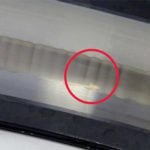 Bearing with damage from fluting
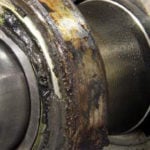 Bearing with lubrication failure
So, if the motor is operated by a VFD, then the pulse width modulation will send high speed switching pulses to the motor. These voltage pulses are capacitively coupled to the rotor and will discharge through the motor’s bearings, burning the grease and electrically eroding the bearing race walls until fluting occurs. Note that even before fluting, the grease is blackened. The grease’s deterioration will decrease the bearing service life by 80% to 90%. This means that the bearings, which should have lasted 60,000 hours, will only last 6,000 to 12,000 hours, or less than 2 years.
OK, now for the math: To get 60,000 hours out of this motor it would need to be replaced 4 times (12,000 hours each) for a total new motor cost of $3,000. But that is not all. Each time the motor is replaced there are additional costs: Removal, disposal, shipping, administrative, alignment, and downtime.
- $3,000 in NEW motor/replacement
- $400 in removal (2 people x 50/hour x 4 replacements)
- $400 in installation (2 people x 50/hour x 4 replacements)
- $200 Disposal ($50 x 4 motors)
- $200 Management and administration
- $200 Alignment, testing, etc.
This $750 one HP motor will cost the facility an additional $4,400 in its 60,000 hour service life! Downtime cost x 4 not included.
2) Failed 1 HP motor, replacement with AEGIS shaft grounding ring installed:
After an unprotected one HP motor fails, replacing it with a motor with an AEGIS ring installed will have the following added costs:
- $910 new motor with shaft grounding ring (adding a shaft grounding ring kit to a new motor costs about $150-$200)
- $100 Removal cost
- $100 Installation cost
- $50 disposal
- $50 management/administration
- $50 alignment, testing etc.
This $750 one HP motor will cost the facility an additional $1,260 in its 60,000 hour service life! Downtime cost is 75% less.
3) Best Case scenario: The 1 HP motor had AEGIS shaft grounding rings installed at the very beginning:
If in the initial installation a one HP motor with a shaft grounding ring was selected and installed to prevent this premature bearing failure, there would only have been one cost adder:
- $60 – the difference in cost for the motor with shaft grounding ring
- Avoided: Removal cost
- Avoided: Re-Installation cost
- Avoided: disposal
- Avoided: Management/administration
- Avoided: Alignment, testing etc.
Downtime cost is ZERO!
Based on this examination it is clear that there really is no such thing as a « throwaway » motor. And even when a decision is made to replace instead of repair, it is always the most cost effective approach to select the most reliable motor.