

Author: AEGIS
Electrical Bearing Protection Q&A Part 8
Part 8 in a series of questions and answers from our Q&A webinars.
Q1. Are there any arcing or sparking concerns with AEGIS® Rings?
A1. Yes, arcing or sparking may occur. Because the shaft voltage is very low when it discharges through the ring, these will be very low-energy arcs, but they may still be a problem in Class I Div 1/Div 2 environments. Underwriters Laboratory (UL) has an approved set of procedures for installing an AEGIS ring inside an explosion proof motor for Class I Div 1 environments. Some motor manufacturers, like Marathon and WEG, offer XP motors with AEGIS. And there are several motor repair companies that are approved to install AEGIS in an XP motor.
To date, NEMA & IEEE have not approved any shaft grounding device for use in Class I Div 2 environments. (Using an XP motor would usually be considered overkill.) But an IEEE task group has been researching this, and we are confident that it will change in the near future.
Q2. The AEGIS Handbook talks about measuring shaft voltage on ac motors. Does this measurement also work for dc motors?
A2. Yes, the testing works exactly the same. The waveforms may look different, because dc drives may use a different modulation scheme. And the shaft voltage is often lower on dc machines than ac induction motors, but the risk of electrical bearing damage is still there.
Q3. How do AEGIS rings compare to common mode cores on large machines?
A3. In ac motors over 100 hp, they work well together. AEGIS rings protect against shaft voltage discharge through the bearings. This is caused by the common mode voltage of the drive’s output. Shaft voltage discharge is a problem is all ac induction motors on drives, regardless of size. There are filters that can reduce common mode voltage, but they are expensive and rarely used.
Common mode cores, or inductive absorbers, filter out much of the common mode current in the drive’s output. Common mode current causes rotor ground current in poorly-grounded motors, and high frequency circulating current in motors over 100 hp (75 kW). So these cores protect against those two modes of damage, but cores do not protect against shaft voltage discharge, the major source of damage in small well-grounded motors. In fact, research suggests that installing improperly sized cores can made shaft voltage discharge damage worse.
In larger motors, we recommend installing an AEGIS Ring at one end, and some type of insulated bearing at the opposite end. The AEGIS Ring discharges shaft voltage, and the insulated bearing blocks circulating current. This is all the protection a well-grounded large motor needs. If the motor frame is not well grounded, you can use high frequency grounding straps to protect against rotor ground current.
Common mode cores can filter up to 65% of common mode current. Although we recommend one grounding ring and an insulated bearing, you could probably use one AEGIS Ring and appropriately sized cores. The ring would protect against discharge current, and the cores would decrease circulating and rotor ground current. Would cores decrease the common mode current enough, so there was no damage from circulating and rotor ground current? Maybe, maybe not. AEGIS used with cores may not be as good as using AEGIS and an insulated bearing, but it’s definitely better than nothing.
Q4. Do servo motors have problems with bearing currents?
A4. Yes and no. We’ve had multiple servo users report bearing fluting, but to date, no servo manufacturers have acknowledged this problem. Another challenge is that with servo motors, there’s no empty space: the case is filled with motor. But we do know of motor repair companies who install AEGIS rings on the outside of servo motors.

AEGIS Rings also come with a 2-year extended warranty against bearing fluting damage. No other form of protection against VFD-caused bearing damage offers a warranty like this.

To learn more about AEGIS shaft grounding and best practices for electrical bearing protection, sign up for a training. We offer monthly live training webinars, and – pandemic situation allowing – we can also visit your site and give an in-person training, with an emphasis on your specific needs.
Getting Around Electrical Bearing Damage
Variable frequency drives (VFDs), or inverter drives, allow precision RPM and torque control of electric motors. In some applications, they can save up to 30% on energy costs. However, VFDs are not without problems, and can induce unwanted shaft voltage. Without effective protection, shaft voltage can cause premature bearing failure and thus motor failure.
The National Electrical Manufacturers Association (NEMA) and other institutions recommend that new motors be equipped with effective bearing protection. But whereas insulation is designed according to the latest standards to protect the windings, bearings are often neglected. In order to be truly suitable for VFD operation, a motor should additionally have long-term bearing protection. Often, this is not given sufficient consideration, and this omission leads to expensive downtime.
Risk of motor damage during VFD operation
Damage to windings and bearings can result from the repetitive and extremely fast impulses produced by modern VFDs in the motor. VFD output voltage’s fast rise time puts stress on the motor windings. Under some circumstances, “reflected waves” can produce voltage spikes up to twice as high as the drive’s specified output voltage.
 New bearing (left) and one with advanced electrical damage (right)
In addition to winding damage from fast voltage rise times, the imbalance of drive output voltage produces a voltage difference between the motor shaft and frame (“shaft voltage”). This leads to a voltage across the bearings, and this bearing voltage can cause arcing when it discharges. This arcing erodes the bearing surfaces and leads to premature failure. Each arc creates a microscopic pit, and in aggregate, these pits give the bearing a matte, frosted appearance. Over time, fluting occurs: A washboard-like series of ridges forms, resulting in increased bearing noise and vibrations. By the time fluting has developed, the motor will make a piercing screech when it runs, and the bearing must be replaced before it fails catastrophically.
A new bearing and one with advanced electrical damage are shown in the figure above (click to enlarge).
Electrical bearing protection
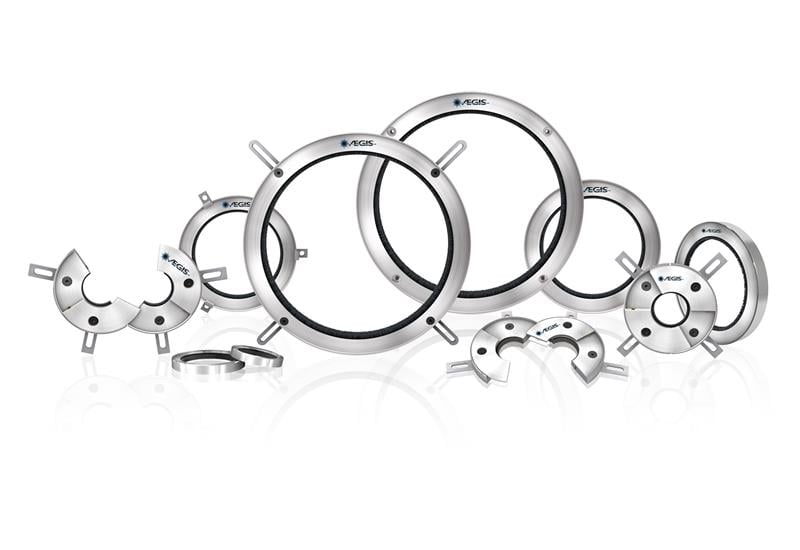 AEGIS Shaft Grounding Rings
In most cases, a reliable and cost-effective way to minimize electrical bearing damage and increase the reliability of VFD-controlled motors is to use an AEGIS® Shaft Grounding Ring. (In addition to an AEGIS ring, motors larger than 100 hp/75 kW also require an insulated bearing at the opposite end from the grounding ring.)
AEGIS rings encircle the shaft with thousands of highly conductive microfibers, which are secured in a patented FiberLock channel. The microfibers create a very low-resistance path from motor shaft to frame. Rather than arcing through the bearings, current from the shaft will instead travel through the grounding ring. The microfibers ride lightly on the shaft with very low friction, so they are much less subject to wear than other forms of shaft grounding. Moreover, AEGIS rings can be scaled up to arbitrarily large shaft diameters.
Simple proof of efficacy
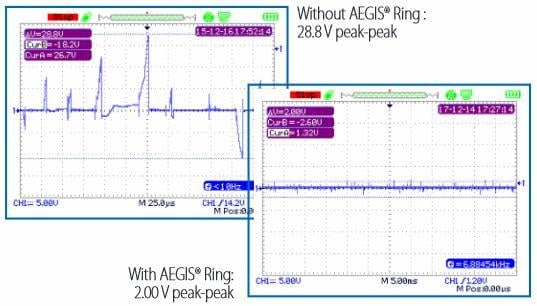
Shaft voltage readings before and after installation of an AEGIS Ring
The effectiveness of shaft grounding rings can be detected by simply measuring the shaft voltage with an oscilloscope. Without shaft grounding, the voltage profile appears in high voltage peaks and steep discharge edges. After applying the shaft grounding ring, a virtually flat line appears.
AEGIS Shaft Grounding Rings have proven their value in millions of installations worldwide, mainly in North America and Asia. Many motor manufacturers, such as ABB Baldor, WEG, and Regal Rexnord, use factory-installed shaft grounding rings as standard or as options for certain motor series, so that the operation of the VFD does not have any harmful side effects on the motors.
AEGIS Rings also come with a 2-year extended warranty against bearing fluting damage. No other form of protection against VFD-caused bearing damage offers a warranty like this.
To learn more about AEGIS shaft grounding and best practices for electrical bearing protection, sign up for a training. We offer monthly live training webinars, and – pandemic restrictions permitting – we can also visit your facility to review your exact application.
Shaft Grounding for Vertical Hollow Shaft Motors
According to the US Centers for Disease Control, drinking water chlorination and treatment was one of the ten greatest public health achievements of the 20th century. And of course, you can’t effectively treat water without pumping it. Vertical hollow shaft motors are an essential part of the modern water pumping process.
And not just for drinking water: Hollow shaft motors have large roles in wastewater, agriculture, mining, and chemical processing. As a rule, these motors do not always need to run at full speed. So it makes sense to run them at reduced speed with variable frequency drives.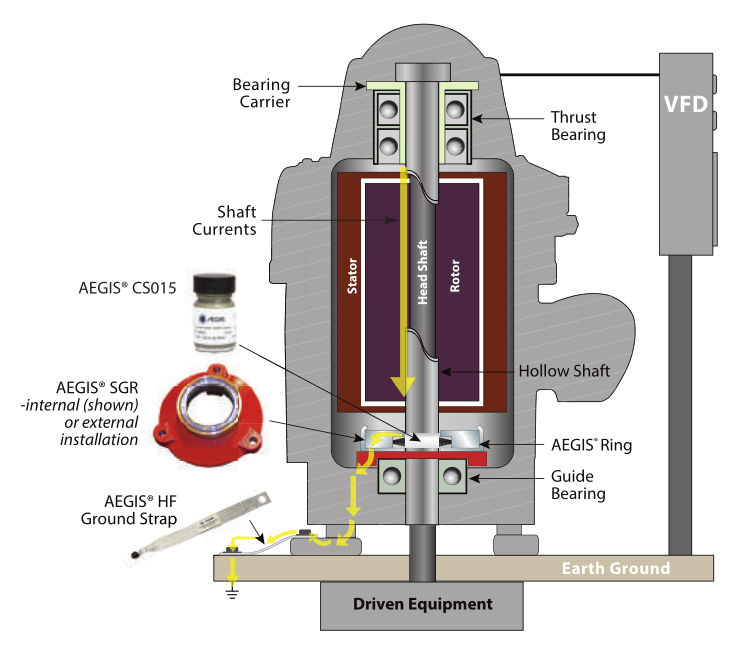
The downside of VFDs is that their pulsed voltage output can cause problems in electric motor windings and bearings. The windings are not such a problem in modern “inverter duty” motors. But many motors, vertical and horizontal, still don’t include electrical bearing protection, and are vulnerable to electrical bearing failure.
The best way to protect vertical hollow shaft motors against electrical bearing damage from VFDs starts with an AEGIS® Shaft Grounding Ring at the lower bearing. For motors over 100 hp (75 kW), the upper bearing must be electrically isolated from the shaft and frame. This is usually done by installing an insulated bearing, with either a ceramic rolling element or an aluminum oxide coated inner or outer ring. Alternatively, if the motor has a bearing carrier, the bearing carrier can be treated with an insulating aluminum oxide coating.
There are scores of specially trained motor repair facilities, AEGIS Trained Installers, who can both install the grounding ring and bearing insulation (where necessary).
There are also vertical hollow shaft motors that come with electrical bearing protection built in. All US Motors CORRO-DUTY Inverter Duty Vertical HOLLOSHAFT® Motors include an AEGIS ring and insulated upper bearing (where necessary).
Wolong’s GE Industrial Motors also offers fully-protected vertical hollow shaft motors. All Ultra+™ Vertical Hollow Shaft with WPI motors include AEGIS rings. And so do motors over 40 hp (30 kW) in the Ultra™ TEFC Vertical Hollow Shaft Inverter Duty with Bearing Fluting Protection line.
Those motor lines come with an AEGIS ring, standard. Other motor lines and manufacturers can add an AEGIS ring as a mod, but modification is not as convenient as, and takes longer than, ordering a standard catalog motor.
So whether you get a new motor with AEGIS installed, or have a grounding ring installed by a trained repair contractor, there’s no reason not to protect vertical hollowshaft motors with AEGIS.
AEGIS Rings also come with a 2-year extended warranty against bearing fluting damage. No other form of protection against VFD-caused bearing damage offers a warranty like this.
To learn more about AEGIS shaft grounding and best practices for electrical bearing protection, sign up for a training. We offer monthly live training webinars, and – pandemic situation allowing – we can also visit your site and give an in-person training, with an emphasis on your specific needs.
Electrical Bearing Protection Q&A Part 7
Part 7 in a series of questions and answers from our Q&A webinars.
 Q1: What’s the largest motor you can use a shaft grounding ring on?
A1: There is no size limit. We routinely make AEGIS® rings for turbines over one foot in diameter. The largest ring we’ve made to date was about 40″. A lot of these larger rings get used in power generation: wind, water, and other projects.
The larger the shaft, the heavier we make the ring. We’ll upgrade the material to stainless if the application requires a very rigid component.
Q2: You can have different levels of shaft voltage. Are 15V discharges high enough to cause bearing fluting?
A2: Just to be clear: you need an oscilloscope to make these kinds of measurements. That said:
Fifteen volts is more than enough charge to damage the bearing when it arcs. We usually see voltage from zero up to 15-20 volts, and occasionally much higher. But the voltage doesn’t tell you the whole story.
You also have to consider the discharge frequency, how many times per second you get arcing through the bearing. If you have 15V discharging a few times per second, that’s bad, but the motor won’t fail tomorrow. But have you have 15V discharging a few thousand times per second, it’s going to fail a lot sooner. (You can get an idea of this by setting the trigger level on the scope. If you set it high and the waveform only updates every few seconds, then you’re not having a lot of discharge at that level.)
We like to get the voltage to less than one volt peak. The best way is to measure a baseline, see what it looks like without shaft grounding. Then you use our shaft grounding simulator and test the shaft voltage again to see what it would look like with a grounding ring. Usually, you’ll go from 15V down to under one volt. As a rule of thumb, anything up to five volts peak is fine. Once you’re down that low, you can be sure the bearing will last for its usual lifetime.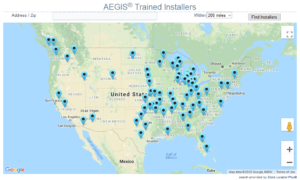
Q3: What contractor would install a grounding ring, if it’s not installed by the manufacturer?
A3: You should have it done by whomever is going to do the best job. HVAC, electrical, and facilities/maintenance contractors can do it, and in-house maintenance staff, and so can motor repair contractors. Whoever you have do it, you want to be sure they’ve got experience.
We have a list of trained installers on our website. It’s in a searchable database, so you can find the closest one to you.
Q4: Can shaft voltage create the white etching effect? This is in a polymer extrusion setup, with motors up to 20 MW.
A4: Yes. High shaft current can basically weld the bearing to the shaft. But there may be other causes.
In your case, the first thing to do is take care of the shaft voltage. For a large motor, you want the nondrive end bearing to be insulated. You want a high frequency grounding strap, too. I recommend bonding the strap directly to the grounding ring.
With that taken care of, you can start troubleshooting other possible causes. If you think you have a problem with your gearbox, AEGIS rings can also go on gearbox shafts. Typically you don’t need to shaft ground both the motor and the gearbox, but some of our users have done this when they’ve had a hard time pinning down the problem.
In injection molding, everything in the plant has a way of acquiring a nonconductive coating. So we recommend installing the ring inside the motor, to keep it away from the nonconductive goop that deposits on everything.
AEGIS Rings also come with a 2-year extended warranty against bearing fluting damage. No other form of protection against VFD-caused bearing damage offers a warranty like this.
To learn more about AEGIS shaft grounding and best practices for electrical bearing protection, sign up for a training. We offer monthly live training webinars, and – pandemic restrictions permitting – we can also visit your facility to review your exact application.
Electrical Bearing Protection Q&A Part 6
Part 6 in a series of questions and answers from our Q&A webinars.
Q1: Do you need a shaft grounding ring and a high frequency bonding strap, or is just the strap enough?
A1: You definitely need a grounding ring. You may or may not need a grounding strap, too. Motor and drive manufacturers recommend them. Here’s what’s going on:
Three phase power off the line is balanced. The voltage in each of the three phases always cancels out; the sum of the three voltages is zero. Power from a VFD is unbalanced. The voltages in each phase do not cancel each other out. So when the power gets to the motor’s stator windings, there is a net voltage. This net, or common mode, voltage also changes rapidly. When the drive switches a phase on or off, the net voltage changes by hundreds of volts in under a microsecond. Whenever voltage in a line changes rapidly like this, you get high frequency current leaking out through stray capacitances. This stray current has to get back to the drive somehow. We talk about “ground” and grounding, but for our purposes, ground is just a part of the path back to the drive.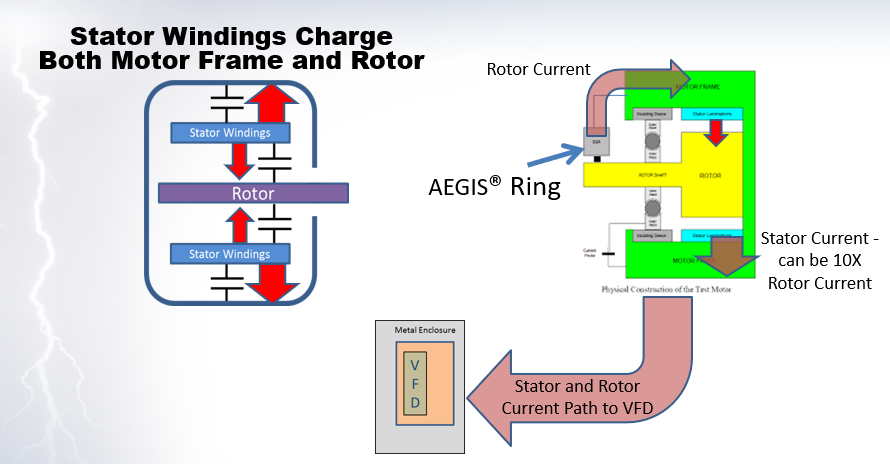
That’s what this image shows. Rapidly changing voltage in the stator windings makes current leak out onto the rotor and the motor frame. Without shaft grounding, current from the rotor will arc through the bearings to get to the frame and then ground. In the image above, it’s called rotor current, but it’s more often called shaft current or shaft voltage discharge. If you put an AEGIS ring on the shaft, then this current can get to the frame without arcing through the bearing. That’s what shaft grounding rings are for.
Meanwhile, you have a large amount of current leaking from the windings onto the frame. In the image, it’s called stator current. This needs to run to ground, too. If the frame’s ground connection is good, no problem. But if the motor is poorly grounded, this current often ends up jumping from the frame through the bearings to the shaft, then through the coupled equipment’s bearings, then to ground. This destructive current is called rotor ground current. It can kill both the motor’s bearings and the equipment’s bearings.
To clarify the terminology in the image: rotor current comes from the rotor; stator current comes from the stator. If the grounding is good, stator current just flows to ground. If the grounding is poor, stator current will instead arc through the bearings as rotor ground current.
What a grounding strap does is ensure that current from the frame can go to ground. The strap gives a nice low-resistance path from the motor to the equipment, so stator current flows through it instead of through the bearings.
Now, getting to your question: If you only have a grounding strap, and no grounding ring, you will prevent rotor ground current from damaging the bearings. But you will still get damage from shaft voltage discharge, unless you also have a grounding ring.
Q2: What’s the difference between an AEGIS HFGS and a regular braided grounding strap?
A2: Any braided grounding strap will do the job. The wider it is, the more surface area it has, and the better it works. The surface area is important because these are high frequency currents, and they travel on the surface of conductors. It’s called the skin effect. The more surface area a conductor has, the less impedance (resistance) it has to high frequencies.
AEGIS HFGS are easier to use because you can get them with bolt holes punched into them. You can size them based on NEMA/IEC frame size, and just attach them through the bolt hole in the motor foot. But otherwise, they’re equivalent.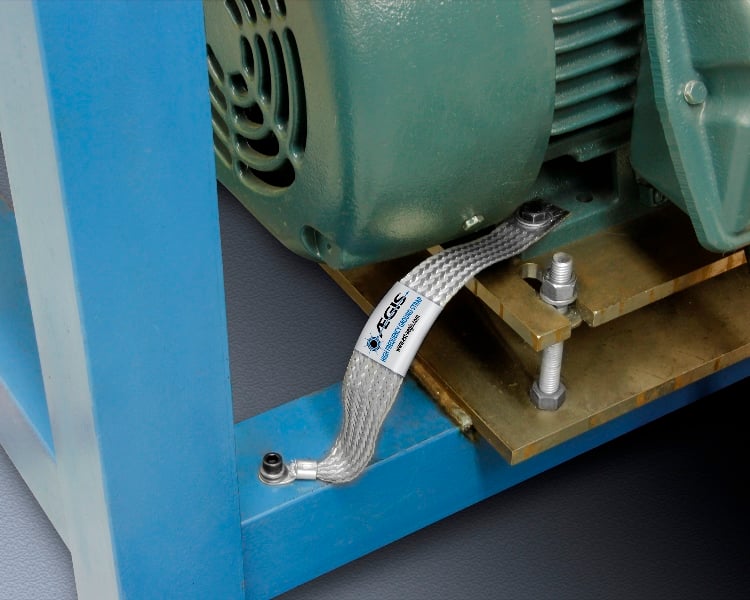
Q3: The grounding strap gets attached to the motor at one end. What is the other end of the strap attached to?
A3: Good question. You want to be sure that from motor frame to earth ground you have good conductors with as few connections as possible. Like the I-beam frame of a building: steel is a good conductor. Concrete is not. So ground wires should not terminate at concrete. We’ve been to plants where they have a grounding mat, which is like a grid of cross-hatched rebar, buried in the ground.
It also helps to use the strap to bond the motor frame to the driven equipment’s frame. If both the motor and equipment are poorly grounded, this won’t help current get back to the drive, but it will prevent rotor ground current from scorching the bearings.
Q4: What kind of amperage on a grounding strap is too high? We have a spec of less than 5 amps, and that seems high, even for a 300 hp motor. Could this be phase imbalance, since our machines only use a VFD to start?
A4: The current capacity of a grounding strap depends on its width and thickness. We size ground straps based on motor specs, so the larger the motor, the higher current capacity the strap will have. On a drive, stator ground current comes in pulses. Those pulses range from 20 amps for small motors up to 200 amps for very large ones.
But if you’re on line power and seeing 5 amps, there’s something else going on. You shouldn’t be able to power another piece of equipment with the ground wire. You’re right that the ground current you see is a symptom of an underlying problem. Whether it’s phase imbalance or something else, we can’t say.
AEGIS Rings also come with a 2-year extended warranty against bearing fluting damage. No other form of protection against VFD-caused bearing damage offers a warranty like this.
To learn more about AEGIS shaft grounding and best practices for electrical bearing protection, sign up for a training. We offer monthly live training webinars, and – pandemic restrictions permitting – we can also visit your facility to review your exact application.
Diagnosing Electrical Bearing Damage
When an electric motor bearing fails prematurely, you should try to determine why it failed. If you don’t, you run the risk of repeated failure. And if one unexpected failure is bad, one after another is a lot worse.
There are any number of guides to bearing failure analysis out there. Many bearing manufacturers publish their own guides. In this article, we’re only going to talk about electrical bearing damage, most often due to VFD control without proper protection. There are three main signs of electrical bearing damage: Burnt or blackened grease; frosting of the bearings and raceways; and fluting of the raceways.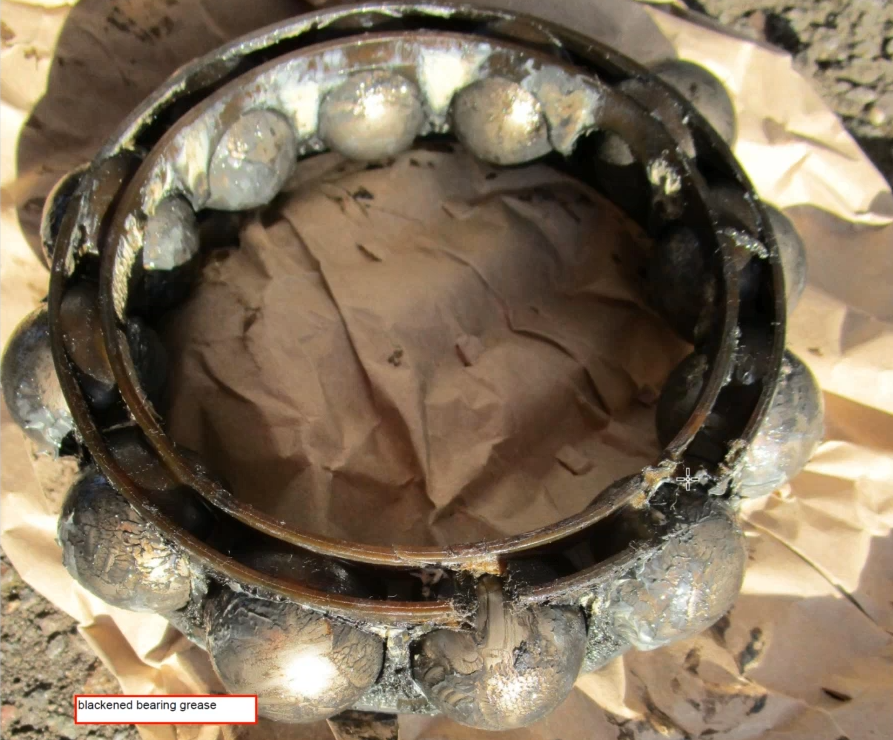
When you cut a bearing for inspection, damage to the grease is the first thing you’ll see. In the first photograph, you’ll see that there are spots of creamy beige grease near the top. This is what the grease looked like when it was new. Contrast that with the grey/brown stained grease on the balls. That discoloration is a sign of electrical damage. When electrical arcing occurs in the bearing, it chemically damages the grease and causes discoloration. This damage decreases the grease’s lubricating properties, which causes excess heating and hastens further damage.
This arcing also causes electric discharge machining (EDM). Each arc, like a tiny lightning bolt, blasts bits of metal off of the races and rolling elements. These bits of metal disperse into the grease, causing further discoloration.
The EDM process leaves behind microscopic pits in the surface. These pits are tiny – on the order of one micron (about 1/25 000 of an inch). But in mass, they are visible as frosting. In the second and third photos, you can see bands of dull, matte surface along with the shinier undamaged metal. That matte surface is frosting. It is very common to see bands of frosting like this, while the rest of the raceway remains smooth and shiny.
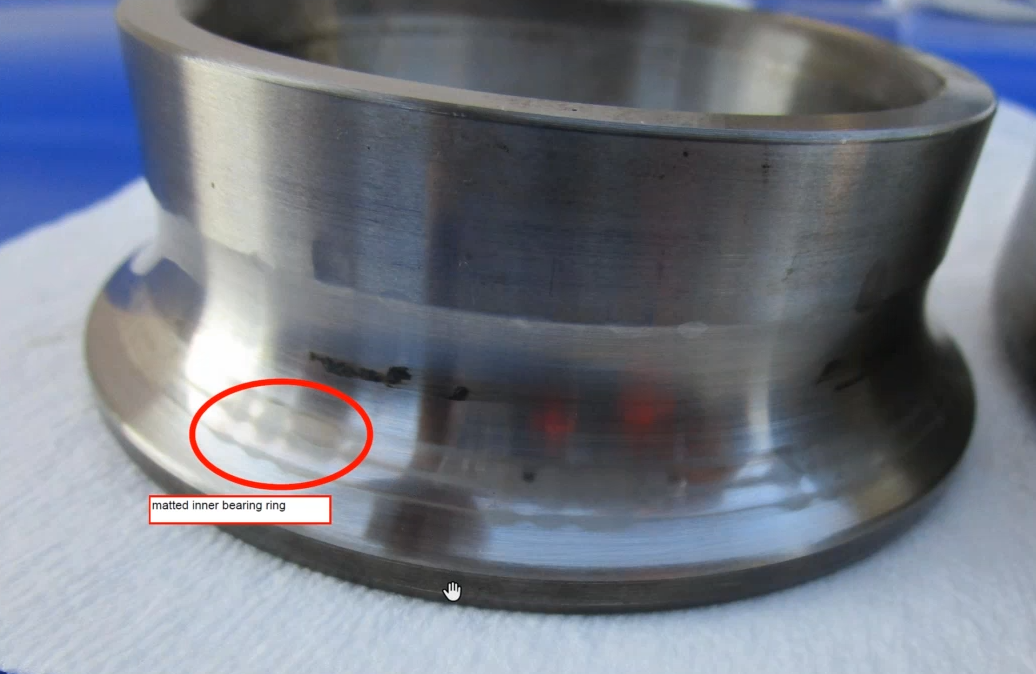
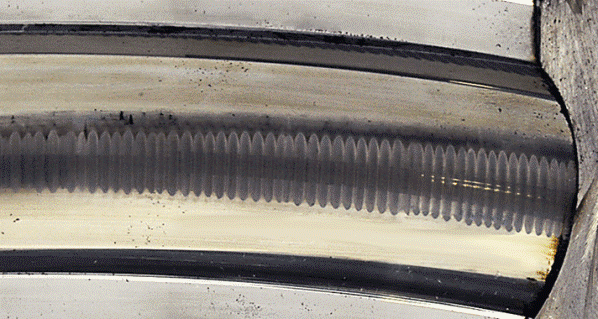
In severe cases, frosting leads in turn to fluting. Fluting is a pattern of washboard like ridges along the bearing race. The beginnings of fluting are can be seen in the second photo (taken from the same machine as photo #1), and a more advanced case is shown below. Oftentimes, the flutes are concentrated in the load zone of the bearing. In the early stages of fluting, they are often more spread out. But over time, additional flutes develop between them. Fluting causes excessive vibration, noise, and heat generation. By the time a bearing is fluted, failure is near.
If a motor develops electrical bearing damage once, the chances are excellent that it will happen again, unless preventive measures are taken. In small, well-grounded motors, an AEGIS® Shaft Grounding Ring will do the trick. In motors over 100 hp (75 kW), we recommend an insulated bearing at the other end from the grounding ring, to interrupt high frequency circulating current. And in poorly grounded motors, we recommend that you bond the motor frame to its coupled equipment with a high frequency grounding strap, or use higher quality VFD cable.
AEGIS Rings come with a 2-year extended warranty against bearing fluting damage. No other form of protection against VFD-caused bearing damage offers a warranty like this.
To learn more about AEGIS shaft grounding and best practices for electrical bearing protection, sign up for a training. We offer monthly live training webinars, and we can also visit your facility to review your exact application.
Electrical Bearing Protection Q&A Part 5
Part 5 in a series of questions and answers from our Q&A webinars.
Q1: What kind of instrument do you need to test for shaft voltage?
A1: You need an ocilloscope with at least 100 MHz of bandwidth. Any brand is fine, as long as it’s got the bandwidth. Sad to say, you can NOT use a multimeter or ordinary voltmeter. Shaft voltage is high frequency, & voltmeters just don’t have fast enough response time.
Fluke is a great brand, and their MDA-550 includes everything you need to test for shaft voltage. But they are expensive.
Our AEGIS Shaft Voltage Tester may not have all of the bells and whistles, but it does the job. One very nice feature ours has is that you can save a reading just by pressing and holding one button. Usually you have to click through a few screens to record a reading.
Q2: We have a three foot diameter fan with a grounding ring at the fan housing. Does this offer any protection to the 250 hp motor that drives it?
A2: Absolutely. But at 250 hp, the motor is also liable to have circulating currents. You really want an insulated or a ceramic bearing to prevent those. Of course it can be hard to change the bearing on an installed motor. So you can also try common mode cores. Those will at least reduce circulating currents.
Q3: Does a motor on VFD running at constant speed have fewer problems than one with constantly varying speed?
A3: It may. Ultimately, you need to check the shaft voltage. We’ve seen installations that are OK running at constant speed, but we’ve seen plenty where they did have bearing discharge. When in doubt: Test.
Q4: Can you put a grounding ring on the non-drive end of a C-face motor?
A4: Absolutely. Sometimes you see C-face motors where there’s enough room at the drive end for a grounding ring. But you can always put a ring on at the opposite drive end. The one catch is for motors over 100 hp: They will have circulating currents, and we recommend an insulated bearing at the non-drive end. The grounding ring must always be at the opposite end from the insulated bearing.
AEGIS Rings also come with a 2-year extended warranty against bearing fluting damage. No other form of protection against VFD-caused bearing damage offers a warranty like this.
To learn more about AEGIS shaft grounding and best practices for electrical bearing protection, sign up for a training. We offer monthly live training webinars, and – pandemic restrictions permitting – we can also visit your facility to review your exact application.
Common Mode Chokes Can’t Prevent (all) Electrical Bearing Damage
As the problem of VFD-caused electrical bearing damage becomes better known, more electric motor users are looking for solutions. And more manufacturers are offering solutions. But most of these products can’t solve the entire problem. For instance, AEGIS® Shaft Grounding rings are great at stopping damage due to shaft voltage discharge, but they cannot prevent circulating currents in larger motors. That’s why for large motors, we recommend an AEGIS ring at one end (to take care of discharge currents) and an insulated bearing at the other (to block circulating currents). Together, they virtually eliminate the risk of electrical bearing damage.
There are many types of VFD output filters out there, but in this post, we are only speaking of purely inductive filters. Inductive filters are commonly called common mode chokes or common mode cores, and occasionally inductive absorbers, and some brands claim to completely solve the problem of electrical bearing damage from VFDs. But do they?
The short answer is: No. These products can reduce damage due to high frequency circulating currents and rotor ground currents, but they cannot eliminate bearing damage due to shaft voltage discharge. To understand why, we’ll have to look at the VFD output power, and three kinds of electrical bearing damage.
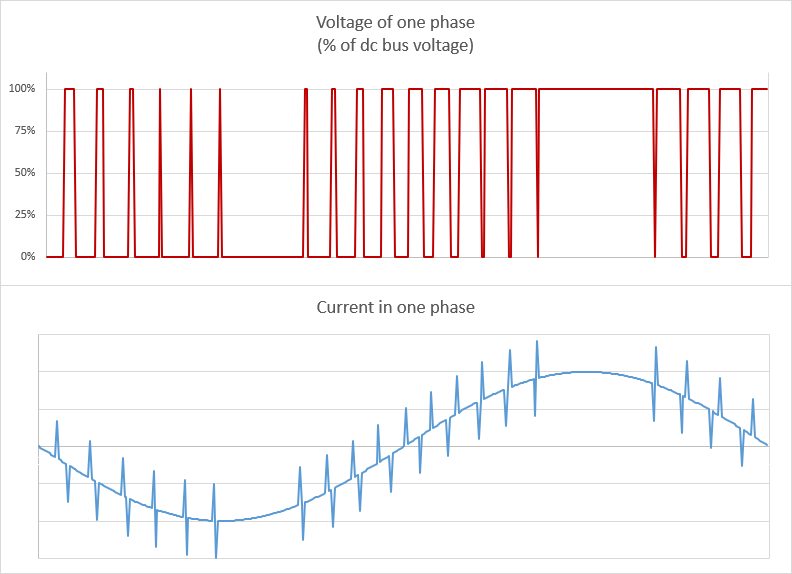
VFDs convert line power into a series of pulses of voltage in each phase (Figure 1, red). By controlling the timing of each pulse, the drive can run the motor at speeds much slower than the line frequency. But unlike line voltage, drive output voltage is not balanced. The pulses in each phase do not cancel each other, the way that line voltage does. The three phases’ average value is called the common mode voltage.
The common mode voltage is a measure of the total (net) voltage that the motor “feels”. This net voltage induces the shaft voltage that causes rotor discharge bearing currents (Figure 2, yellow). Rotor discharge currents are a problem in all motors on drives, regardless of size.
The current from a drive looks less like a pulse and more like a sine wave (Figure 1, blue). But every time the drive switches on or off, there is a spike of high frequency current, as the rapidly changing voltage charges capacitances in the motor and cabling. Between the three phases of drive power, the current mostly cancels out. Except for those spikes. The sum of the current spikes in each phase is called the common mode current.
When common mode current gets to the motor, it doesn’t go through the stator windings because they have high impedance (resistance) to high frequency current. Instead it leaks by capacitance from the windings to the motor frame, and then runs to ground (and back to the drive). This can cause bearing damage in two ways.

In motors over 100 hp (75 kW), common mode current produces high frequency circulating currents (Figure 2, orange). These are larger than rotor discharge current, and they damage the bearings faster. They are not a problem in smaller motors.
In poorly grounded motors, there is no low-impedance path back to the drive. So some of the common mode current may arc through the motor bearings, run down the shaft to the driven equipment, arc through the equipment’s bearings, and then run to ground and back to the drive. This is called rotor ground current (Figure 2, blue), and it damages motor and other equipment’s bearings. Rotor ground current may be even larger than circulating currents. It can be a problem in all motors on drives, but only if they’re poorly grounded.
Inductive filters can reduce the common mode current by 10 to 65%. So they can absolutely reduce the damage due to high frequency circulating and rotor ground currents. We recommend one insulated bearing to block circulating current, and a high frequency grounding strap to avoid rotor ground current. But these filters are definitely better than no protection against circulating and rotor ground currents.
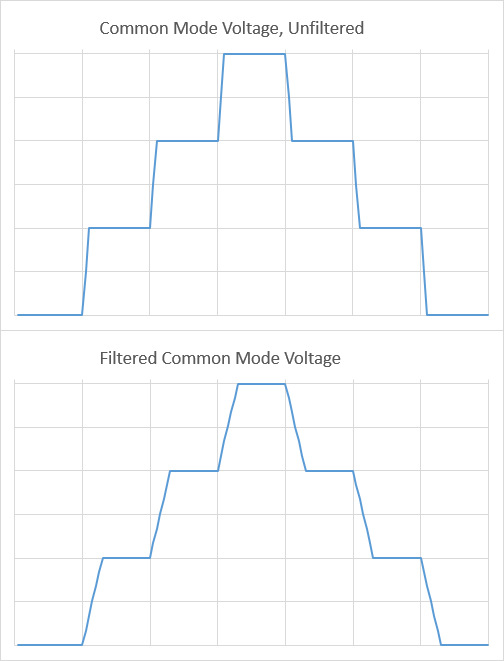
These filters reduce common mode current. But they barely affect the common mode voltage, the cause of rotor discharge currents. They may reduce the voltage by up to 15%, but they mainly only decrease how quickly it changes (Figure 3). What matters for rotor discharge currents is the SIZE of the common mode voltage, not how quickly it rises.
Because the common mode voltage is not reduced, the shaft voltage is not reduced. Some distributors and marketers of these filters specifically say that the shaft voltage should not be measured. “Pay no attention to the man behind the curtain!”
So with or without inductive filters, you will still get shaft voltage discharge through the bearings… Unless they’re protected with effective shaft grounding. Like an AEGIS ring.
AEGIS Rings also come with a 2-year extended warranty against bearing fluting damage. No other form of protection against VFD-caused bearing damage offers a warranty like this.
To learn more about AEGIS shaft grounding and best practices for electrical bearing protection, sign up for a training. We offer monthly live training webinars, and we can also visit your facility to review your exact application.
Note: In addition to the purely inductive filters described here, there are also inductive + capacitive (LC or LRC) filters like dV/dt filters and sine filters. These can also reduce high-frequency circulating and rotor ground currents. There is a third type called a four-pole or all-pole filter, which is an LC filter with additional circuit elements linking each phase to ground or back to the drive’s dc bus. This third type can accurately be called a common mode voltage filter, and it can minimize all VFD-sourced bearing currents. These filters, however, have their own drawbacks, including large size, high cost, and significant voltage drop (sometimes over 10%).
Electrical Bearing Protection Q&A Part 4
Part 4 in a series of questions and answers from our Q&A webinars.
Q1: Is the grounding of the motor important, and if so, what kind is needed?
A1: AEGIS rings bleed charge off the shaft, but that charge then needs to get back to the VFD somehow. It’s important that there be a good, low-impedance path from the motor frame to the drive. To be clear, that is what we mean by “grounding”: a low-impedance path from frame to drive. Even if “grounding” is not strictly the right term when that path doesn’t go through the facility ground. The return path often does lead through the ground, but if you use a high-quality VFD cable, that will carry most of the return current. 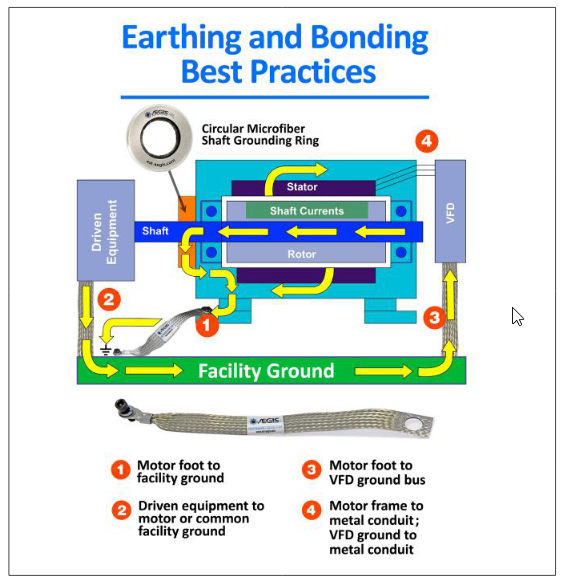
Regardless of the return path: You can have what are called rotor ground currents when the motor is not well-grounded. Rotor ground current jumps from the frame through the bearings, and then goes to ground through the load. These currents are doubly destructive, because they arc through motor and equipment bearings.
Either way, these are high-frequency discharges, and with high frequency electricity, you have the skin effect where current only travels close to the surface of a conductor. So we recommend a high frequency grounding strap, with high surface area. You bond one end of the strap to the motor frame, and the other end to the driven equipment or other well-grounded conductor. There are also excellent VFD cables with special features to decrease the impedance, but some of them get pretty expensive.
Q2: Sometimes we see shaft voltage even on motors that are not controlled by VFD. Do you recommend AEGIS rings in that case?
A2: Yes, they’re often used on motors without drives, and on generators for that matter. Besides VFDs, this can come from static, power surges, and other sources. When in doubt, use a scope and measure the shaft voltage. If there’s voltage across the bearing, regardless of the source, it can discharge through and damage the bearings.
Q3: Do shaft grounding rings work if they get grease on them?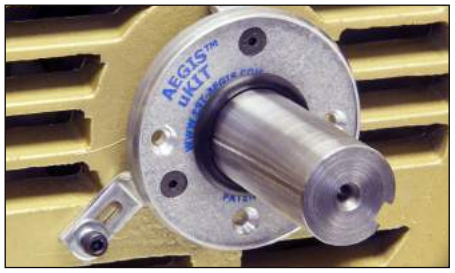
A3: There’s a certain amount of grease in every application, whether small or large. Our microfibers are good at wiping away grease and oil as the shaft spins. If you’re concerned about large amounts of grease, there are other options. First, we recommend mounting the ring inside the motor whenever possible. If you can’t mount inside, we recommend a slinger or an O-ring to cut down the amount of grease getting to the fibers.
Q4: If the ring is mounted internally, is it still necessary to use colloidal silver shaft coating?
A4: We have several motor manufacturers who install SGRs inside their motors. Not one of them uses colloidal silver. A big part of the silver coating’s purpose is to prevent rust or other oxidation on the shaft. If you choose a good, stable position on the shaft to mount the ring inside, oxidation is less of a problem.
AEGIS Rings also come with a 2-year extended warranty against bearing fluting damage. No other form of protection against VFD-caused bearing damage offers a warranty like this.
To learn more about AEGIS shaft grounding and best practices for electrical bearing protection, sign up for a training. We offer monthly live training webinars, and – pandemic restrictions permitting – we can also visit your facility to review your exact application.
Electrical Bearing Protection Q&A Part 3
Part 3 in a series of questions and answers from our Q&A webinars.
Q: If you use insulated bearings without an SGR, where will the current from the shaft go?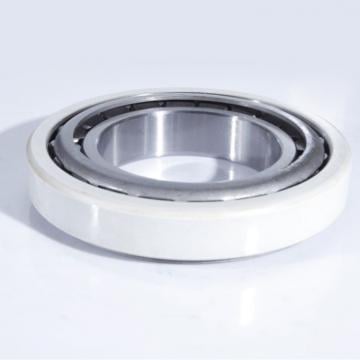
A: First off, there are two levels of insulated bearings.
“Insulated bearings” per se have an aluminum oxide coating on the outer or inner ring – for example, SKF’s INSOCOAT bearings. The rolling elements are steel. Their cost is about 3-5 times a standard bearing. The electrical resistance of the aluminum oxide coating is high, from 5 to 150 MΩ (megaohms). But it is still possible to get shaft voltage building up enough to cause arcing through the steel parts of the bearing.
There are also hybrid or ceramic rolling element bearings. These have steel rings and ceramic balls (rolling elements), and are essentially electrically inert (~ millions of MΩ). If you put two ceramic bearings on the motor, then current cannot pass through the bearings, period. One downside is that ceramic bearings and couplings are 7-10 times more expensive than standard bearings.
Back to the question, if it can’t get through the motor bearings, then how can the shaft voltage discharge? If the motor is coupled to a fan or a pump, the path of least resistance to that current from the shaft will be through the equipment. So the motor bearings will be fine, but the bearings of the coupled equipment will be damaged.
If your primary concern is the coupled equipment – your fans, gearboxes, and pumps – they’re typically 2-3 times more expensive than the motor driving them. If you electrically isolate the motor shaft from the frame, with insulated bearings, the shaft voltage from the VFD will still seek a path to ground, and that path is probably going to go through that expensive coupled equipment. Insulated bearings protect the less-expensive part of the system and leave the more expensive parts vulnerable.
This can be prevented with an electrically insulating ceramic coupling between the motor shaft and the driven equipment. But like ceramic bearings, ceramic couplings are expensive, again 7-10 times the cost of an ordinary steel coupling.
It is more economical to protect small motors and their driven equipment with an AEGIS® Shaft Grounding Ring. By bleeding voltage off the shaft, the ring protects both motor and equipment bearings. Motors over 100 hp (75 kW) are prone to high frequency circulating currents, as well as shaft voltage discharge damage. For these larger motors, we recommend one bearing with outer ring insulation to interrupt the circulating current, along with an AEGIS ring to take care of the shaft voltage.
So insulated bearings are limited, but they’re definitely better than nothing at all. We recommend one of them, in conjunction with a grounding ring, because they’re much less expensive, but still protect adequately against circulating currents.
Q: How do AEGIS rings compare against carbon brushes for shaft grounding?
A: We recently published a full blog post on this. In brief: Carbon brushes are 100 years old. Nowadays carbon brushes have different composition and holder designs, but they’re basically the same technology. AEGIS rings were patented in 2005. Over the past 15 years, they’ve become the globally dominant shaft grounding technology.
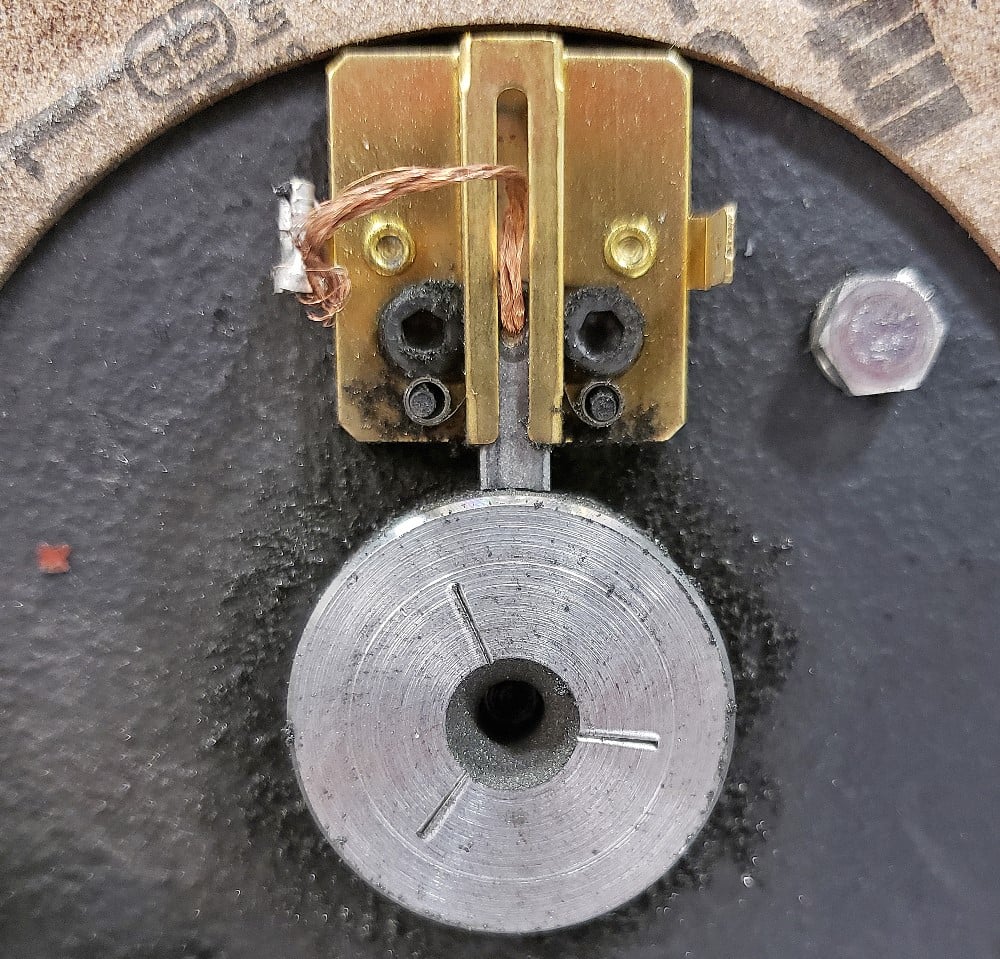
All carbon brushes have a spring pushing the carbon block against the motor shaft. Because it’s under pressure, the brush wears over time, producing dust. And because of this wear, the brushes require adjustment. In field we often see brushes not even in contact with shaft. So brushes are typically mounted outside the motor frame because of this dust and need for adjustment. The brush must also form a patina to slide properly and with low friction. Over time, patina oxidizes and provides electrical resistance.
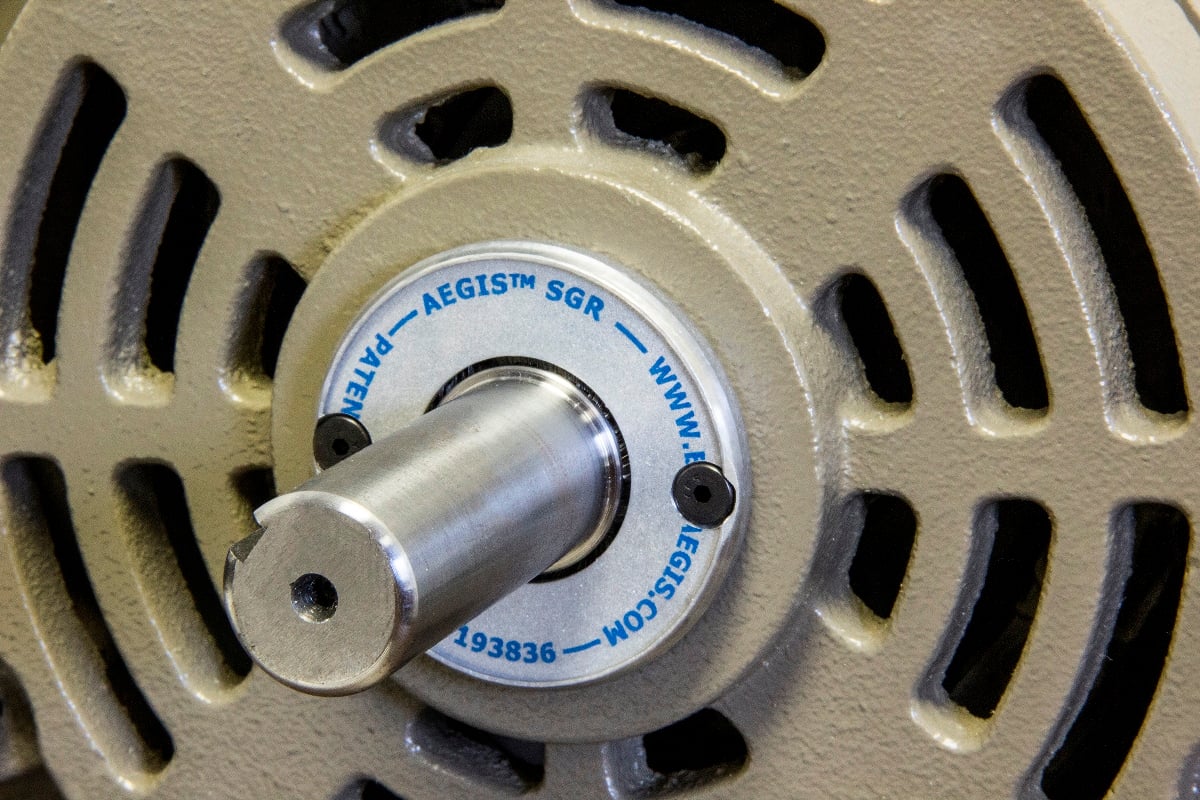
Shaft Grounding Rings, on the other hand, use conductive microfibers in contact with the shaft. They’re not under pressure, so they don’t wear or generate dust appreciably. Given that they don’t require adjustment, they can be installed inside motors, and in fact we recommend that. Our lab testing indicates a lifetime of 100,000 hours, which is over 11 years. And AEGIS Shaft Grounding Rings are the only electrical bearing protection product to offer a two-year extended warranty.
Q: Does VFD carrier frequency have any effect on the rate of bearing degradation?
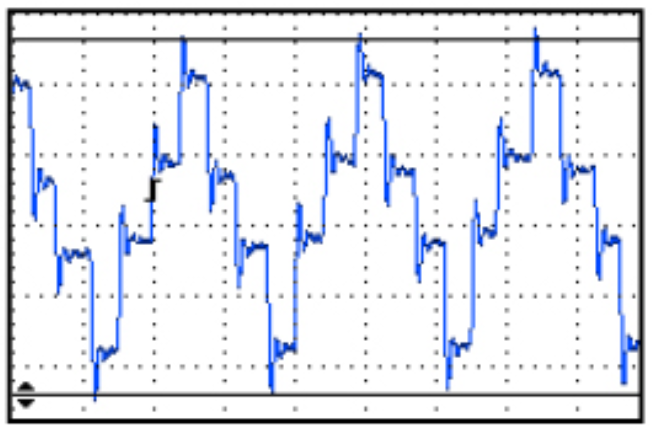
A: The higher the carrier frequency, the more damaging. But it’s impossible to dial it down low enough to eliminate EDM.
EDM is caused by high shaft voltage. The size of the shaft voltage is controlled by the size of the common mode voltage (CMV). The larger the CMV, the larger the shaft voltage. The CMV’s maximum (see figure) is primarily determined by the dc bus voltage, although higher carrier frequencies can increase it by reflected wave effects.
But whatever the carrier frequency, if the CMV and shaft voltage get high enough, EDM damage will occur.
AEGIS Rings also come with a 2-year extended warranty against bearing fluting damage. No other form of protection against VFD-caused bearing damage offers a warranty like this.
To learn more about AEGIS shaft grounding and best practices for electrical bearing protection, sign up for a training. We offer monthly live training webinars, and – pandemic restrictions permitting – we can also visit your facility to review your exact application.