

Author: AEGIS
Electrical Bearing Protection Q&A – Part 23
Q1. How you install grounding in concrete? I have a pump being retrofit with a new VFD.
A1. For safety grounding, if the pump is on the ground floor, you’ll want to mount a copper rod in the concrete. How deep you need to drive it will vary with the local electrical code; it could be six or eight feet. If it’s on a higher level, you’ll need to ground the motor frame through the building’s structural steel. Exactly how you do that will vary.
But that’s safety grounding. For bearing protection, you’ll also want to use proper VFD cable as recommended by the drive manufacturer. You usually want either three ground wires, symmetrically arranged, going back to the drive, or at least one ground wire and mesh or shielding. Both of these types of cable give a good, low-impedance path back to the drive for high frequency current. Without the right cable, you can get what’s called rotor ground current, which damages motor and load equipment bearings. (See more here.)
An AEGIS ring can protect the motor bearings from rotor ground current, but it can’t protect the equipment’s bearings from it. You still need proper cable with an AEGIS ring. For a belt-and-suspenders approach to rotor ground current, you can also bond the motor frame to the driven equipment with a high frequency grounding strap like the AEGIS HFGS.
Q2. My motor has one insulated bearing to block high-frequency circulating current. Why doesn’t that also stop EDM/shaft voltage discharge current; why do I still need shaft grounding?
A2. In order for circulating current (of any frequency) to flow continuously between the motor frame and rotor, arcing must occur through both bearings. If one bearing is protected by insulating it, or using a nonconductive rolling element, then the other bearing will be protected as well. 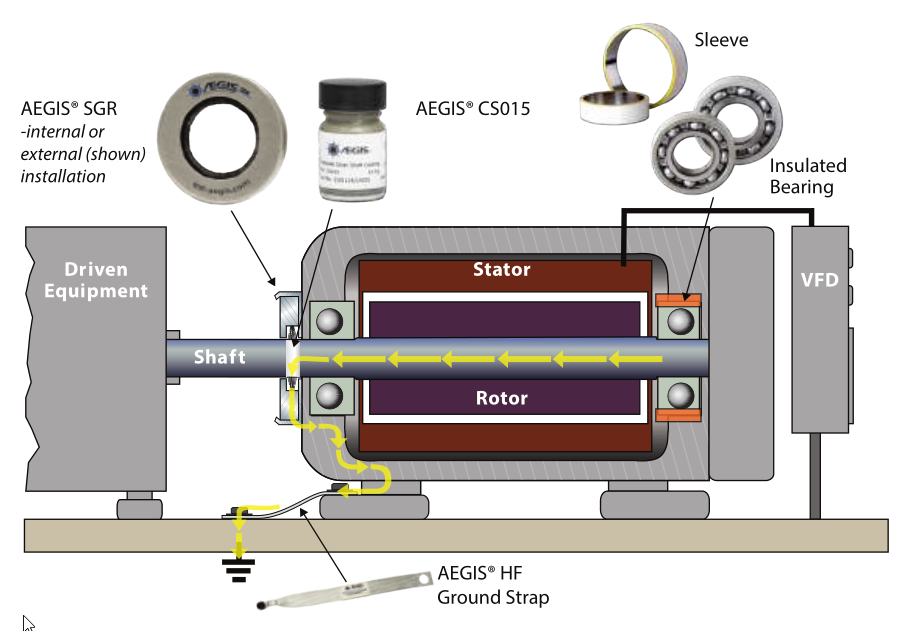
This is because circulating current flows through each bearing in opposite directions: shaft to frame at one end, and frame to shaft at the other. If current can flow onto the shaft at one end, but not off at the other, then charge will quickly build up on the shaft and stop further flow. To use a water/current analogy, water can flow freely through a tube (neither bearing insulated). But if you seal one end (insulate a bearing), then you stop flow: once the tube is full, you can’t fit any more water in.
So insulating one bearing protects both bearings from circulating current. This works both for VFD-derived high frequency circulating current in motors over 100 hp (75 kW), and low frequency circulating current in motors on line power over 300-500 hp (225-375 kW).
Shaft voltage discharge current is different: It flows in the same direction at each end. So if you insulate one bearing, current can still arc unencumbered through the other bearing. But if you also put a shaft grounding ring at the uninsulated end, the current that would arc through the bearing instead passes harmlessly through the grounding ring.
Summing up: One insulated bearing can’t protect the other bearing from shaft voltage discharge, and an AEGIS ring can’t protect the opposite-end bearing from circulating current. But in combination, at opposite ends, they protect both bearings against both types of bearing current.
AEGIS Shaft Grounding Rings come with a 2-year extended warranty against bearing fluting damage. No other form shaft grounding offers a warranty like this.
To learn more about AEGIS shaft grounding and best practices for electrical bearing protection, sign up for a training. We offer monthly live training webinars, and – pandemic restrictions permitting – we can also visit your facility to review your exact application.
Inductive Absorbers Cannot Substitute for Shaft Grounding
We got an email recently from an engineering consultant. He had recently specified a project calling for AEGIS Shaft Grounding Rings for motors controlled by variable frequency drives. Then a contractor put in a bid including, not shaft grounding, but common mode chokes or inductive absorbers. He said that they do the same thing as shaft grounding. Well, the engineer wanted to know, is that true?
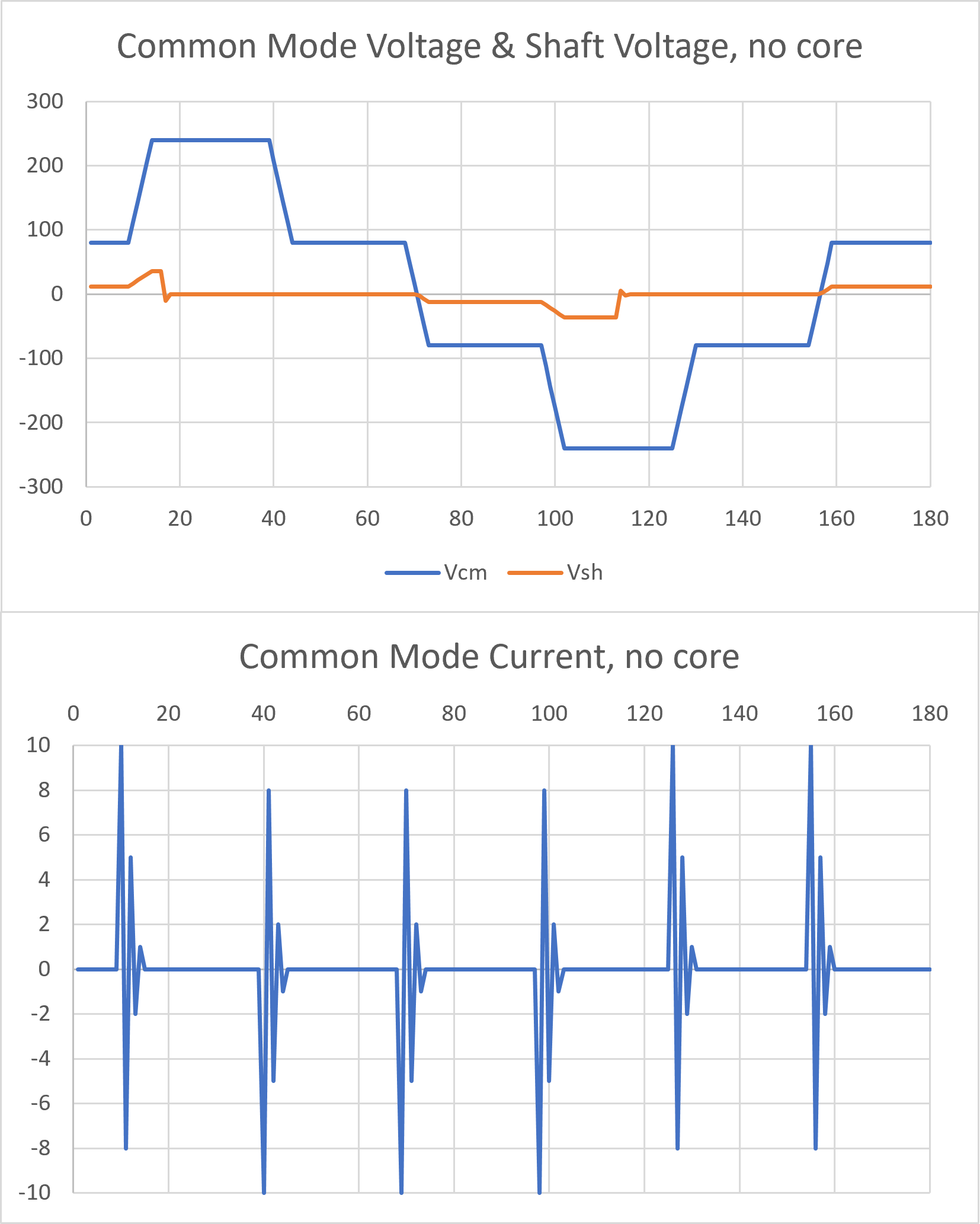 They do not. To see why, let’s have a look at what drives’ output looks like, and then talk about what each of these devices does.
What is Common Mode Voltage?
VFDs put out pulses of voltage in each of the three phases. The average of the three phase voltages is called common mode voltage (top graph, blue), and it is never zero. The average of the phase currents, the common mode current (bottom graph), is near zero most of the time, but it jumps every time the common-mode voltage changes.
The Difference Between Common Mode Voltage and Shaft Voltage
When the common mode voltage reaches the motor, it couples to the rotor by capacitance. This creates a so-called shaft voltage (top, orange). This part is important: The higher the common mode voltage, the higher the shaft voltage produced. When the shaft voltage gets too high, it will discharge by arcing through the bearings. This is shown around time = 18 on the graph: the shaft voltage drops suddenly, the smoking gun of an arc. The same thing happens around time = 115, but starting from negative shaft voltage.
This arcing causes electrical bearing damage, and it is a problem in all motors on drives. AEGIS rings prevent this damage by bleeding off shaft voltage before it gets high enough to discharge through the bearings.
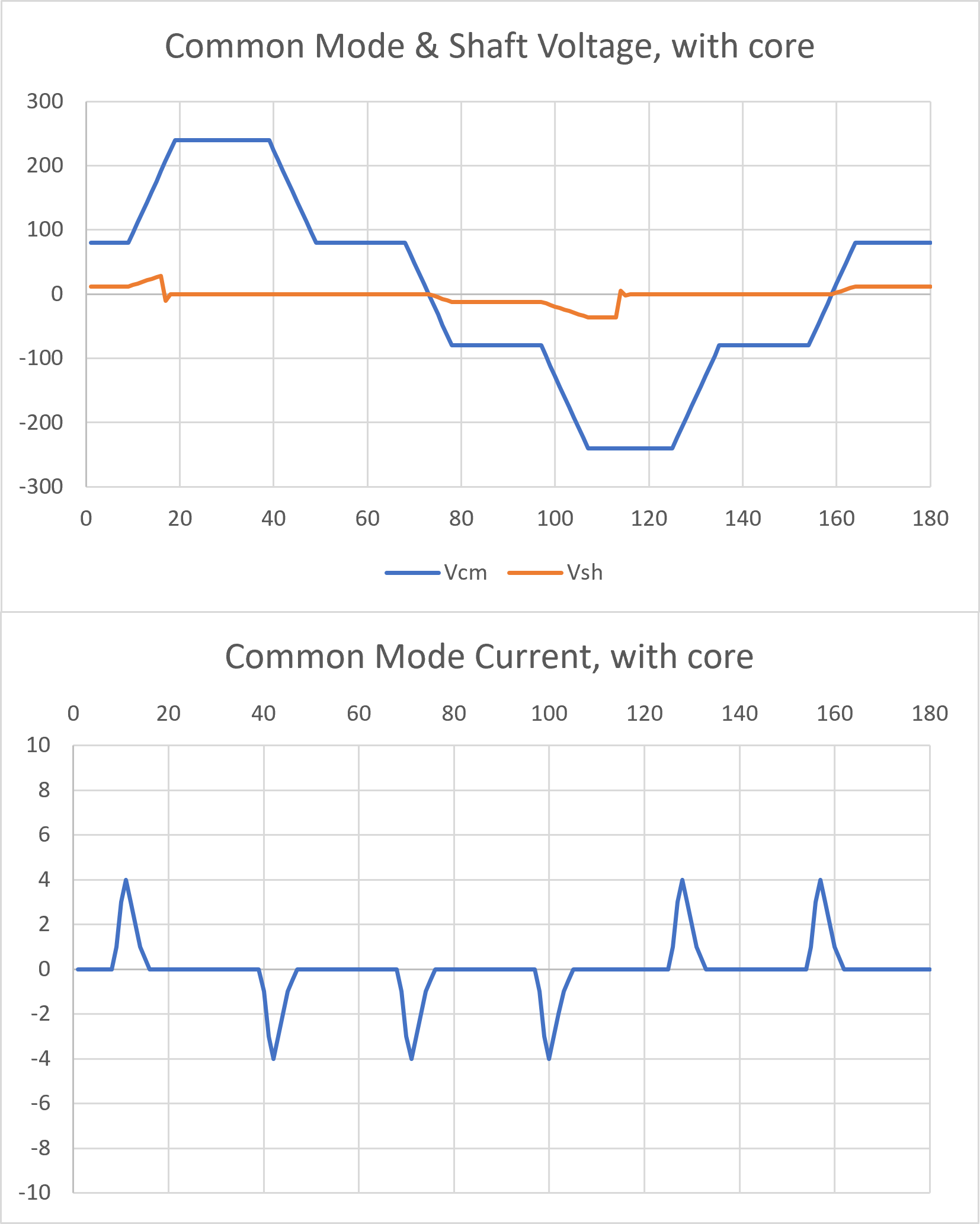
How Do Inductive Absorbers Work?
Inductive absorbers work totally differently. They decrease the peak common mode currrent, as shown in the second set of graphs. They also decrease the slope of the common mode voltage, i.e., how fast it changes. (Jargon alert: they decrease dv/dt.) But inductors do not change the maximum size/height of the common mode voltage, so they will not prevent shaft voltage buildup and discharge.
Types of Electrical Bearing Damage
In fairness, inductive cores do have their uses. In addition to shaft voltage discharge, there are two other types of electrical bearing damage: High-frequency circulating current in large motors, over 100 HP/75 kW, and rotor ground current in poorly grounded motors. Inductive absorbers decrease both of those bearing currents, and they also reduce stray/noise current from the drive.
But they do not affect shaft voltage buildup and discharge, and so cannot replace AEGIS Shaft Grounding Rings.
AEGIS Rings also come with a 2-year extended warranty against bearing fluting damage. No other form of protection against VFD-caused bearing damage offers a warranty like this.
To learn more about AEGIS shaft grounding and best practices for electrical bearing protection, sign up for a training. We offer monthly live training webinars, and – pandemic restrictions permitting – we can also visit your facility to review your exact application.
Electrical Bearing Protection Q&A – Part 22
Q1. What are the pros and cons of shaft grounding rings compared with shaft grounding brushes?
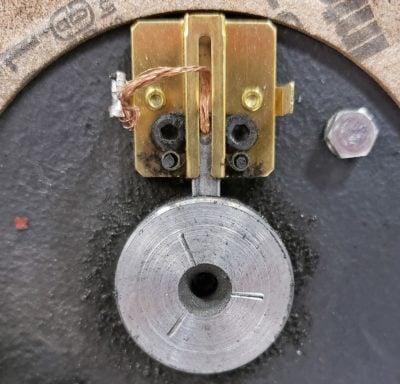 A1. Our understanding is that carbon block brushes wear a lot faster than our AEGIS® rings. There are some other factors, too, but these brushes have a couple of strengths.
Carbon brushes can conduct dc current better than high-frequency ac current. These brushes have been used for over 100 years in dc motor commutators. With grounding rings, it’s the opposite. So you wouldn’t want to use an AEGIS ring in a commutator. But VFD-sourced shaft current is high-frequency, so AEGIS rings are the better fit there.
There are also cases where you have dc/low-frequency and high-frequency current. So sometimes you want a carbon brush and an AEGIS ring. Wind turbine generators are a great example. Neither a carbon brush nor a grounding ring alone is enough. But together, they can protect the generator bearings.
Q2. Can a shaft grounding ring protect a motor from nearby welding?
A2. We wouldn’t recommend it. Welding current can be hundreds of amps, continuously. Depending on the size of the rings, SGRs can handle up to 70 amps, and PRO rings up to 250, but those are peak ac current ratings, not continuous dc.
Q3. If you use a shielded VFD cable, should the shield be attached to the grounding ring?
A3. No. When you use shielding, it should be connected with glands at the motor junction box and at the VFD. It’s important to get this right because doing it wrong will lose most of the shielding’s benefits. There’s more detail in this blog post by Southwire. At any rate, you should always follow the drive manufacturer’s instructions.
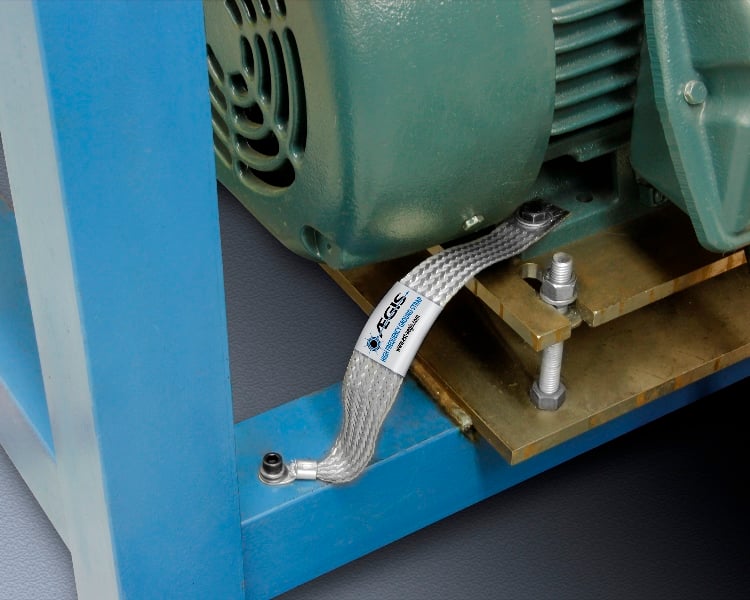 Q4. If we specify shaft grounding rings be used on VFD-controlled motors, do we also need to specify high-frequency grounding straps explicitly?
A4. Short answer: Yes, if you want HFGS to be installed. We recommend using HFGS to bond the motor and drive, and motor and load. But the grounding ring is more important. If the motor is well-grounded, you can usually get by without an HFGS. But there are cases where you definitely want to use at least one. In those cases, you need to specify them explicitly.
AEGIS Rings also come with a 2-year extended warranty against bearing fluting damage. No other form of protection against VFD-caused bearing damage offers a warranty like this.
To learn more about AEGIS shaft grounding and best practices for electrical bearing protection, sign up for a training. We offer monthly live training webinars, and we can also visit your facility to review your exact application.
New Baldor-Reliance Food Safe Motors with AEGIS
Washdown motors must be, above all else, safe, cleanable, and reliable. Baldor-Reliance® Food Safe motors are all three. In fact, they just got even more reliable: They now include an AEGIS® Shaft Grounding Ring for protection against electrical bearing damage.
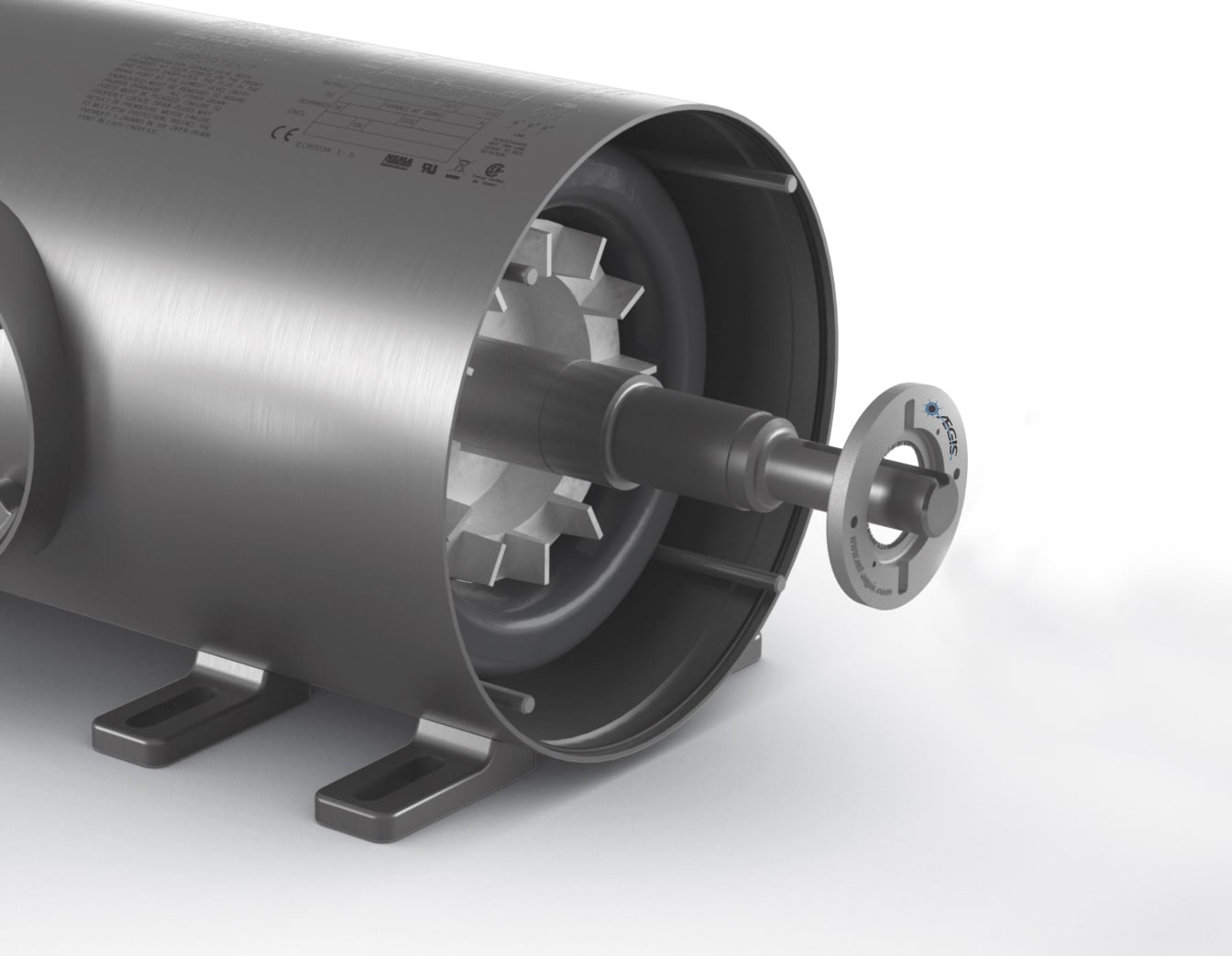 These motors are suitable for applications from food processing to water treatment. They stand up to sanitary and high pressure washdown, and caustic cleaning chemicals. Among their many protective features, these motors are smooth. Every angle is carefully engineered to facilitate cleaning and prevent food and other organic matter from getting trapped.
But they’re not only protected from external hazards. They are also well-protected against internal damage from VFD control. They have a class H insulation system to protect against winding damage. And an internal AEGIS Shaft Grounding Ring protects the bearings against shaft voltage discharge.
Inside and out, Baldor-Reliance Food Safe motors are up to whatever task you put them. For more details, see the manufacturer’s Product Note.
Food Safe motors come with a 3-year warranty. On top of that, AEGIS Rings offer a 2-year extended warranty against bearing fluting damage. No other form of protection against VFD-caused bearing damage offers a warranty like this.
To learn more about AEGIS shaft grounding and best practices for electrical bearing protection, sign up for a training. We offer monthly live training webinars, and – pandemic restrictions permitting – we can also visit your facility to review your exact application.
Electrical Bearing Protection Q&A – Part 21
Q1. I’ve heard that AEGIS® Ring you’ve made, to date, was 44″ (112 cm), for a hydroelectric turbine. What is the smallest shaft size that you can make AEGIS Rings for?
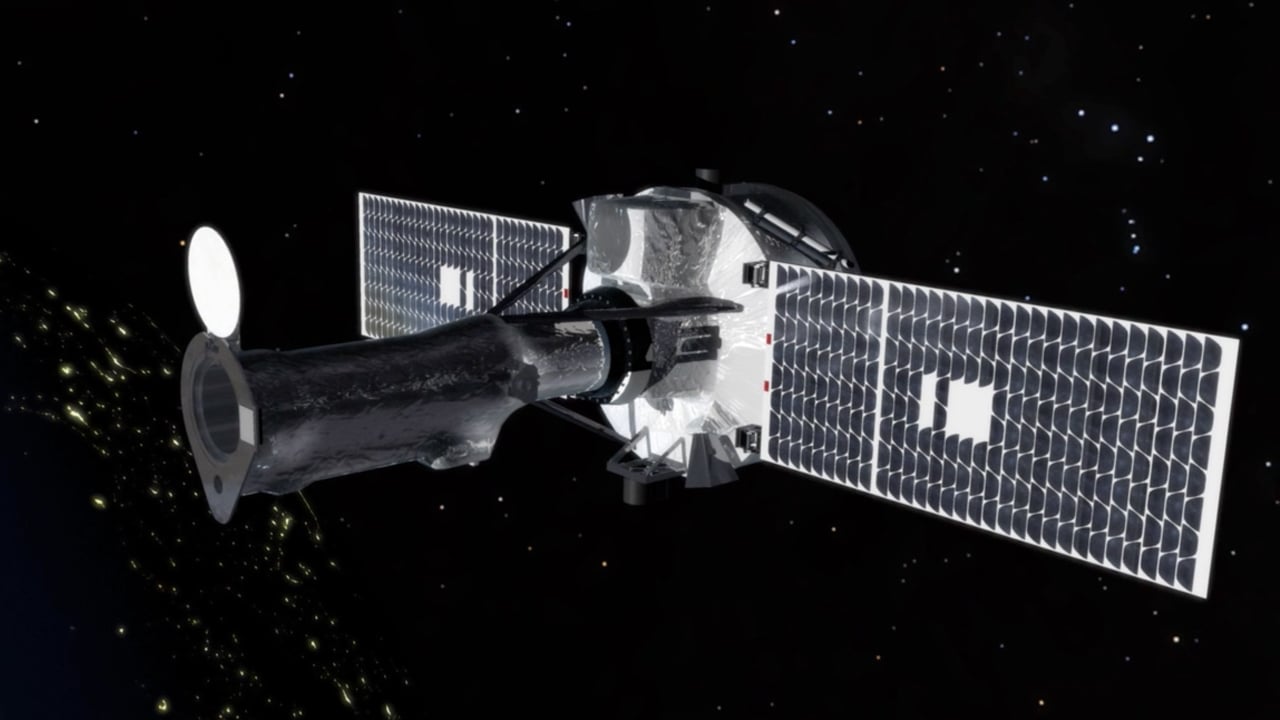 A1. Our standard rings go down to 0.311″ (7.9 mm). But for even smaller – say 1/8″ – we’ve made little button brushes, that contact the shaft axially instead of radially. Some of these tiny rings are for satellites with solar panels – the panels need to be oriented to face the sun, and that’s what these little motors do.
Q2. Are all AEGIS Rings made of aluminum, or an alloy, or some other metal?
A2. The base metal is typically aluminum. It’s highly conductive and lightweight, and it machines and handles well. But we can and do use other metals, like stainless steel. The US Navy & chemical plants use a lot of stainless grounding rings. We also see special applications that use nickel plating and other coatings.
Q3. There are several US-based motor manufacturers who factory-install AEGIS Rings. Are there motor manufacturers in Europe who install AEGIS as an option?
A3. Yes. Just like in the US, many EU manufacturers have evaluated AEGIS rings and decided they should offer them. Three large ones are ABB, Leroy-Somer (Nidec), & WEG.
Q4. What are AEGIS’ competing products, & what makes AEGIS better?
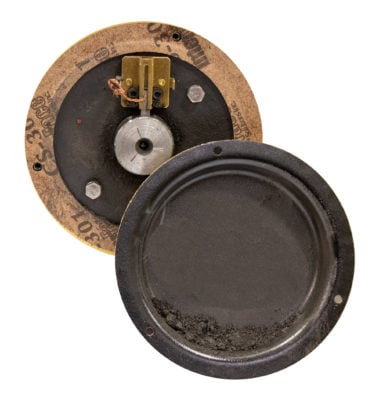 A4. The most common is probably the carbon brush. It’s a little spring-loaded carbon block, doped with metal. It sits in a metal holder, with a spring to press the block against the motor shaft. There are a few problems with this, like wear and dust. The image to the right is a carbon brush that was inside the motor at the nondrive end. In the foreground is the motor fan shield, holding several grams of dust that wore off the brush. You can find more detail here.
There are also devices called common mode chokes. The new marketing term is “inductive absorbers.” Whatever you call them, they are rings of ferrite that you run the motor’s power cables through. Without getting too far into it, they do confer a few benefits. But they don’t protect motors against the same problem that AEGIS Rings do. See Question 3 here for more detail. So the bottom line is, if you use them, you still need an AEGIS Ring for protection against shaft voltage.
AEGIS Rings also come with a 2-year extended warranty against bearing fluting damage. No other form of protection against VFD-caused bearing damage offers a warranty like this.
To learn more about AEGIS shaft grounding and best practices for electrical bearing protection, sign up for a training. We offer monthly live training webinars, and – pandemic restrictions permitting – we can also visit your facility to review your exact application.
AEGIS® Bearing Protection Standard on Baldor-Reliance® Food Safe Stainless Steel Motors
AEGIS® Shaft Grounding Rings have been made standard equipment on the Baldor-Reliance® Food Safe line of motors. The addition of the internal shaft grounding ring provides increased motor reliability and stops early bearing failure from EDM. The Baldor Food Safe line consists of 25 models with horsepower ratings from ½ HP up to 10 HP. They are ideal for food processing, high pressure washdown, sanitary washdown, outdoor or caustic environment applications.AEGIS® Shaft Grounding Rings have been integrated into these motors to mitigate the effects of bearing currents caused by variable frequency drives (VFDs). When VFDs are used to control AC motors, voltage is induced on the motor shaft. This voltage builds up until it is strong enough to discharge by arcing through the bearings, causing frosting, pitting, fusion craters, and fluting. Over time, this bearing current causes premature bearing failure.
AEGIS® Shaft Grounding Rings protect motors by channeling VFD-induced bearing current safely to ground. Continuous circumferential rows of conductive microfibers, embedded securely in the ring’s patented AEGIS® FiberLock channel, completely surround the motor shaft and provide millions of discharge points for harmful shaft voltage. This unique design creates the path of least resistance that effectively diverts current away from the bearings to ground. The microfibers themselves are specially engineered for exceptional conductivity and flexibility to minimize wear and prevent breakage. AEGIS® rings are the only long-term shaft grounding technology proven effective in millions of VFD/motor applications worldwide.
AEGIS® bearing protection is available on motors from most leading manufacturers and can be specified at the time of purchase. Motors can also be retrofitted either in the field or at motor repair shops.
A best practices handbook — the AEGIS® Bearing Protection Handbook — describes best practices for protecting motor bearings from electrical damage. It explains how to diagnose electrical bearing damage caused by VFDs and details methods for preventing such damage to motors of various types and voltage and horsepower ratings. Ideal for plant maintenance personnel as well as motor repair companies, the handbook is available for download.
For almost 20 years Electro Static Technology, an ITW company, has produced the patented AEGIS® Shaft Grounding Ring technology used in millions of motors around the world to protect motor bearings from electrical discharge. AEGIS® Shaft Grounding Rings are the leading solution to the problem of VFD-caused electrical bearing damage and premature failure. AEGIS® Rings can be factory-installed by Baldor-Reliance® and many other leading motor manufacturers and can also be installed on in-service motors. A Made in the USA product, the AEGIS® Shaft Grounding Ring is manufactured in Mechanic Falls, ME.
For more information, contact:
Sunshine Spaulding, Marketing Manager,
Electro Static Technology
31 Winterbrook Road
Mechanic Falls, ME 04256,
Toll-Free: 1-866-738-1857, TEL: (207) 998-1222
How Can Insulated Bearings Get Electrically Damaged?
A couple of months ago, we published a Q&A post including an account of electrically damaged insulated bearings. We got a few questions about that one. “Aren’t insulated bearings supposed to block bearing current? Then how did they get damaged?” Let us explain. (Make yourself comfortable.)
All electric motors on drives are subject to shaft voltage buildup. So they’re all at risk of damage from shaft voltage discharging through the bearings. That’s what AEGIS® Shaft Grounding Rings are for: they bleed off shaft voltage before it gets high enough to discharge. Larger motors on drives, over 100 hp/75 kW, are also subject to high frequency (HF) circulating currents. An AEGIS ring alone can’t stop circulating currents, because they go through both bearings simultaneously, in opposite directions. And though it seems like an AEGIS ring at both ends of the motor should work, we’ve found that it can backfire.
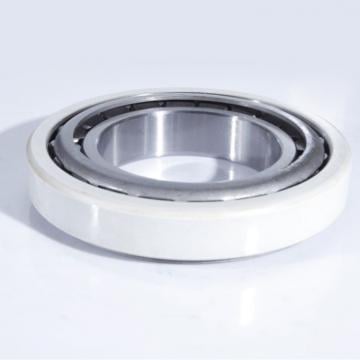
So for larger motors we recommend using some type of insulated bearing at the opposite end from the AEGIS ring. A ceramic bearing is perfect, but insulating sleeves and insulation-coated bearings are also fine. At least, they are most of the time.
These bearings are made of steel, with a thin layer of aluminum oxide on one race (typically the outer race). So you end up with a thin non-conductive layer between the bearing and the motor frame. Ordinarily, that insulating layer is enough to break the circuit so circulating current can’t flow. In order to flow at all, it must flow at both ends: Onto the rotor at one end, and off it at the other. Insulated bearings block that flow at one end, and that’s all it takes.
But whenever you have a thin layer of insulator between two conductors, you have a capacitor. Together, the bearing’s outer race, alumina, and bearing housing make a capacitor. The bearing itself also has some smaller capacitance. Now, HF circulating current is driven by a HF end-to-end voltage on the shaft. To that voltage, the bearing, insulation, and housing look like two capacitors in series. Because the bearing’s capacitance is lower than the alumina’s, most of that voltage ends up across the bearing.
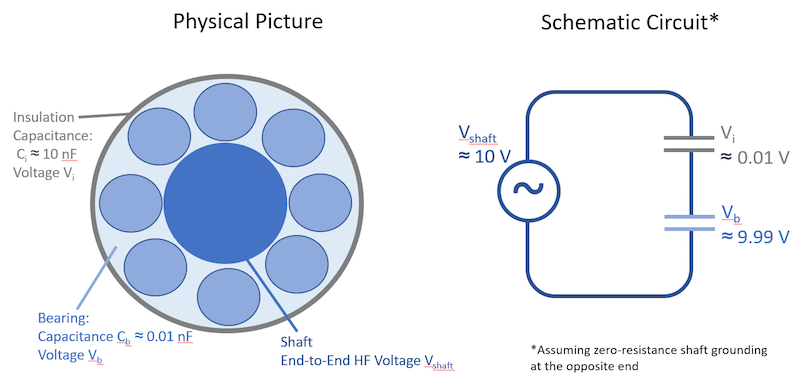
Model circuit of an insulated bearing. With the ballpark figures given for capacitances and shaft voltage, 99.9% of the voltage ends up across the bearing.
In the rare cases where insulated bearings fail, that voltage is enough to cause arcing through the bearing. At the other end, current would flow in the other direction through the grounding ring (if installed) or the other bearing, to complete the circuit. Again, this problem is rare. 99% of the time, an ordinary insulated bearing will not be damaged by circulating currents. At least, not fast enough to cause premature failure.
In the rare exception, you’ve got options. A hybrid bearing will solve the problem. No current can make it through a ceramic rolling element. Admittedly, hybrid bearings are expensive. But if you’ve already had an alumina-coated bearing fail, you have to ask: What’s more expensive? A ceramic bearing, or the downtime from another unexpected failure?
You can also try an insulated inner race. Because it’s smaller, an insulated inner race will have less capacitance than an insulated outer race. Having less capacitance in the insulation makes for less voltage across the bearing. So breakdown (arcing) is less likely.
Another thing you can try is common mode chokes, sometimes branded as “inductive absorbers.” Chokes decrease HF circulating current. We don’t have any hard data on this, but the combination of choke and insulated bearing may prevent HF circulating current damage. At the very least, adding chokes will slow down damage to an insulated bearing.
In any case, you would still want an AEGIS ring at the opposite end from the insulation. Neither chokes nor a single insulated bearing will protect the other bearing against shaft voltage discharge.
AEGIS Rings also come with a 2-year extended warranty against bearing fluting damage. No other form of protection against VFD-caused bearing damage offers a warranty like this.
To learn more about AEGIS shaft grounding and best practices for electrical bearing protection, sign up for a training. We offer monthly live training webinars, and – pandemic restrictions permitting – we can also visit your facility to review your exact application.
Electrical Bearing Protection Q&A – Part 20
Q1. How important is a clean environment for the ring’s operation and lifetime?
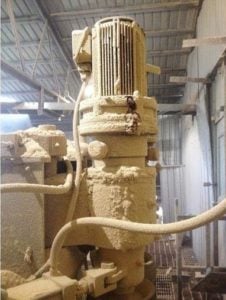
This is a good candidate for internal shaft grounding.
A1. It’s important, but not super-critical. AEGIS® Rings’ conductive microfibers are pretty tolerant of contamination. They cut through small amounts of dust and grease. You want to install the ring in whatever location is best – it can be outside at the drive end, inside the motor, or at the non-drive end, maybe inside the end bell. You can also put an O ring on the shaft and slide it up to SGR. That prevents a lot of contamination. People also add slingers or covers to prevent contaminant ingress. For larger motors, we make the PROSL-R with a rubber gasket.
But we’ve got grounding rings in all kinds of applications – paper mills, mines, cement milling. Dusty, mucky places. We know of one limestone processor around the Great Lakes with lime dust everywhere, and grounding rings everywhere. And those rings are still working.
The bottom line is you want to keep the rings as clean as you can, but don’t sweat it too much if they get a little dirty. If there’s ever a question of whether they’re still working, test the shaft voltage. We’re here for you if you ever need help with that.
 Q2. How is the ring grounded/bonded to the motor frame?
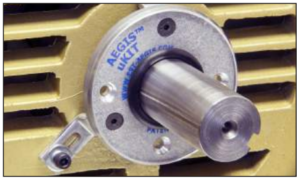
An AEGIS uKIT with rubber o-ring to protect the conductive microfibers from contamination.
A2. Just a preliminary bit of jargon: This is really bonding we’re talking about. Grounding has a few meanings, with often subtle differences. But electrical bonding always means that two objects are in electrical contact. That is, charge can flow easily from one to the other. In the case of a grounding ring, charge flows from the motor shaft to the ring. The question is, how does that charge get off the ring and onto the motor frame?
Through the mounting hardware (or conductive epoxy). Our basic “clamp-on” shaft grounding rings are held on by clamps bolted to the motor frame. Here, the bonding is through the clamps and screws. Bolt-through rings have screws through them into the motor frame. Fairly obviously, the bonding is through the bolts. With AEGIS uKITs, the bonding is the same but with the addition of mounting brackets.
Many motor repair contractors install press-fit rings. Here, they bore a cavity into the motor frame or bearing retainer ring, and press the grounding ring in. So the bond here is direct metal-metal contact between the ring and the frame. With conductive epoxy mounting, you grind away the paint from the motor frame where the ring will be mounted, so the bond is from the ring, through the epoxy, to the frame.
We should point out that while the mounting bonds the ring to the motor frame, the frame also needs to be bonded back to the VFD. This bond can be through the facility ground. But it’s best to use a good VFD cable, including symmetric ground wires and shielding (braided or foil). Good cabling makes a big difference to motor grounding. It also helps with electrical noise (EMI/RFI) in your facility.
Q3. Can we get away with a higher shaft voltage amplitude with a good choice of bearing grease?
A3. Not really. Whatever grease you use – and you should always follow the bearing manufacturer’s recommendation – you will always end up with a thin film between the bearing rollers and races. Voltage will build up across that film, and arcing will occur without protection. And no matter how good an insulator the grease starts off as, its insulating strength will always go down. That’s because as arcing occurs, you’ll end up with tiny bits of metal blasted off the bearing metal going into the grease. That’s why grease blackens over time. All those metal bits make the grease more conductive, so you have even more arcing occurring.
About twenty years ago, a lot of people’s thinking was that conductive grease was the way to go. The thought was: Let the shaft voltage discharge easily, and less-destructively. But there were all kinds of problems with this. Among other things, it turns out that the conductive particles in this grease were abrasive. You want bearings to stay smooth; you don’t want abrasive powders in your grease. So people would use this grease, and it would work at first, and then a year or two later, the bearings would overheat and fail due to this abrasion.
AEGIS Rings also come with a 2-year extended warranty against bearing fluting damage. No other form of protection against VFD-caused bearing damage offers a warranty like this.
To learn more about AEGIS shaft grounding and best practices for electrical bearing protection, sign up for a training. We offer monthly live training webinars, and – pandemic restrictions permitting – we can also visit your facility to review your exact application.
Proper Grounding is Vital for Motors on Drives
We talk a lot about shaft grounding for motors on drives, to mitigate electrical bearing damage. It almost goes without saying that motors’ frames need to be grounded, too. Almost. In fact, poor frame grounding contributes to electrical bearing damage as well. This bears discussion. For a video presentation, see this excellent on-demand webinar.
When a motor is run across the line, the voltage and current supplied to it are balanced. In a perfect world, all of the current flowing through the motor would always be in the three phase wires. Current would flow in through one phase, and return to the mains through the others. No grounding would be necessary. See A in the figure below. In the real world, the motor frame is grounded for safety reasons.
If an ungrounded frame was energized by a fault in one of the phases, it would create a lethal safety hazard. The motor might still run, but the frame would be “hot.” If someone touched the frame (B), their body would create an alternate path to ground (and back to the mains), and they would be shocked or electrocuted. Grounding the frame gives any stray current a safe low-resistance path to ground and back to the mains (C), mitigating the hazard. (The faulty motor would still need repair, but it would be much less likely to cause severe injury.)
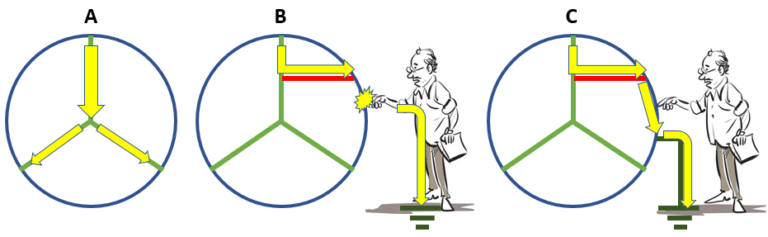
A: Ungrounded motor with no faults. All current (yellow) enters and leaves the motor through the phase wires (green). B: A fault (red) energizes the frame and creates a shock hazard. When touched, current runs from the frame, through the man, to ground. C: With the frame grounded, stray current goes through the ground wire (dark green) instead of the man.
When a motor is powered by a drive, neither the voltage nor current is balanced. Drives’ output contains a lot of high-frequency (HF) noise. The frequency is important, because the motor windings have high impedance to HF currents. Consequently this noise will seek an alternate path back to the drive. When a drive’s output gets to a motor, the low frequency components of the current move through the phase windings, just like in a motor on line power.
But the HF current seeks an alternate route back to the drive. Rather than going through the stator windings, it moves (by capacitive coupling) onto the motor frame. From the motor frame, it will move back to the drive by every path it can find. If the motor is well-grounded, HF current will run to ground and then back to the drive. But if the motor is poorly grounded, it may arc through the bearings to the shaft, and seek ground through the coupled equipment. This is called rotor ground current, and it is the most destructive type of bearing current. It not only damages the motor bearings, but those of the driven equipment (pump, gearbox, etc.).
There are a few ways to avoid rotor ground current. Bonding the motor frame to the driven equipment gives stray current a lower-resistance path than going through the bearings. High frequency grounding straps, like the AEGIS® HFGS, work well for protecting motor and equipment bearings this way. Grounding straps are good for protecting bearings, but they’re not always enough. Bonding the motor and equipment frames still leaves the stray current free to meander through the facility grounding system on its way back to the drive. This can cause interference with or damage to sensitive equipment in the noise’s path.
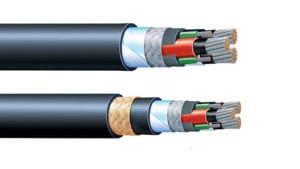 Cross sections of high-end VFD cable. These examples include three symmetrically arranged ground wires and a conductive mesh sheath.
In addition to motor-load bonding, you should bond the motor directly to the drive using proper VFD cable. There are many options for this, and drive manufacturers’ recommendations vary somewhat. ABB and Rockwell Automation have excellent booklets on grounding motors and drives. Variations aside, all good VFD cables include one or more ground conductors bonding the motor frame and the drive, and usually conductive mesh or foil shielding.
One more point: The cable’s shield must be properly terminated. If not, most of its benefits will be lost. See this blogpost, or the guides linked above, for details.
With properly installed cable, up to 95% of the HF current moves directly from the motor frame back to the drive. Good cable thus protects the motor and equipment bearings from rotor ground current, and protects other sensitive equipment from stray noise current. We’ve only discussed conducted noise, but good cable minimizes radiated noise as well.
All of this said, rotor ground current is not the only source of electrical bearing damage. Proper cabling practices do not stop shaft voltage from building up and causing arcing through the bearings. So no matter how good the VFD cable, motors on drives still need reliable shaft grounding, like an AEGIS Shaft Grounding Ring.
AEGIS Rings also come with a 2-year extended warranty against bearing fluting damage. No other form of protection against VFD-caused bearing damage offers a warranty like this.
To learn more about AEGIS shaft grounding and best practices for electrical bearing protection, sign up for a training. We offer monthly live training webinars, and we can also visit your facility to review your exact application.
Electrical Bearing Protection Q&A 19: Large Motor Edition
Q1. We have a 5000 hp dc motor, running at 40 rpm. Is there an AEGIS® ring suitable for this machine?
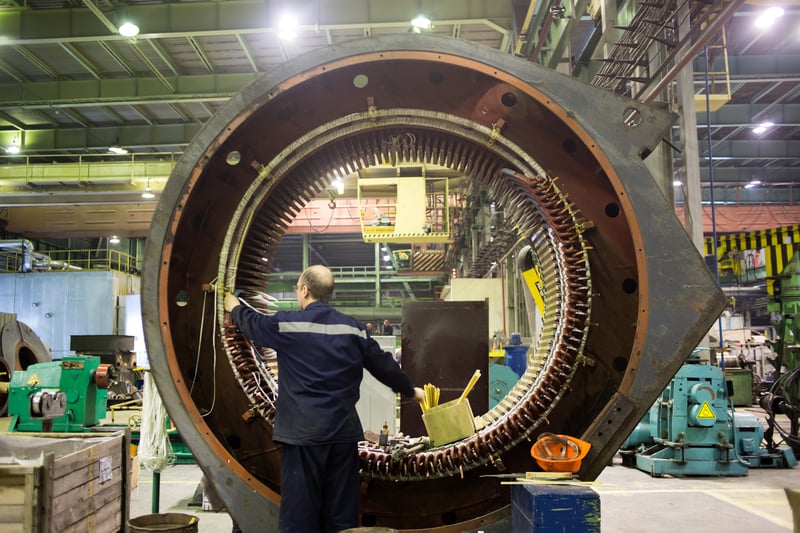 A1. Yes. To review, our SGR rings have two rows of fiber. SGRs are fine for motors up to a few hundred horsepower. The general rule for low voltage motors is 300 hp (225 kW) for dc motors, and 500 hp (375 kW) for ac. For larger motors, and medium voltage motors (over 600V), we make our PRO Series of grounding rings. PRO rings have six rows of conductive microfiber. That allows them to carry more current from the shaft. Higher fiber density means better conductance/lower impedance. And you really need that extra current capability with these larger motors.
For 5,000 hp, you definitely want a PRO ring, whether the motor is ac or dc, or low or medium voltage.
Q2. We use AEGIS rings in combination with insulated bearings on medium-sized motors. We follow your recommendations and put the grounding ring at the drive end, and insulated bearing at the non-drive end (NDE). But we have actually had some insulated bearings fail do to fluting damage. What is your experience with this?
A2. That is a rare problem, but it does happen. Remember that you use an AEGIS ring to drain off capacitive shaft voltage from the VFD, and the insulated bearing is there to interrupt high frequency circulating currents (also caused by the drive). 99% of the time, this setup works fine.
But in some cases, the insulated bearings can still be damaged by circulating current. Insulated bearings usually have a thin layer of alumina, an insulator, on the outside of the outer race. When you install this bearing in a motor, you have the motor frame, then alumina, then the steel of the bearing’s outer race: Metal, insulator, metal. That looks like a capacitor. And high frequency current can easily flow through capacitors. What happens, in these rare cases, is that circulating current flows through the alumina by capacitively charging it, and then arcs through the rolling elements and inner race. In your case, the other bearing was protected by an AEGIS ring, so the circulating current completed the loop by going through the grounding ring rather than the uninsulated bearing. That’s why only the insulated bearings failed.
So what can you do? You can solve the problem by using a ceramic bearing, aka hybrid bearing, at the NDE. These have all-metal races and ceramic rolling elements. Circulating current is not getting through a ceramic ball. But hybrid bearings are pretty expensive.
The other option is to use some type of common mode filter. Without getting too far into it, filters reduce high frequency circulating current. But they can’t eliminate it. Would they reduce it enough to prevent premature bearing failure? Maybe. They’ll certainly slow the rate of damage and prolong the NDE bearing’s life. At any rate, chokes don’t reduce shaft voltage, so you still need an AEGIS ring in this case, as well.
This has been a long answer, so to summarize: A hybrid bearing at the NDE the sure-fire way to go to protect against circulating current. 99% of the time, you’ll be fine with a cheaper insulated bearing. Common mode chokes help, but we can’t say just how much. And in any case, you need AEGIS shaft grounding to protect the drive end bearing from shaft voltage discharge.
Q3. Is high-frequency circulating current a bigger problem than low-frequency circulating current?
A3. It depends on the size of the motor and whether it’s on a drive. All electric motors can have low-frequency circulating current. But it’s only high enough to be a problem in very large motors, 500 frame or above. You can address it with an AEGIS ring at the drive end and insulated bearing at the NDE. Because it’s fairly low frequency (50/60 Hz across the line, or whatever frequency the motor’s running at on a drive), it’s less likely to require a ceramic bearing (as above). Common mode chokes will not help with low-frequency circulating current.
Medium-sized and larger motors on drives are prone to high-frequency circulating currents. By “medium” we mean over 100 hp/75 kW. These can be dealt with as above. If you have a very large motor on a drive, if you use shaft grounding at the drive end and insulation at the NDE bearing, that will take care of low- as well as high-frequency circulating currents (and shaft voltage discharge).
AEGIS Rings come with a 2-year extended warranty against bearing fluting damage. No other form of protection against VFD-caused bearing damage offers a warranty like this.
To learn more about AEGIS shaft grounding and best practices for electrical bearing protection, sign up for a training. We offer monthly live training webinars, and – pandemic restrictions permitting – we can also visit your facility to review your exact application.