

Author: AEGIS
VFD-Ready Electric Motors from Marathon
The Marathon® Motors brand began with a single washing machine motor and a simple ambition: To produce the most efficient and longest-lasting motors. A lot has changed since 1913, but the goal remains the same. Marathon, and its parent company Regal Beloit, still provide high-quality ultra-efficient motors, but now with more advanced technology and for hundreds of industries.
One relatively new development in the motor arena is control by variable frequency drives (VFDs). These drives are used in all sorts of applications because they offer precise control and often large energy savings as well. But these benefits come at a price: VFDs’ pulsed output can burn through the insulation on motor stator windings, and can also cause electrical discharge through, and damage to, the bearings. Both of these can cause the motor to fail prematurely.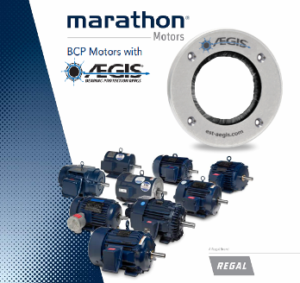
But Marathon is up to these new challenges. Like all major motor manufacturers, they offer “inverter duty” motors with Class F or H insulation to resist sudden changes and spikes in the voltage supply. Several lines include their patented MAX GUARD® insulation. And as for bearing damage, Marathon offers several lines of motors with Bearing Current Protection (“BCP”) in the form of AEGIS® Shaft Grounding Rings. These BCP motors, with protection against electrical damage to the windings and bearings, can truly be called “inverter duty.”
BCP (as an AEGIS Ring) is included in all Marathon Blue Max® 2000 vector-duty motors and Blue Chip® Severe Duty cooling tower motors. BCP is also included in all motors whose part numbers end with “-P” in general-purpose NEMA Premium® XRI® Efficiency motors and Hazardous Duty™ Blue Chip Severe Duty motors.
For the part numbers of all stock Marathon Motors with BCP, see this brochure. BCP can also be added as a mod to any Marathon motor. Also, all motors with AEGIS Rings factory installed are eligible for the AEGIS 2-year extended warranty against electrical bearing damage.
Two Superior Choices: WEG Cast Iron & Rolled Steel Motors with AEGIS Inside
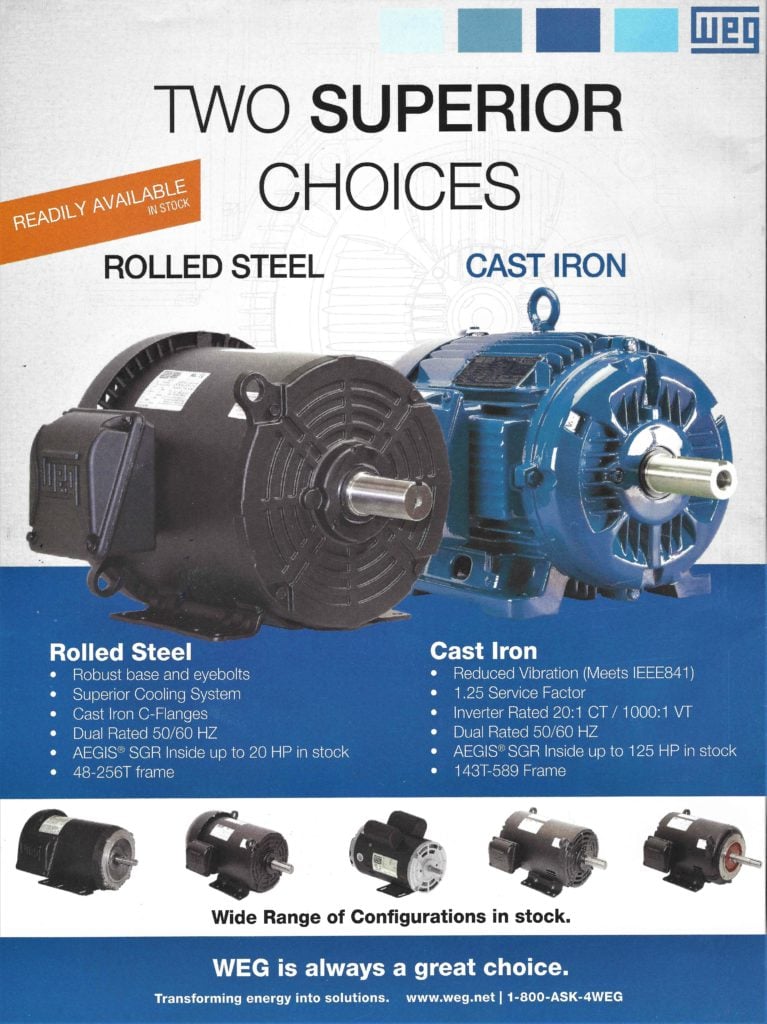
WEG stocks NEMA Premium-Efficiency rolled steel and cast iron motors with AEGIS® Shaft Grounding Rings inside. These motors combine the robustness of WEG design, efficiency of NEMA premium standards, and the simplicity of AEGIS shaft grounding protection against bearing currents. AND they’ve got variety: WEG motors with AEGIS are available in both ODP and TEFC styles, in both general purpose and close-coupled builds, from 1 to 100 hp. And like all motors with AEGIS rings factory-installed, they are eligible for our 2-year extended warranty against electrical fluting damage, above and beyond the manufacturer’s warranty.
For an overview of WEG motors with AEGIS, see this page on the AEGIS site. Or for more detailed information, head to weg.net, or for the part numbers of scores of WEG motors with AEGIS, see this pdf.
In Space, No One Can Hear Your Bearings Fail
We recently came across a remarkable video about bearing failure due to electrical damage. But here’s the twist: These were reaction wheel bearings, and they failed in space.
The Kepler space telescope, the Far Ultraviolet Spectroscopic Explorer (FUSE), Dawn, and Hayabusa: Each of these space probes suffered reaction wheel bearing failures, leading to problems with changing the probe’s orientation (or attitude). In space, as on earth, having the right attitude is essential to success. If you spend millions of dollars to launch a probe to study Jupiter, you’ll want to be sure the probe is pointing at Jupiter!
In space, with nothing to push against, there are two main ways to rotate a craft: Firing propellant and spinning a system of reaction wheels. Both of these work using Newton’s second law: For every action, there is an equal and opposite reaction. Releasing propellants can easily generate torque to rotate a spacecraft. The problem is that propellant is limited. A craft can only bring so much with it.
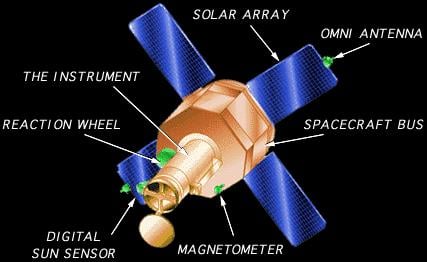
On the other hand, reaction wheels work almost like a child’s Sit ‘n Spin: An electric motor is fixed to the craft, and its shaft is attached to the wheel. When the motor puts a torque on the wheel, the wheel exerts an equal and opposite torque on the motor. The torque on the relatively small wheel accelerates it quickly; the opposite torque on the motor (and the rest of the probe) makes it rotate in the opposite direction, but slowly, so fine adjustments can be made to the position. When reaction wheels fail, the craft may be forced to use some of its limited amount of propellant to maintain the proper orientation.
One reaction wheel bearing manufacturer, whose RWA line was used in Kepler and FUSE, performed a relentless root cause analysis and found that these bearing failures all occurred while or just after the Sun was in the midst of violent activity. After painstaking analysis and testing, they proposed that these failures were caused by electrical arcing through the reaction wheel bearings. The huge amounts of radiation released during these solar storms were creating a voltage difference across the bearings, and when that voltage discharged, bearing damage and sometimes failure occurred. The researchers’ paper summarizing their findings can be found here.
The RWA manufacturer inadvertently solved the problem of electrical damage before this research was completed, by using ceramic bearings, instead of steel, in their reaction wheels. Because ceramic has such a high electrical resistance, the voltage on the craft is unable to discharge through the bearings.
Although this happened literally millions of miles from the nearest variable frequency drive, this is exactly like the electrical bearing damage that VFDs cause. Both phenomena share the same critical element: a voltage difference across motor bearings. With motors on VFDs, the drive’s pulsed output creates a voltage across the bearings (usually called simply a shaft voltage). Regardless of how the voltage gets there, the result is the same: Discharge through the bearing, destruction of the bearing’s smooth surface, and eventual failure.
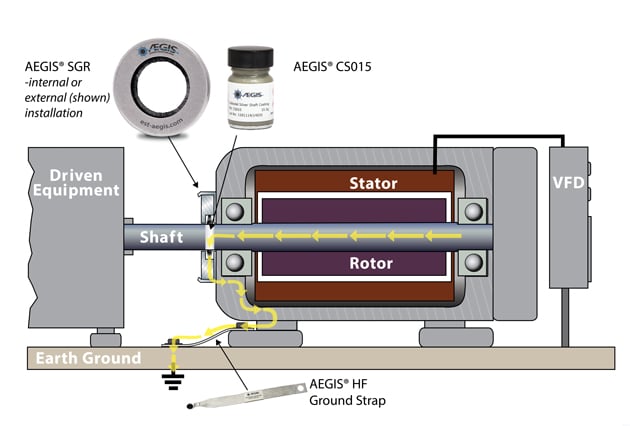
While ceramic bearings are one way to address the problem of bearing discharge, they are one of the more expensive solutions. An equally effective solution is the AEGIS® Shaft Grounding Ring – a ring of conductive microfibers surrounding the motor shaft and electrically connected to the motor frame. Shaft grounding rings have lower electrical resistance than motor bearings. So rather than shaft voltage building up high enough to discharge through the bearings, current flows along the path of least resistance: through the AEGIS ring, instead of through the bearings.
In larger motors, additional sources of bearing currents may be present, so one ceramic or insulated bearing may be necessary, along with an AEGIS ring.
AEGIS Rings also come with a 2-year extended warranty against bearing fluting damage. No other form of protection against VFD-caused bearing damage offers a warranty like this.
To learn more about AEGIS shaft grounding and best practices for electrical bearing protection, sign up for a training. We offer monthly live training webinars, and we can also visit your facility to review your exact application.
6 More Things You Need To Know About Shaft Grounding
Even More Questions and Answers from the Plant Services Webinar, “Motors & Drives: VFDs and Motors — What You Don’t Know About Them Could Cost You”
1. Can you provide more information about applications where AEGIS rings are installed?
AEGIS rings are installed in every type of application where VFDs are used worldwide. Commercial HVAC, pumps, compressors, conveyors, processing equipment of all types and in all industries from pharmaceuticals to steel mills. AEGIS rings are installed on the smallest shafts of 6mm to the largest motors with shaft diameters of 800mm.
If a motor is on a VFD, then we recommend AEGIS rings.
2. Most vibration analyzers work like an oscilloscope. Could I measure shaft voltage with one of these?
No. Vibration analyzers do not have the bandwidth to read shaft voltages. You need at least a 100 MHz oscilloscope, and a shaft voltage measuring kit. That said, vibration analysis will provide predictive data to help plan maintenance actions.
3. Do you recommend the grounding strap on every motor, or only if we have noticed a problem?
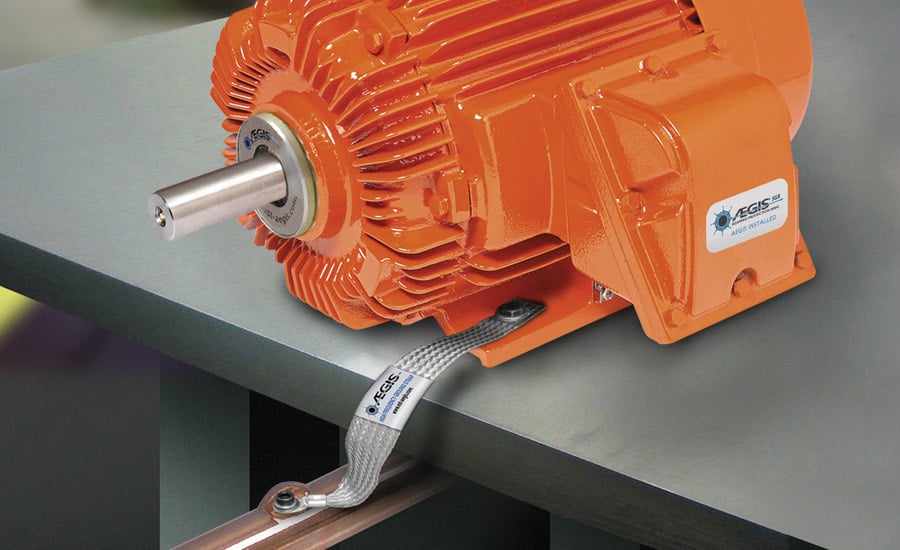
Any motor on a VFD should use a high frequency grounding strap from the motor’s foot to the facility ground. This type of grounding strap is made from flat braid designed for low impedance at high frequencies. See the ABB Technical Bulletin #5 and other similar sources for additional technical information. It is a good practice and a relatively low-cost improvement to any VFD driven motor system. The AEGIS HFGS is a high frequency grounding strap with one side having a hole punched that fits the motor foot mounting screw and the other end terminated with a ring termination. Stock and custom sizes are available to order.
4. If I buy an inverter-duty motor, does it come with a Shaft Grounding Ring?
Not necessarily. To be called “inverter duty,” a motor only needs to have class “F” or “H” insulation. A “true inverter duty motor” should have both the inverter rated windings AND an AEGIS Shaft Grounding Ring factory installed. Manufactures like ABB (Baldor), WEG Electric, Regal Beloit (Marathon and Leeson), TECO-Westinghouse, and GE all have full product lines for general purpose and definite purpose motors.
But since not every “inverter duty” motor has AEGIS installed, make sure you ask and look at the specification. Most manufacturers, including those named above, have modification programs to add an AEGIS ring to any motor. Today, all integral HP motors sold in the US and IEC E3 motors in Europe are manufactured with a minimum class “F” insulation. To make one of these motors a “True Inverter Duty Motor,” just add an AEGIS ring.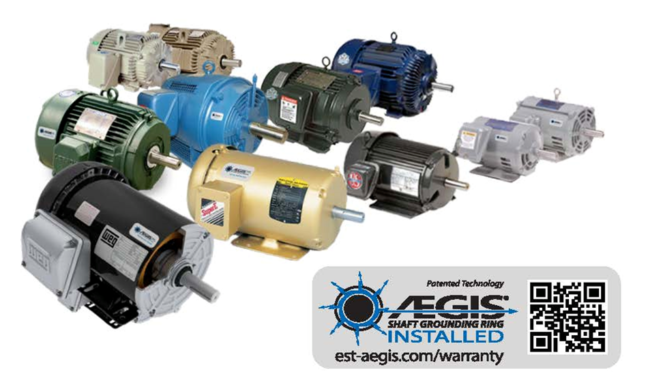
5. How often do you have to replace the shaft grounding rings?
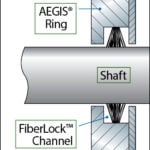
The AEGIS rings should be replaced when you change out the motor’s bearings. They are designed to outlast the motor bearing’s L10 life with a “wear-to-fit” design which ensures the longest life of any shaft grounding technology.
6. What is the business benefit for low motor rating, like 1 hp (0.75kW) conveyor motors? Is run-to-failure not a good maintenance approach?
This scenario is the “throwaway” motor theory where the motor is small and not worth rewinding and repairing. But the cost to replace even a small motor can be 3x more than the cost of the new motor when considering time, labor rates, downtime costs, and administrative costs. So it makes sense to select a motor that does not fail prematurely.
Even 1 HP (0.75 kW) motors will have bearing fluting damage when operated on a VFD. Running to failure is fine but this failure can occur in weeks to months. So when the motor does fail, replace it with a motor that has the AEGIS ring installed. AEGIS Rings on small motors prevent both lubrication failure in sealed bearings, which can reduce their life by up to 90%, and bearing fluting damage which can occur in as little as 2 months or less.
This topic was discussed in detail, with an ROI analysis, in the blog post “Is there such a thing as a “throwaway” motor? Let’s examine…”
To learn more about AEGIS shaft grounding and best practices for electrical bearing protection, sign up for a training. We offer monthly live training webinars, and – pandemic restrictions permitting – we can also visit your facility to review your exact application.
8 Answers to Shaft Grounding Questions – Don’t Let Bearing Failures Cost You
Questions and Answers from the Plant Services Webinar, “Motors & Drives: VFDs and Motors — What You Don’t Know About Them Could Cost You”
The following questions were asked by the Plant Services audience, and here are the answers from the presenter [Adam Willwerth]:
1) What are the key considerations when searching for a shaft grounding product?
Answer: Long service life, proven reliability, wear-to-fit design, and millions of discharge points that completely surround the motor’s shaft.
| Technology Comparison | |
| AEGIS® Shaft Grounding Ring | Spring Energized Brushes; Carbon Block |
|
|
|
|
|
|
|
|
|
|
|
|
|
|
|
|
2.) Will installing 2 insulated bearings prevent bearing damage?
 Motors over 100 HP
Answer: It depends on the bearings and insulation used.
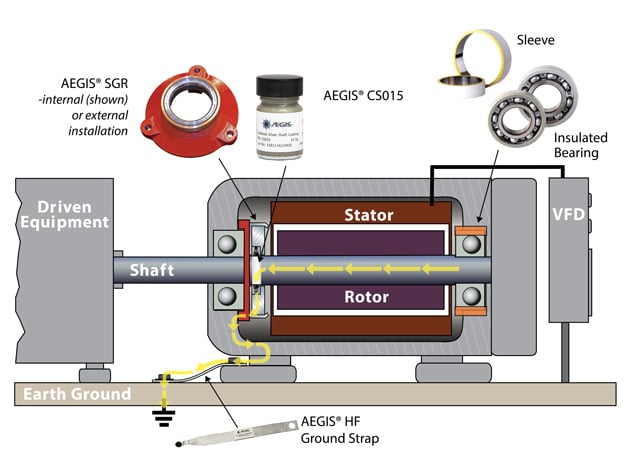
Ceramic coated bearings: Ceramic coating mitigates about 80% of the current. But because these bearings have low impedance to the high-frequency components of the capacitive EDM currents, an AEGIS Shaft Grounding Ring should be installed on the opposite end of the motor to discharge shaft voltage. This combination has proven almost 100% effective.
Hybrid Ceramic Ball Bearings: 100% effective in stopping current through the hybrid bearing. However, the voltage on the shaft of the motor is now at a maximum and will seek a path to ground through the attached equipment. Therefore, when installing hybrid bearings on both the DE and the NDE, an AEGIS ring should also be installed to discharge these shaft voltages. We recommend installing the AEGIS ring on the DE to discharge capacitive EDM currents and the hybrid bearing on the ODE of the motor to stop high-frequency circulating currents.
Attached equipment: When both motor bearings are insulated, the shaft voltage will be maximized if no shaft grounding is present. This puts attached equipment’s bearings at risk. An AEGIS ring installed on the motor will prevent shaft voltages and EDM currents from discharging through the attached equipment bearings.
Motors up to 100 HP
3) Does any other shaft grounding/electrical bearing protection manufacturer offer warranty against bearing failure?
Answer: AEGIS is the only shaft grounding manufacturer that warrants a motor against bearing fluting damage. We put our money where our mouth is.
Your motor must be registered within 30 days of installation to receive the warranty.
4) Does the AEGIS ring work equally well whether it’s installed inside or outside the motor?
Answer: In general, AEGIS rings discharge shaft voltage equally well whether they’re mounted inside or outside the motor.
Field installations in most applications are mostly outside the motor while most motor manufacturers install AEGIS rings on the inside.
In high-contamination areas and hostile environments, such as steel mills, paper mills, and other severe-duty applications, AEGIS should be installed on the inside of the motor.
5) Does the AEGIS ring work with any type of bearing? Ball, cylindrical, etc.?
Answer: Yes. AEGIS Shaft Grounding Rings divert shaft voltages away from the motor’s bearings to ground, regardless of the type of bearing, because they provide the least resistive path.
6) Is the AEGIS SGR approved by motor manufacturers such that it doesn’t interfere with the OEM warranty?
Answer: WEG and ABB Motors & Mechanical (formerly Baldor) will cover bearing damage during the normal warranty period, including EDM damage. For detailed warranty questions, contact the motor’s manufacturer.
For any AEGIS installation that follows AEGIS Best Practices, you can register your motor for the AEGIS 2-year warranty against bearing fluting damage. (For a new motor, this is the two years after the OEM warranty has expired.)
7) What about Hazardous duty and explosive environments?
Answer:
Class 1, Div 1 – AEGIS is approved by UL for installations inside explosion-proof motors. Marathon Electric offers stock XP motors with AEGIS rings factory-installed.
Class 1, Div 2 – shaft grounding may not be installed because of guidelines and standards such as IEEE 303.
However, you can install an XP motor with AEGIS inside in a Class 1 Div 2 area.
8) The AEGIS grounding ring is a zero-maintenance product. What is the life cycle?
Answer: The AEGIS ring is designed to be a “wear-to-fit” device. Because AEGIS rings operate with virtually zero friction, the fibers wear very slowly, if at all. After 200k hours it may wear to exactly fit the motor’s shaft, but it will continue to operate normally.
AEGIS rings more than match the longest L10 life of the bearing which can be 60,000 to 130,000 hours.
9) CS015, AEGIS Colloidal Silver Shaft Coating – What is it, and what does it do?
 Answer: AEGIS recommends using our colloidal silver shaft coating under the ring’s fibers when installing the ring in a repaired motor or in the field. The colloidal micron size engineered silver particles are coated over the shaft surface and are polished into the shaft’s machine lines under the fibers. This has the effect of improving the shaft’s surface conductivity and inhibiting corrosion/rust of the motor’s shaft.
How NOT to Kill an Electric Motor on a Variable Frequency Drive
Motion Control Tips recently published a tongue-in-cheek article called “How to kill your favorite variable frequency drive.” (You read that right.) It has a lot of good suggestions of things not to do if you want your drive to live, written in a fun-to-read facetious style. Our favorite: letting quarters, washers, or other small conductive objects fall through the vents on top of the VFD, where they can short out the DC bus.
 One thing that was beyond the scope of that article was the motor at the far end of the drive-motor system. Which begs the question: Why keep a VFD alive if the motor it drives is broken? So let’s talk here about a few of the things you can do to keep your motors in good shape so your still-living VFDs will have something to control.
1. Winding Insulation
Make sure any VFD-fed motor has inverter-duty insulation. Otherwise, the winding insulation is likely to fail. Briefly, the voltage output of the VFD changes very rapidly. When that voltage gets to the motor’s stator windings, its fast change leads to large voltages between adjacent turns in the winding. If the insulation is not inverter-duty, it can break down and lead to winding failure, requiring motor repair or replacement.
While some motors, fed by some inverters, in some situations, can get by with lower-grade winding insulation, it’s really not worth the risk. In the likely event that the motor fails and you need to replace or rewind the motor, you’re likely to lose more than you stand to save. Don’t be penny-wise and pound-foolish.
2. Shaft Grounding
All motors run by VFDs develop a capacitive voltage on the shaft. If there’s no better path to ground, that voltage may discharge through the bearings, causing cumulative damage and eventually premature failure. The best way to get rid of capacitive shaft voltage is to ground the shaft, giving voltage a low-resistance path to ground, and keeping it from arcing through the bearings.
The best form of shaft grounding is the AEGIS Shaft Grounding Ring, which is available as a retrofit or factory-installed inside many leading motor brands. AEGIS Rings are the only form of shaft grounding that offers a two year extended warranty against bearing fluting damage. For motors with AEGIS factory-installed, this warranty is in addition to the manufacturer’s warranty.
3. Bearing Insulation
Motors over 100 HP/75 kW are susceptible to bearing damage from high-frequency circulating currents (in addition to shaft voltage discharge). Installing one insulated bearing suffices to interrupt these circulating currents. An AEGIS Ring is still necessary, at the uninsulated end, to protect from the shaft voltage that is still present. (Insulating both bearings is also fine, but shaft grounding is still recommended to protect the driven equipment from shaft voltage discharge.)
AEGIS Shaft Grounding Rings also have a 2-year extended warranty against bearing fluting damage. No other form of shaft grounding offers a warranty like this.
To learn more about AEGIS shaft grounding and best practices for electrical bearing protection – for motors and generators – sign up for a training. We offer monthly live training webinars, and we can also visit your facility to review your exact application.
5 Great Ways to Lower Risk for New Construction
As reported in Construct Connect Blog of June 1, 2018, U.S. Construction Spending Hit an All-Time Record High in April of 2018
06/01/2018 by Kendall Jones
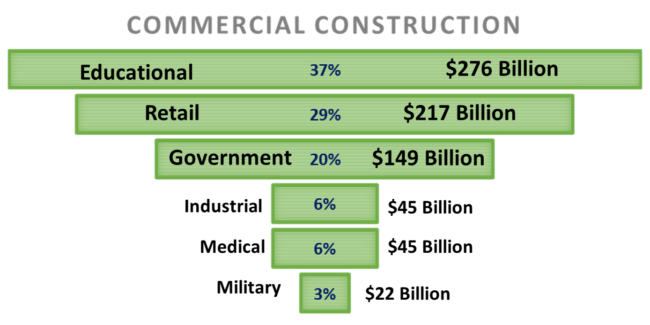
Commercial construction hit a healthy $747 Billion in April 2018 with 86% of the spending in Educational at $276 Billion followed by Retail at $217 Billion and Government at $149 Billion. With variable frequency drive (VFD) attachment rates (motors operated by VFD) increasing to 60% of motors by 2021, so does the risk of motor failure should the correct motors not be specified for use in the VFD driven systems.

The biggest potential failure mode is bearing fluting failure which often occurs within the first 3 to 12 months after commissioning. This failure mode results when bearing protection in the form of shaft grounding rings are not included in the specifications, usually found in the CSI section 23 05 13 where motors are specified.
Below we discuss 5 ways to mitigate the risk in new construction specifications:
- Select the only bearing protection technology that includes a 2-year extended warranty against bearing fluting damage:
- AEGIS Shaft Grounding Rings when installed by the motor’s manufacturer or even when installed in the field by a motor repair company or contractor comes with a 2-year warranty against bearing fluting damage.
- All AC induction motors are covered by this warranty – even the largest and most critical motors both Low Voltage supply and Medium Voltage Supply.
- Motors must-have new bearings and the AEGIS ring installation, whether AEGIS SGR or AEGIS PRO Series, must be installed per the AEGIS Best Practices as published in the Bearing Protection Handbook.
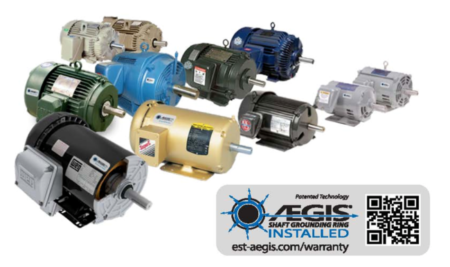
- Select and list motor manufacturers with AEGIS Shaft grounding Rings (ODP and TEFC) factory installed:
- ABB (Baldor): ODP and TEFC up to 100 HP
- WEG Electric: ODP and TEFC Up to 150 HP
- TECO Westinghouse: ODP and TEFC up to 75 HP
- GE: ODP and TEFC up to 300 HP
- REGAL brands Marathon Electric and Leeson: General Purpose up to 50 HP and Cooling Tower 3 to 250 HP
- Include the following language in the specification:
- GENERAL REQUIREMENTS – SHAFT GROUNDING RINGS
All motors operated on variable frequency drives shall be equipped with a maintenance-free, conductive microfiber shaft grounding ring to meet NEMA MG-1, 3.4.4.4.3 with a minimum of two rows of circumferential microfibers to discharge damaging shaft voltages away from the bearings to ground. SGR’s Service Life: Designed to last for service life of motor. Provide AEGIS SGR Conductive MicroFiber Shaft Grounding Ring, or approved equal. - Application Note: Motors up to 100 HP shall be provided with one shaft grounding ring installed on either the drive end or non-drive end. Motors over 100 HP shall be provided with an insulated bearing on the non-drive end and a shaft grounding ring on the drive end of the motor with the exception of line contact bearings in the drive end of the machine. In this instance, the line contact bearing must be electrically insulated and the AEGIS Bearing Protection Ring installed on the opposite drive end of the motor. Grounding rings shall be provided and installed by the motor manufacturer or contractor and shall be installed in accordance with the shaft grounding ring manufacturer’s recommendations.
- GENERAL REQUIREMENTS – SHAFT GROUNDING RINGS
- Specify Proper high-frequency Bonding by including the following language:
- GENERAL REQUIREMENTS – HIGH-FREQUENCY BONDING: All motors operated on variable frequency drives shall be bonded from the motor foot to system ground with a high-frequency ground strap made of flat braided,
tinned copper with terminations to accommodate motor foot and system ground connection. Provide AEGIS HF Ground Straps, or equal. - Application Note: High-frequency grounding straps must be used to ensure the proper grounding of all inverter-driven induction motor frames.
- GENERAL REQUIREMENTS – HIGH-FREQUENCY BONDING: All motors operated on variable frequency drives shall be bonded from the motor foot to system ground with a high-frequency ground strap made of flat braided,
- Include Shaft Voltage Testing in the commissioning requirements to verify and document that the specifications were followed:
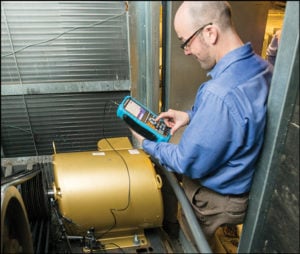
- Any oscilloscope with 100MHz+ bandwidth can detect VFD-sourced shaft voltage, using a special conductive microfiber probe tip. The technician simply touches the motors spinning shaft, records and saves the shaft voltage readings and stores them in the motor’s file.
 To learn how to specify shaft grounding for bearing protection, see this whitepaper, which includes several samples of specification for long-lived shaft grounding rings.
Protecting VFD Driven Motors in Steel Mills
VFDs Improve Process Control and Reduce Energy Costs
According to the American Iron and Steel Institute, the cost of energy makes up 20% of the total cost of steel production. So by reducing energy consumption, plants can increase profitability.
 By allowing precise control of motor speed, variable frequency drives (VFDs) not only reduce energy costs by 30% or more, they improve process control, reduce waste/spoilage, and help improve product quality.
But VFDs Can Damage Motor Bearings and Shut Down Processes…
But, VFDs can damage motors. They induce voltages on the shafts of the motor they control — voltages that can discharge through motor bearings, causing fluting and catastrophic motor failure.
And the Cost of Downtime is Staggering
Steelmaking is a continuous process, so a problem in one part of a production process or even a single piece of equipment can idle an entire plant. And the cost of such shutdowns can be staggering — from $200,000 to $600,000 per day or more, depending on the production capacity of the plant.
Protect VFD-Driven Motors From Bearing Damage With AEGIS® Shaft Grounding Rings
By diverting damaging bearing currents safely to ground, AEGIS Shaft Grounding Rings ensure the reliable, long-term operation of VFD-driven steel mill motors and systems.
So, to prevent VFD-induced bearing damage and costly, unnecessary downtime and repairs, specify/install AEGIS Shaft Grounding Rings on all AC and DC motors. Designed to withstand the harsh conditions of steel mills, they can be installed on:
- New motors before they are put into service
- In-service motors when they are refurbished or repaired
- Spare motors when they are purchased or before they are put into service
Unlike other shaft grounding products, AEGIS Rings do not require routine maintenance or adjustment. They provide effective protection for the L10 life of the motor bearings.
AEGIS Rings also come with a 2-year extended warranty against bearing fluting damage. No other form of protection against VFD-caused bearing damage offers a warranty like this.
To learn more about AEGIS shaft grounding and best practices for electrical bearing protection, sign up for a training. We offer monthly live training webinars, and – pandemic restrictions permitting – we can also visit your facility to review your exact application.
US Steel Mills Must Stay Productive
The American Iron and Steel Institute estimates that 20% of the cost of producing a ton of steel comes from consuming energy, whether from electricity, natural gas, coal, or from other sources. So increasing energy efficiency per ton of steel produced is one of the critical factors in sustaining profitable production.
Reducing the energy consumption of steel manufacture has benefits beyond simple profitability: It also reduces the industry’s environmental footprint. One of the key technologies used to save energy is variable frequency drives (VFDs), used to control the electric motors in steel production. VFDs can allow savings of up to 30% or more in energy costs, and when integrated into modern steel production equipment, they also allow production processes and efficiencies to be improved through precise control of motors’ speed and/or torque.
 Modernizing existing facilities or adding new production lines as capacity and demand increase often includes the integration of VFD into the equipment design. The result of these modernizations is production improvements, which have contributed to dramatically lowering the number of man-hours used to produce a ton of steel from more than 10hrs/ton in the 1980’s to 2hrs/ton or even less than 1hr/ton for finished steel [source: Profile of the American Iron and Steel Institute 2017]
“High-strength and versatile, steel is the material of choice for many key markets and customer sectors. The automotive, construction, container, transportation and infrastructure, energy and national security sectors all depend on steel to be competitive in the global marketplace.” THOMAS J. GIBSON, President and CEO, American Iron and Steel Institute
VFDs Can Lead to Bearing Failure
 But productivity can only be increased if the motors stay up and running. If a motor’s bearings fail and the line must be shut down, the costs can be staggering. Even a short interruption may cost tens of thousands or even millions of dollars in downtime, lost production, and motor repair or replacement. When a motor is run operated by a VFD, its bearings are vulnerable to electrical discharge damage. This is because the VFD produces a common mode voltage in the stator windings of the motor which is then capacitively coupled to the motor’s shaft. Voltages of only 20 to 40 volts peak [source: NEMA MG1 Part 31.4.3.3] can cause millions of electrical discharges in the motor’s bearings and result in fluting damage and failure.
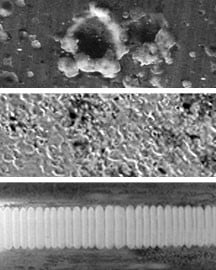
Pitting, frosting, & fluting bearing damage from shaft voltage discharge
Protecting Bearings from Harmful Shaft Voltages
The problem of shaft voltage and bearing currents can be solved by following a proven set of best practices outlined in the AEGIS® Bearing Protection Handbook. Motors of any size may be protected from premature bearing failure with the application of AEGIS Shaft Grounding Rings, along with insulation of the opposite bearing for motors over 100 hp.
Case in Point
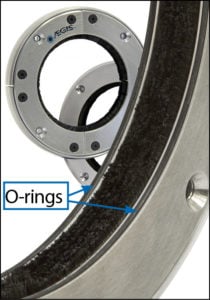 Several years ago a prominent steel manufacturer in the US installed AEGIS rings on their galvanizing line. From there the galvanized steel was transferred over to the rolling mill where it was rolled to the correct thickness for consumer goods like washing machines. On this line they installed six AEGIS PRO Series rings on the rolling mills. These rings had O-rings installed to retard the flow of grease into the ring. They were all mounted on the outside of the mills.
The AEGIS PRO Series design provides reliable shaft grounding for large AC induction motors, medium voltage applications, and generators and turbines. By diverting harmful shaft voltages to ground, they protect the bearings from electrical damage and extend bearing life.
Designed for:
- Large frame low-voltage motors: 500 HP (375kW) or greater
- Medium-voltage motors
- DC motors: 300 HP or greater
- Available in shaft diameters from 2.5” to 30” [63.5mm to 762mm]
- Aluminum or stainless steel construction
- Solid and split ring designs
- Monitoring ring option for voltage monitoring

5 Things you Need to Know Before Repairs Start
Whether a failing electric motor is already in the repair facility or is still at the plant and needs repair, there is crucial information which MUST be considered to make sure it will stay up and operating after it is repaired.
1. Was the Motor on a Variable Frequency Drive?
Today, variable frequency drives (VFDs) are commonly used to control the speed of motors. They not only provide precise process control for improved productivity and product quality, they also save energy. But, VFDs can also damage motors. They induce currents on motor shafts that discharge through the bearings, causing pitting, fluting, and in many cases catastrophic motor failure. Without bearing protection, any savings from the use of VFDs can be quickly wiped out by system downtime and the cost of replacing motors.
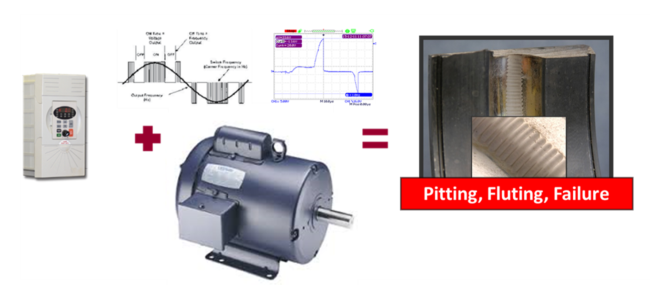
2. How Long Has the Motor Been in Service? Does the Motor Have a History?
New VFD-driven motors should have bearing protection installed at startup. If the motor’s been in service, adding a bearing protection ring will not fix damage which has already occurred. Bearing failure accounts for about half of all motor failures, and when the motor is on a VFD, electrical bearing failure is the most likely root cause. If bearings are replaced repeatedly a bearing analysis will point to the cause or causes of failure. They may be electrical, mechanical, or lubrication failure, or even a combination of all three. If the motor is in failure mode and on a VFD, a shaft grounding ring can be installed when the motor is repaired.
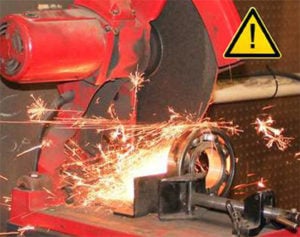
2. Cut open the bearing housing
3. Has the Motor Been Repaired? If so, were the Bearings Inspected and Did You Receive a Bearing Failure Analysis?
At the time of a VFD-driven motor repair, cutting and inspecting the motor bearings will often provide vital information needed to make the best repair recommendations. Detection of electrical discharge machining pits or fluting in the bearings often requires repair services.
- Bearings should be checked for electrical discharge machining effect (EDM); pitting, frosting, fluting
- Installing a Shaft Grounding Ring (AEGIS® SGR or PRO Series) on any motor operated on variable frequency drives (VFD)
- Insulating a motor bearing with an insulated sleeve; coating bearing housing with insulating material; adding a hybrid ceramic ball bearing or ceramic coated bearing to the repair for motors over 100 HP (75kW).
4. Do You Have Shaft Voltage?
Technician measuring shaft voltage
Measuring the shaft voltage on VFD driven motors provides valuable information to determine if there is a potential risk of bearing damage from electrical bearing discharges. Surveying and documenting shaft voltage readings and waveforms will assist in determining the appropriate mitigation or solution. Note: The best time for shaft voltage measurements is during initial start-up in new or repaired motors. Shaft voltage measurements should be incorporated into preventive and predictive maintenance programs and may be combined with vibration analysis, thermography or other services.
5. AEGIS Handbook
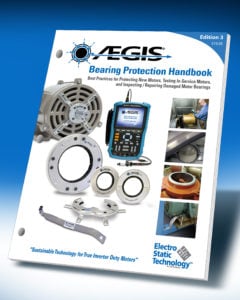
AEGIS Bearing Protection Handbook
Referring to the Bearing Protection Handbook provides best practices guidance for motor operated by VFDs. Downloading and reviewing this handbook puts valuable information at your fingertips and when followed will help improve the reliability and operation of any size motor.
ANSI/EASA Standard AR100-2010, Section 2, Mechanical Repair: 2.2 Bearings “Bearings should be inspected for fretting, fluting, frosting, scoring or other damage.” Best practices for Bearing Protection, Shaft Voltage Testing, and Bearing Inspection.